आप, तुम or तू: which Hindi word for “you” should you use?
The englishtohindi.online editors · · 6 min read
Hindi has three words for 'you' and picking the wrong one is the fastest way to sound rude or oddly distant. Here is how native speakers choose.
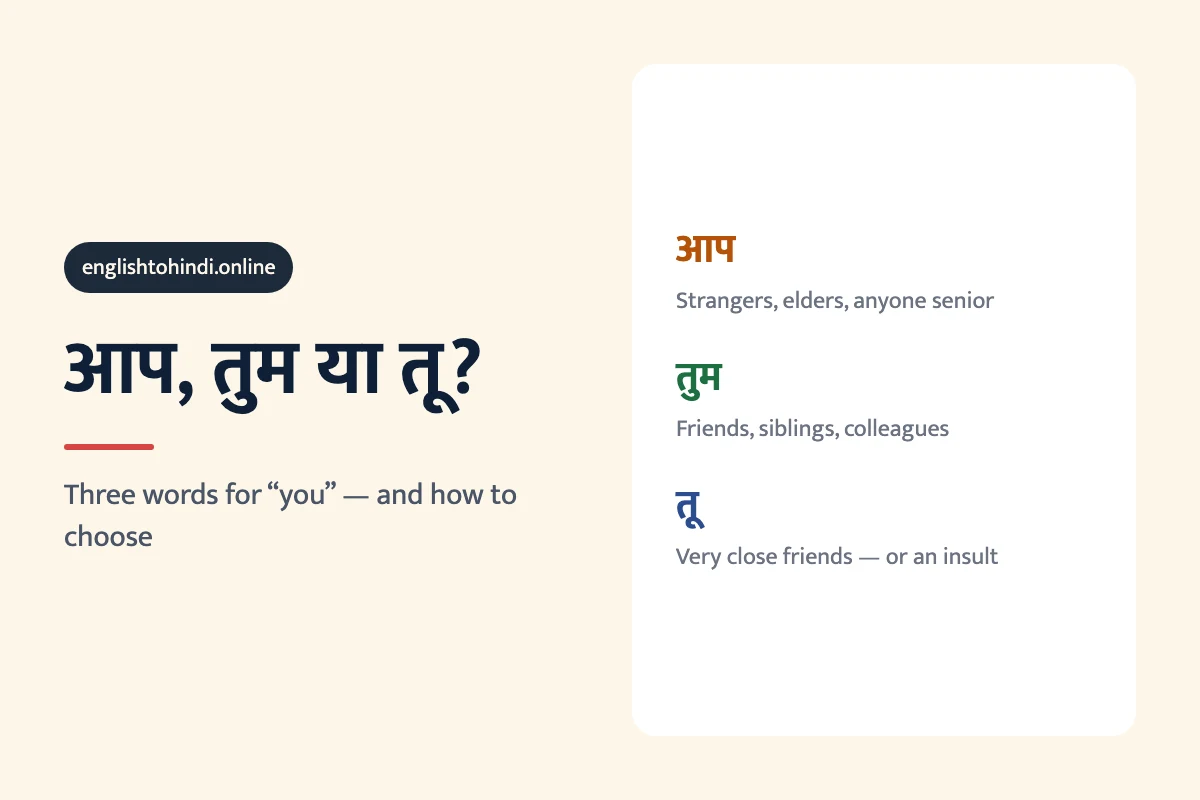
Hindi has three words for “you”. आप (aap) is the formal one, used with strangers, elders and anyone senior. तुम (tum) is casual, used with friends, siblings and colleagues your own age. तू (tu) is intimate — reserved for very close friends and small children, and openly insulting to anyone else. When in doubt, use आप.
English gives you one word for the person you are speaking to. Hindi gives you three, and they are not interchangeable. Choosing wrongly does not produce a grammar error — it produces a social one, which is worse, because nobody will correct you.
This is also the single thing machine translation gets wrong most often, because a translation engine cannot know who you are talking to.
The three levels
| Word | Verb example | Who you use it with |
|---|---|---|
| आप (aap) | आप कैसे हैं? | Strangers, elders, teachers, customers, anyone senior |
| तुम (tum) | तुम कैसे हो? | Friends, siblings, colleagues your age, children |
| तू (tu) | तू कैसा है? | Very close friends, small children, or as an insult |
आप is also the plural, which is why it doubles as the respectful form — addressing one person as though they were many is a politeness strategy Hindi shares with French vous and German Sie.
When in doubt, use आप
Over-formality is a small mistake. Under-formality is a real one. Calling your friend आप sounds slightly stiff and they will laugh. Calling a shopkeeper twice your age तू sounds openly disrespectful.
The safe default with anyone you have just met is आप, and you drop down to तुम only when they do it first, or when the relationship clearly warrants it.
तू is a trap for learners
Learners often meet तू in film songs and poetry, where it signals intimacy, and assume it is simply the casual option. In everyday speech it carries far more weight than that.
Between two lifelong friends, तू is warm. Directed at a stranger, it is a deliberate insult — it is what people use in an argument in traffic. Unless someone uses it with you first, leave it alone.
The verb has to follow
Getting the pronoun right is only half the job. Every verb in the sentence changes to match — and it also changes with the speaker's own gender. Mixing levels mid-sentence is the clearest sign of a translation produced by a machine.
आप कैसे हैं? आपका नाम क्या है?
Aap kaise hain? Aapka naam kya hai?
तुम कैसे हो? आपका नाम क्या है?
Tum kaise ho? Aapka naam kya hai?
Paste both of those into any general-purpose translation tool in English and watch how often the output mixes आप and तुम inside a single paragraph. It happens because each sentence is translated in isolation, with no memory of the one before it.
Regional and generational variation
- In much of Uttar Pradesh and Bihar, तू is used far more casually among family than it is in Delhi or Mumbai.
- Younger urban speakers often mix English into the same sentence, which sidesteps the choice entirely — 'aap busy ho?' is common.
- In writing, especially anything official, आप is effectively the only acceptable form.
The short version
- Meeting someone new: आप.
- They switch to तुम: you can switch too.
- You are not sure: आप. Nobody has ever been offended by too much respect.
- तू: only if you are certain, and never with a stranger.
- Whichever you pick, keep every verb in the sentence at that level.
Frequently asked questions
What is the difference between आप, तुम and तू?
They are three levels of formality for the English word “you”. आप is formal and respectful, used with strangers, elders and anyone senior. तुम is casual, for friends, siblings and peers. तू is intimate, used with very close friends and small children, and insulting with anyone else.
Should I use आप or तुम with someone I just met?
आप. Over-formality is a minor mistake and under-formality is a real one. Move to तुम only after the other person uses it with you, or when the relationship is clearly close enough to warrant it.
Is तू rude in Hindi?
It depends entirely on the relationship. Between lifelong friends or from a parent to a small child it is warm. Directed at a stranger it is a deliberate insult — it is what people use in an argument. Unless someone uses it with you first, avoid it.
Why is आप both plural and respectful?
Addressing one person as though they were several is a politeness strategy, the same one behind French vous and German Sie. This is why आप takes plural verb forms even when only one person is meant.
Do the verbs change with आप, तुम and तू?
Yes, and they must stay consistent. आप कैसे हैं?, तुम कैसे हो? and तू कैसा है? are the same question at three levels. Mixing levels within a sentence is the clearest sign of machine translation.
More guides
- Hindi plurals: लड़का, लड़के, लड़कों and which to use whenHindi has two plurals for every noun: one for the plain sentence and one for when a postposition follows. लड़के and लड़कों are both “boys”, and using the wrong one is the most common learner error.
- वाला in Hindi: what वाला, वाली and वाले actually meanवाला means “the one that” — the one who sells it, the one wearing it, the thing about to happen. One suffix doing three jobs English needs three constructions for.
- How to say “can” in Hindi: सकना, आना and पानामैं हिंदी बोल सकता हूँ. Ability, permission and “managed to” are three different verbs in Hindi, and picking the wrong one is the usual learner mistake.
Looking for a specific phrase? Browse the phrase guides.