Hindi plurals: लड़का, लड़के, लड़कों and which to use when
The englishtohindi.online editors · · 7 min read
Hindi has two plurals for every noun: one for the plain sentence and one for when a postposition follows. लड़के and लड़कों are both “boys”, and using the wrong one is the most common learner error.
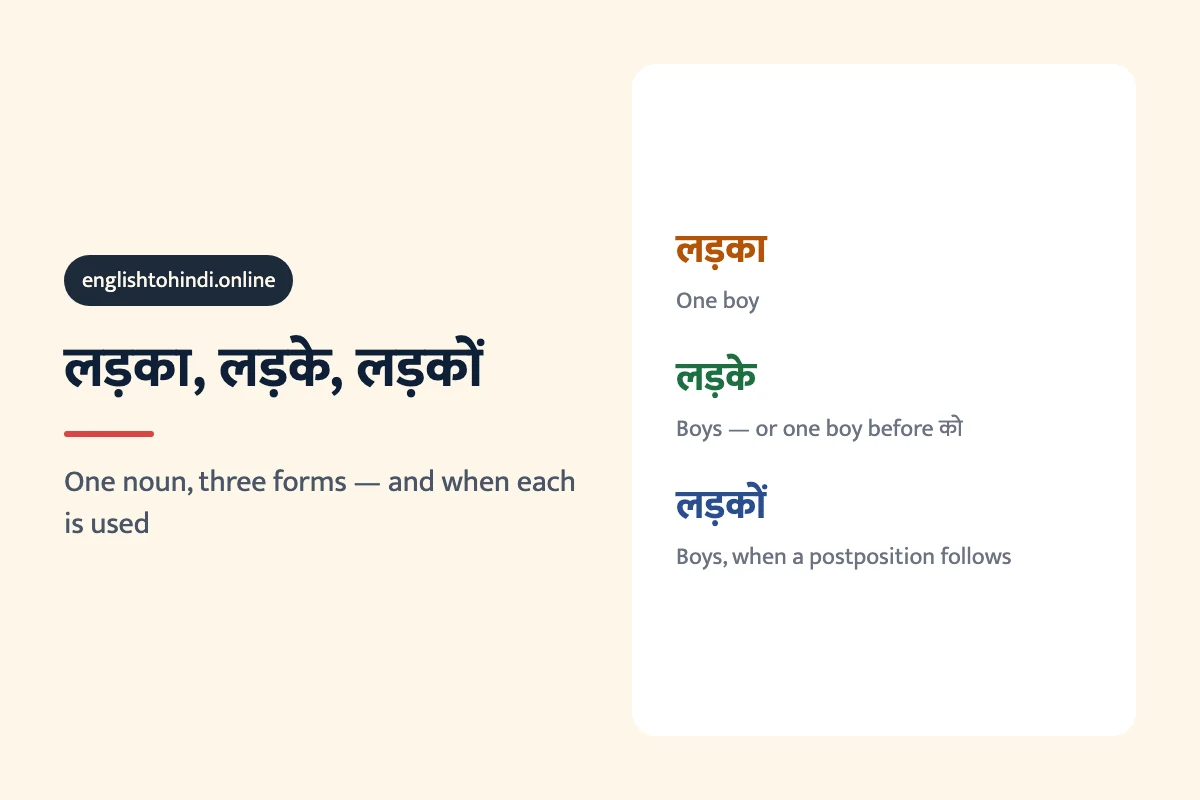
How a Hindi noun forms its plural depends on its gender. Masculine nouns ending in -आ change it to -ए: लड़का becomes लड़के. Every other masculine noun stays exactly as it is: घर is both “house” and “houses”. Feminine nouns ending in -ई change it to -इयाँ: लड़की becomes लड़कियाँ. All other feminine nouns add -एँ: किताब becomes किताबें. Gender comes first, because nothing else can be worked out until it is settled — every Hindi noun has a gender covers how to tell.
Then there is a second plural. As soon as a postposition follows the noun, every plural of every gender ends in -ओं: लड़के becomes लड़कों, किताबें becomes किताबों, घर becomes घरों. Learners reliably learn the first plural, never meet the second, and end up saying लड़के को when the sentence needs लड़कों को.
Masculine plurals
Masculine nouns split into two groups, and the split is visible: does the word end in -आ or not?
| Singular | Plural | Roman | Meaning |
|---|---|---|---|
| लड़का | लड़के | larka → larke | boy → boys |
| कमरा | कमरे | kamra → kamre | room → rooms |
| कुत्ता | कुत्ते | kutta → kutte | dog → dogs |
| घर | घर | ghar → ghar | house → houses |
| आदमी | आदमी | aadmi → aadmi | man → men |
| दोस्त | दोस्त | dost → dost | friend → friends |
The second group does not change at all. एक घर and दस घर use the same word, and the verb is what carries the number: घर है for one, घर हैं for many. That is not laziness in the language — Hindi simply puts the information in the verb instead, the same way the verb always goes last carries the sentence.
Not every -आ noun is marked. Words borrowed from Sanskrit and most kinship terms keep their form: पिता stays पिता, चाचा stays चाचा, राजा stays राजा, नेता stays नेता. Saying पिते for “fathers” is a mistake the rule invites and the language does not allow.
Feminine plurals
Feminine nouns are more regular than masculine ones — there is no group that stays unchanged. Either the noun ends in -ई, or it takes -एँ.
| Singular | Plural | Roman | Meaning |
|---|---|---|---|
| लड़की | लड़कियाँ | larki → larkiyan | girl → girls |
| कुर्सी | कुर्सियाँ | kursi → kursiyan | chair → chairs |
| चिड़िया | चिड़ियाँ | chidiya → chidiyan | bird → birds |
| किताब | किताबें | kitaab → kitaaben | book → books |
| बहन | बहनें | bahan → bahanen | sister → sisters |
| माता | माताएँ | maata → maataen | mother → mothers |
Note that माता ends in -आ and is still feminine, so it takes -एँ rather than becoming माते. The ending tells you how to form the plural only after the gender is known, never instead of it.
The plural you actually use: -ओं
This is the part that gets skipped. The plurals above are the forms a noun takes when nothing follows it. Put a postposition after the noun — को, से, में, पर, का, ने — and the plural changes again, to -ओं in every case.
| Plain plural | Before a postposition | Roman | Example |
|---|---|---|---|
| लड़के | लड़कों | larke → larkon | लड़कों को बुलाओ |
| किताबें | किताबों | kitaaben → kitaabon | किताबों में |
| लड़कियाँ | लड़कियों | larkiyan → larkiyon | लड़कियों के लिए |
| घर | घरों | ghar → gharon | घरों में |
| आदमी | आदमियों | aadmi → aadmiyon | आदमियों से |
| दोस्त | दोस्तों | dost → doston | दोस्तों के साथ |
Look at the last three rows. घर, आदमी and दोस्त do not change in the plain plural at all, but they do change here — घरों, आदमियों, दोस्तों. A noun that appeared to have no plural turns out to have one after all; it only shows up in front of a postposition. The postpositions themselves are covered in Hindi postpositions.
दोस्तों के साथ घरों में रहना आसान नहीं है।
Doston ke saath gharon mein rahna aasaan nahin hai.
The trap: लड़के को and लड़कों को
A masculine -आ noun produces the same form twice. लड़के is the plural of लड़का, and लड़के is also what लड़का becomes in the singular before a postposition. So लड़के को is grammatical — it means “to the boy”, one boy. लड़कों को means “to the boys”.
| Hindi | Roman | English |
|---|---|---|
| लड़का आया | Larka aaya | The boy came |
| लड़के आए | Larke aae | The boys came |
| लड़के को बुलाओ | Larke ko bulao | Call the boy — one boy |
| लड़कों को बुलाओ | Larkon ko bulao | Call the boys |
This is why लड़के को for “to the boys” is not heard as a small slip. It is a complete, correct sentence that says something else — one boy instead of several. The listener has no way to tell it was meant as a plural.
Adjectives move with the noun
Adjectives ending in -आ agree with the noun and change through all three forms alongside it. Adjectives that do not end in -आ never change at all.
- अच्छा लड़का — a good boy.
- अच्छे लड़के — good boys.
- अच्छे लड़कों को — to the good boys.
- बड़ा घर becomes बड़े घर — the adjective changes even though घर does not.
- सुंदर लड़की and सुंदर लड़कियाँ — सुंदर does not end in -आ, so it stays put.
Feminine -ई adjectives are invariable too: अच्छी लड़की and अच्छी लड़कियाँ use the same अच्छी. Colours behave exactly this way, and colours in Hindi sorts out which ones change and which do not.
The plural that means respect
Hindi also uses the plural for one person, to show respect. The noun usually stays singular while the verb and adjectives go plural: पिताजी आए हैं is “father has come”, about one father. आप is grammatically plural for the same reason and always takes हैं, even when addressing a single person.
- पिताजी आए हैं — Father has come. One person, plural verb.
- आप कैसे हैं? — How are you? One person, plural verb.
- डॉक्टर साहब क्या कहते हैं? — What does the doctor say?
Which pronoun this applies to is the subject of आप, तुम or तू, and the titles that trigger it — जी, साहब, भैया — are covered in Hindi honorifics.
The mistakes worth checking for
- लड़के को when लड़कों को was meant — the single most common one, and it produces a correct sentence with the wrong number.
- Adding -ओं with no postposition in sight. लड़कों आए is wrong; the plain plural लड़के आए is what the sentence needs.
- पिते, राजे, चाचे. These -आ nouns do not take the -ए plural.
- माते for “mothers”. माता is feminine, so it is माताएँ.
- Leaving the adjective behind: अच्छा लड़के instead of अच्छे लड़के.
- Making the noun plural for respect. It is पिताजी आए हैं, not पिताओं आए हैं — the verb carries the respect, not the noun.
One habit removes most of these. Before writing a plural noun, look at the word immediately after it. If that word is a postposition, the noun ends in -ओं. If it is a verb, use the plain plural. That single check covers every noun in the language, in either gender.
Frequently asked questions
How do you make a noun plural in Hindi?
It depends on gender. Masculine nouns ending in -आ change it to -ए, so लड़का becomes लड़के. All other masculine nouns stay unchanged: घर means both “house” and “houses”. Feminine nouns ending in -ई change it to -इयाँ, so लड़की becomes लड़कियाँ. All other feminine nouns add -एँ, so किताब becomes किताबें.
What is the difference between लड़के and लड़कों?
Both mean “boys”. लड़के is used when nothing follows the noun — लड़के आए, “the boys came”. लड़कों is used when a postposition follows — लड़कों को बुलाओ, “call the boys”. Every Hindi plural switches to an -ओं ending in front of को, से, में, पर, का or ने, regardless of gender.
Why does लड़के sometimes mean one boy?
Because a masculine -आ noun produces the same form twice. लड़के is the plural of लड़का, and it is also what लड़का becomes in the singular before a postposition. So लड़के को means “to the boy”, one boy, while लड़कों को means “to the boys”. Both sentences are correct, which is why the mistake is hard to spot.
Which Hindi nouns do not change in the plural?
Masculine nouns that do not end in -आ keep the same form: घर, आदमी, दोस्त, फूल. The verb shows the number instead — घर है for one house, घर हैं for many. These nouns still change before a postposition, becoming घरों, आदमियों, दोस्तों.
Is पिता plural पिते in Hindi?
No. पिता does not take the -ए plural despite ending in -आ. Sanskrit-derived nouns and most kinship terms keep their singular form: पिता, चाचा, राजा and नेता are unchanged in the plural. Before a postposition they take -ओं, giving पिताओं, चाचाओं, राजाओं and नेताओं.
Why is आप used with हैं even for one person?
Because Hindi uses the plural to show respect. आप is grammatically plural, so it takes हैं whether it addresses one person or several. The same politeness makes पिताजी आए हैं correct for a single father — the verb goes plural while the noun stays singular.
Do Hindi adjectives change in the plural?
Only adjectives ending in -आ. अच्छा लड़का becomes अच्छे लड़के and then अच्छे लड़कों before a postposition. Adjectives that do not end in -आ never change, so सुंदर is the same in सुंदर लड़की and सुंदर लड़कियाँ. Feminine -ई adjectives are invariable too: अच्छी works for both अच्छी लड़की and अच्छी लड़कियाँ.
More guides
- वाला in Hindi: what वाला, वाली and वाले actually meanवाला means “the one that” — the one who sells it, the one wearing it, the thing about to happen. One suffix doing three jobs English needs three constructions for.
- How to say “can” in Hindi: सकना, आना and पानामैं हिंदी बोल सकता हूँ. Ability, permission and “managed to” are three different verbs in Hindi, and picking the wrong one is the usual learner mistake.
- जो in Hindi: how to say “the one who” and “which”Hindi builds relative clauses with a pair — जो in the first half, वह in the second. Once you see the pattern, long Hindi sentences stop being unreadable.
Looking for a specific phrase? Browse the phrase guides.