Hindi sentence structure: why the verb always goes last
The englishtohindi.online editors · · 6 min read
Hindi is subject–object–verb, and prepositions come after the noun instead of before it. Two rules, and most word-for-word translation problems disappear.
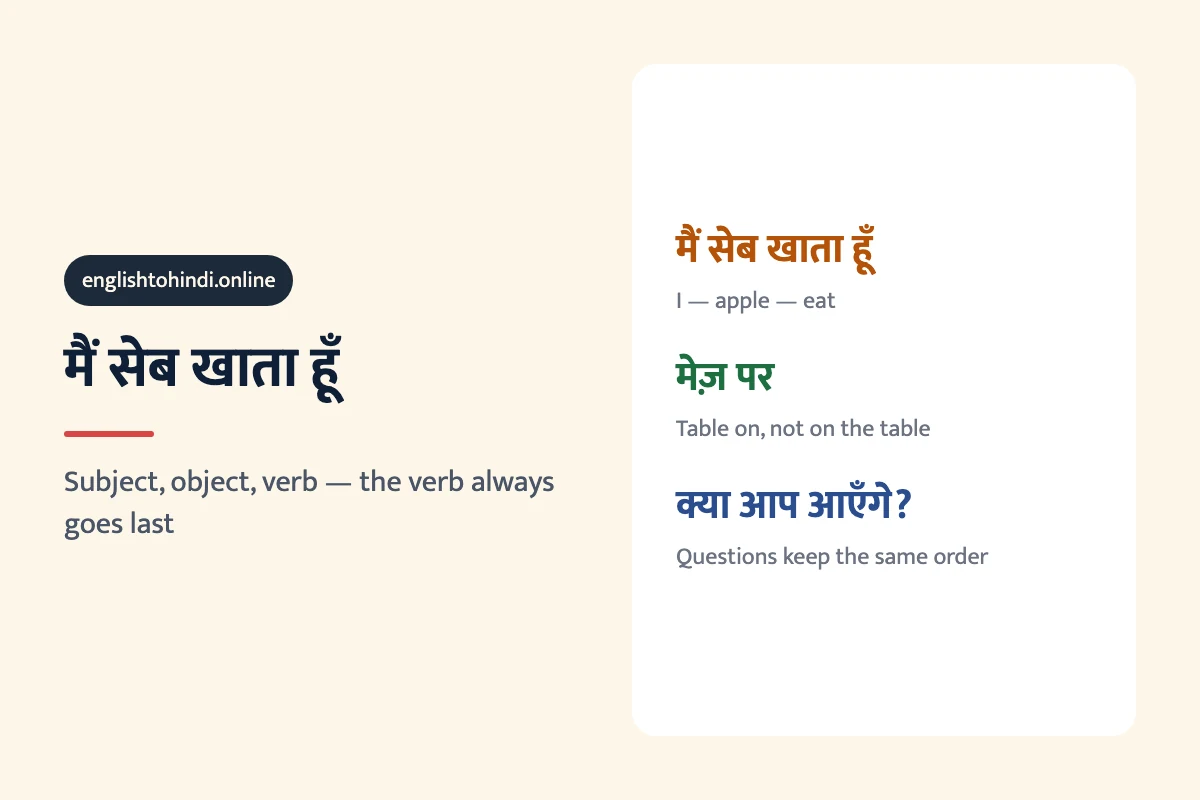
Hindi sentences follow subject–object–verb order: मैं सेब खाता हूँ is literally 'I apple eat'. English uses subject–verb–object. Hindi also places its equivalent of prepositions after the noun rather than before it — मेज़ पर means 'table on'. Both rules are consistent, so once you stop translating word by word the structure becomes predictable.
Almost every sentence a beginner builds wrong is wrong for one of these two reasons. Neither is difficult; they simply have to be unlearned from English.
The verb goes at the end
| English | Hindi order | Hindi |
|---|---|---|
| I eat an apple | I apple eat | मैं सेब खाता हूँ |
| She reads a book | She book reads | वह किताब पढ़ती है |
| We are going home | We home going are | हम घर जा रहे हैं |
| I do not know | I not know | मुझे नहीं पता |
The auxiliary comes after the main verb, so the very last word of a Hindi sentence is usually है, हैं, था or थे. If you find yourself with one of those stranded in the middle, something has gone wrong.
Postpositions, not prepositions
English puts these words before the noun: on the table, in the house, from Delhi. Hindi puts them after — which is why they are called postpositions.
| English | Hindi | Literally |
|---|---|---|
| on the table | मेज़ पर | table on |
| in the house | घर में | house in |
| from Delhi | दिल्ली से | Delhi from |
| to the market | बाज़ार को | market to |
| with my friend | मेरे दोस्त के साथ | my friend with |
A postposition changes the noun before it into what grammars call the oblique case. लड़का becomes लड़के in लड़के को. The noun itself shifts form — this is why a phrase you learned in isolation looks different inside a sentence.
Questions keep the same order
English reshuffles a sentence to ask a question: 'you are going' becomes 'are you going'. Hindi does not move anything. The question word sits where the answer would sit, and क्या at the front turns a statement into a yes-or-no question.
आप कहाँ जा रहे हैं?
Aap kahaan jaa rahe hain?
क्या आप हिंदी बोलते हैं?
Kya aap Hindi bolte hain?
Negation sits just before the verb
नहीं goes immediately before the verb it negates, near the end of the sentence — never at the front, and never after the verb.
| English | Hindi | Roman |
|---|---|---|
| I do not eat meat | मैं मांस नहीं खाता | main maans nahin khaata |
| He is not here | वह यहाँ नहीं है | vah yahaan nahin hai |
| Do not worry | चिंता मत करो | chinta mat karo |
Note the last row. Commands take मत, not नहीं. चिंता नहीं करो is one of the most common learner errors and marks a sentence as non-native instantly.
Word order is flexible, but only for emphasis
Because Hindi marks roles with postpositions, the words can be rearranged without the sentence becoming ambiguous. Speakers use this to shift emphasis, in the same way English uses stress.
- मैं कल दिल्ली जाऊँगा — neutral: I will go to Delhi tomorrow.
- कल मैं दिल्ली जाऊँगा — emphasis on tomorrow, as opposed to some other day.
- दिल्ली मैं कल जाऊँगा — emphasis on Delhi, as opposed to somewhere else.
What does not move is the verb. Every one of those variants still ends with जाऊँगा. Treat the final position as fixed and rearrange whatever you like in front of it.
The verb at the end is also where the speaker's gender shows up, so word order and agreement are the same problem viewed twice — a woman and a man end the same sentence differently.
Frequently asked questions
What is the word order in Hindi?
Subject–object–verb. 'I eat an apple' is मैं सेब खाता हूँ, literally 'I apple eat'. The verb, together with any auxiliary such as है or हैं, comes at the very end of the sentence.
Does Hindi use prepositions?
No, it uses postpositions — the same words, placed after the noun instead of before it. 'On the table' is मेज़ पर, literally 'table on'. The noun in front of a postposition also changes to its oblique form.
How do you ask a question in Hindi?
Keep the statement word order and either add क्या at the front for a yes-or-no question, or put a question word such as कहाँ (where) or कब (when) in the position the answer would occupy. Nothing is reordered the way English reorders 'you are' into 'are you'.
Where does नहीं go in a Hindi sentence?
Immediately before the verb: मैं मांस नहीं खाता. For negative commands use मत instead — चिंता मत करो, not चिंता नहीं करो.
Can you change the word order in Hindi?
Yes, for emphasis. Because postpositions mark each word's role, moving a word does not create ambiguity. The verb is the exception: it stays at the end regardless of how the rest of the sentence is arranged.
More guides
- Hindi plurals: लड़का, लड़के, लड़कों and which to use whenHindi has two plurals for every noun: one for the plain sentence and one for when a postposition follows. लड़के and लड़कों are both “boys”, and using the wrong one is the most common learner error.
- वाला in Hindi: what वाला, वाली and वाले actually meanवाला means “the one that” — the one who sells it, the one wearing it, the thing about to happen. One suffix doing three jobs English needs three constructions for.
- How to say “can” in Hindi: सकना, आना and पानामैं हिंदी बोल सकता हूँ. Ability, permission and “managed to” are three different verbs in Hindi, and picking the wrong one is the usual learner mistake.
Looking for a specific phrase? Browse the phrase guides.