Hindi verb gender: why the verb changes when a woman speaks
The englishtohindi.online editors · · 5 min read
मैं करता हूँ or मैं करती हूँ? The ending depends on who is speaking, not who is listening — and this is where most translation output goes wrong.
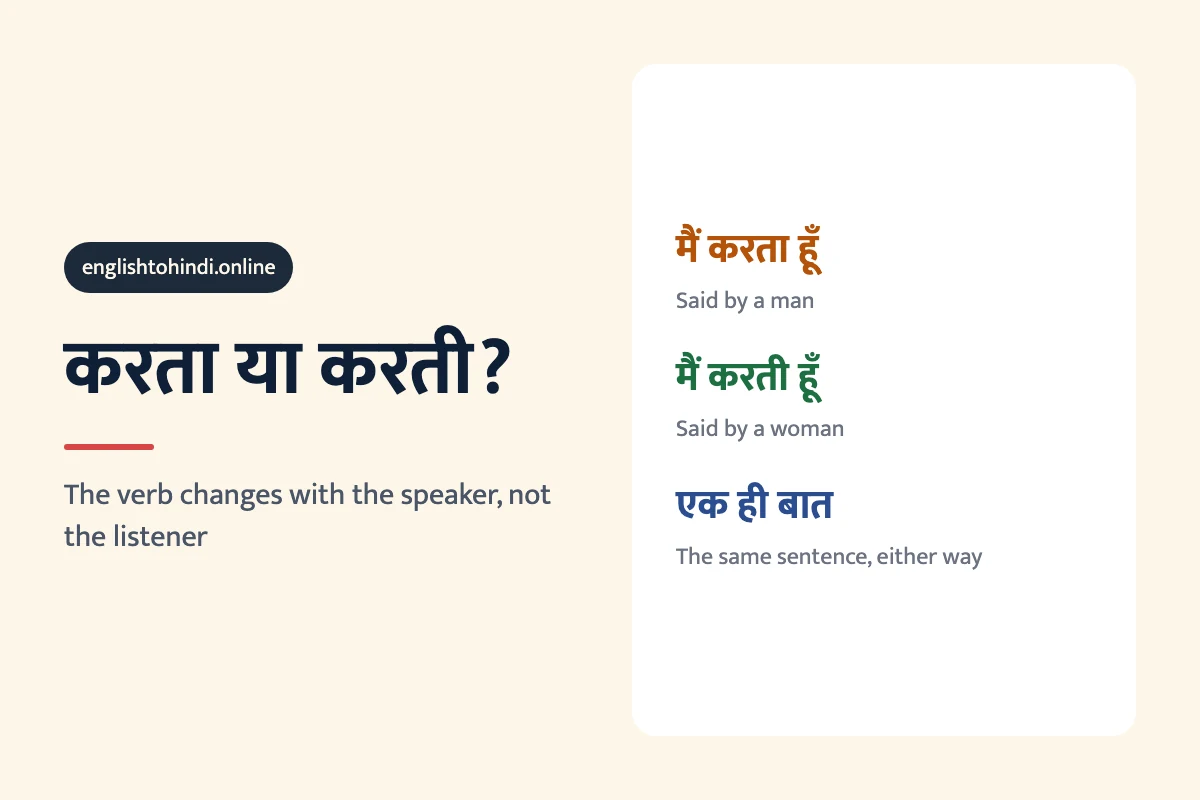
Hindi verbs agree with the gender of the speaker, not the listener. A man says मैं करता हूँ for “I do”; a woman says मैं करती हूँ for exactly the same sentence. The pattern is -ता for masculine and -ती for feminine, and it runs through every tense. Translation tools default to the masculine form because they cannot know who is typing.
In English, 'I work' is the same sentence regardless of who says it. In Hindi it is not. The verb carries the speaker's gender, and getting it wrong is immediately noticeable to any native listener.
The basic pattern
| Speaker | Hindi | Roman |
|---|---|---|
| Man | मैं काम करता हूँ | Main kaam karta hoon |
| Woman | मैं काम करती हूँ | Main kaam karti hoon |
| Mixed or plural group | हम काम करते हैं | Hum kaam karte hain |
The pattern is consistent: -ता for a male subject, -ती for a female subject, -ते for plural. It applies to essentially every verb in the language.
The mistake English speakers make
The instinct is to assume the ending matches the person being addressed, the way politeness levels do. It does not. It matches the grammatical subject of the sentence.
मैं तुमसे प्यार करती हूँ
Main tumse pyaar karti hoon
The listener's gender is irrelevant here. करती is chosen because the speaker is a woman, and मैं is the subject.
Why translation tools cannot solve this
A translation engine receives a sentence with no information about who is typing it. When it sees 'I love you' it has to guess, and virtually all of them default to the masculine form.
This is not a bug that better software fixes — the information genuinely is not in the input. It is why any Hindi translation of a first-person sentence should be checked by the person sending it.
Practical rule: if the Hindi output contains करता, किया, गया, रहा, or था and the speaker is a woman, change the ा to ी. करती, की, गई, रही, थी.
It affects adjectives too
| English | Male subject | Female subject |
|---|---|---|
| I am tired | मैं थक गया हूँ | मैं थक गई हूँ |
| I am ready | मैं तैयार हूँ | मैं तैयार हूँ |
| I am hungry | मुझे भूख लगी है | मुझे भूख लगी है |
Note the second and third rows do not change. तैयार is invariant, and in the hunger construction the grammatical subject is भूख (hunger), not the person — so the speaker's gender never enters into it. This is a different mechanism from the gender carried by the noun itself, and it is why blanket find-and-replace does not work.
How to check your own sentences
- Find the verb at the end of the sentence.
- Ask who is performing it — that is the subject, and usually it is मैं.
- If that person is female and the verb ends in ा, change it to ी.
- If the sentence has no explicit doer, as in the hunger example, leave it alone.
Frequently asked questions
Do Hindi verbs change with gender?
Yes. The verb agrees with the gender of the subject, which for sentences beginning मैं means the speaker. A man says मैं करता हूँ and a woman says मैं करती हूँ for the same English sentence, “I do”.
Is it the speaker's gender or the listener's?
The speaker's, when the speaker is the subject. The listener's gender is irrelevant — a woman says मैं करती हूँ to a man, a woman, or a room full of people. What matters is who is performing the action.
What is the difference between करता and करती?
करता is the masculine form and करती the feminine form of the same verb. The ending -ता marks masculine and -ती marks feminine, and the same alternation appears across the tenses: करता था and करती थी, करूँगा and करूँगी.
Why does Google Translate always use the masculine form?
Because it has no way to know who is typing. Faced with “I am tired” it must choose between मैं थका हूँ and मैं थकी हूँ, and it defaults to the masculine. Roughly half of all first-person output is therefore wrong for the person who asked for it.
Are there sentences where gender does not change the verb?
Yes. Some adjectives are invariant — तैयार stays तैयार for everyone. And in constructions like मुझे भूख लगी है the grammatical subject is भूख (hunger), not the person, so the speaker's gender never enters into it.
More guides
- Hindi plurals: लड़का, लड़के, लड़कों and which to use whenHindi has two plurals for every noun: one for the plain sentence and one for when a postposition follows. लड़के and लड़कों are both “boys”, and using the wrong one is the most common learner error.
- वाला in Hindi: what वाला, वाली and वाले actually meanवाला means “the one that” — the one who sells it, the one wearing it, the thing about to happen. One suffix doing three jobs English needs three constructions for.
- How to say “can” in Hindi: सकना, आना and पानामैं हिंदी बोल सकता हूँ. Ability, permission and “managed to” are three different verbs in Hindi, and picking the wrong one is the usual learner mistake.
Looking for a specific phrase? Browse the phrase guides.