Every Hindi noun has a gender — how to guess it right
The englishtohindi.online editors · · 7 min read
There is no neuter in Hindi. A table is feminine, a room is masculine, and the adjectives and verbs around them change to match. Two endings cover most of it.
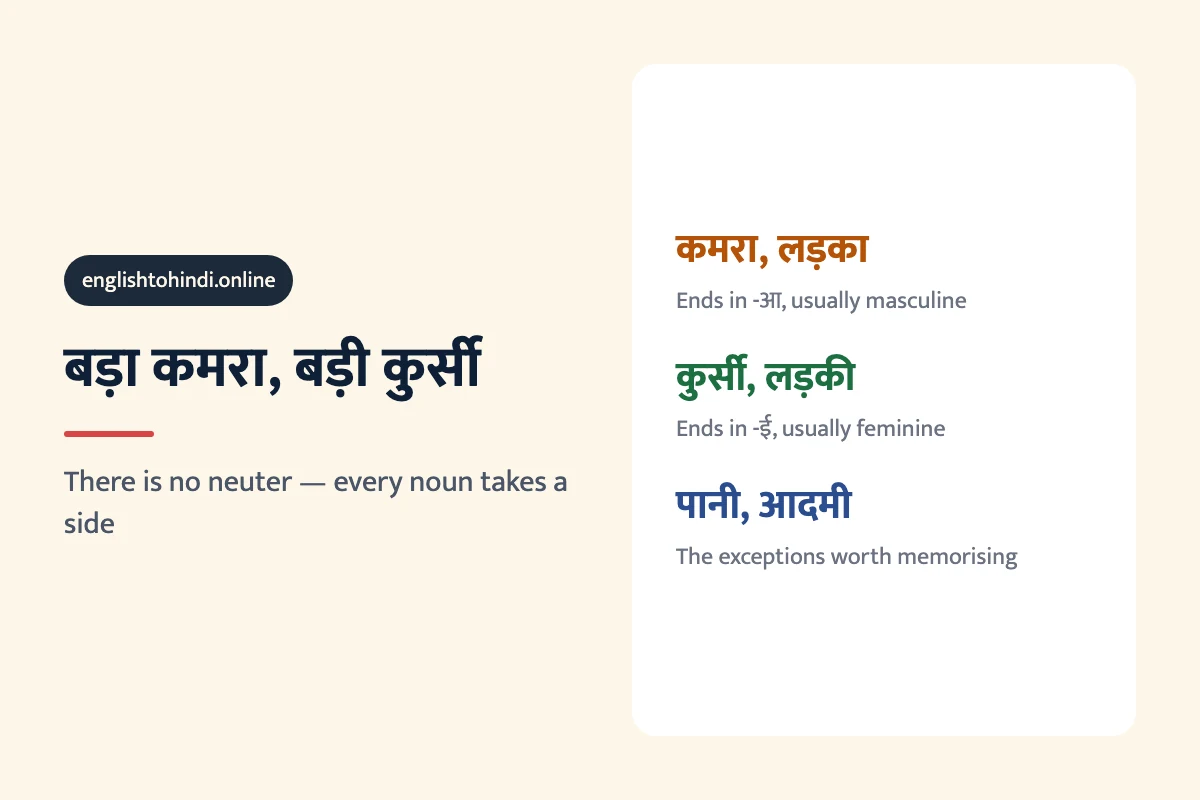
Every Hindi noun is either masculine or feminine — there is no neuter, so even objects have a gender. Most nouns ending in -आ are masculine (लड़का a boy, कमरा a room), and most ending in -ई are feminine (लड़की a girl, कुर्सी a chair). The gender then controls the adjectives and verbs around the noun, which is why guessing wrong is audible across the whole sentence.
English speakers find this arbitrary, and it partly is. But unlike French or German, Hindi gives you a usable rule that covers most of the vocabulary, and the exceptions are a short list rather than a lifetime of memorisation.
The two endings that do most of the work
| Ending | Usually | Examples |
|---|---|---|
| -आ | Masculine | लड़का (boy), कमरा (room), दरवाज़ा (door) |
| -ई | Feminine | लड़की (girl), कुर्सी (chair), गाड़ी (vehicle) |
| -ता | Feminine (abstract) | सुंदरता (beauty), स्वतंत्रता (freedom) |
| -पन | Masculine (abstract) | बचपन (childhood), पागलपन (madness) |
Nouns ending in a consonant could be either and simply have to be learned: घर (house) is masculine, किताब (book) is feminine, and nothing in the shape of the word tells you.
Why it matters: everything else agrees
The gender is not decoration. Adjectives ending in -आ change form, and so does the verb.
| Masculine | Feminine | Meaning |
|---|---|---|
| बड़ा कमरा | बड़ी कुर्सी | a big room / a big chair |
| अच्छा लड़का | अच्छी लड़की | a good boy / a good girl |
| कमरा साफ़ है | कुर्सी साफ़ है | the room / chair is clean |
| कमरा बड़ा था | कुर्सी बड़ी थी | the room / chair was big |
Adjectives that do not end in -आ never change. साफ़ (clean), मुश्किल (difficult) and सुंदर (beautiful) look identical in both columns. Only the -आ class inflects, which cuts the work down considerably.
The exceptions worth knowing now
A handful of extremely common words break the -आ and -ई rule. They are common enough that you will meet them in your first week, so learn them as exceptions rather than deriving them.
| Word | Ends in | Actually |
|---|---|---|
| पानी (water) | -ई | Masculine |
| आदमी (man) | -ई | Masculine |
| दही (yoghurt) | -ई | Masculine |
| माता (mother) | -आ | Feminine |
| भाषा (language) | -आ | Feminine |
| हवा (air) | -आ | Feminine |
पिता (father) ends in -आ and is masculine, which looks like an exception to the exception. It is not — it simply follows the main rule while माता does not.
Borrowed words get a gender too
English nouns used in Hindi are assigned a gender by convention, and speakers agree on it without ever having been taught. There is no rule; there is just usage.
| Word | Gender | In use |
|---|---|---|
| ट्रेन (train) | Feminine | ट्रेन लेट है |
| बस (bus) | Feminine | बस आ गई |
| फ़ोन (phone) | Masculine | फ़ोन कहाँ है? |
| कार (car) | Feminine | कार नई है |
| होटल (hotel) | Masculine | होटल अच्छा था |
Vehicles skew feminine, probably because गाड़ी — the native word for a vehicle — is feminine and the borrowed words fell in behind it. That is a pattern rather than a rule, but it guesses right often enough to be useful.
Plurals depend on the gender as well
| Type | Singular | Plural |
|---|---|---|
| Masculine in -आ | लड़का | लड़के |
| Masculine, other | घर | घर (unchanged) |
| Feminine in -ई | लड़की | लड़कियाँ |
| Feminine, other | किताब | किताबें |
Masculine nouns that do not end in -आ look identical in the plural — एक घर and दस घर use the same word. The verb is what tells you: घर है for one, घर हैं for many.
How to actually handle this
- Learn every new noun with an adjective attached — not कुर्सी but बड़ी कुर्सी. The gender comes along for free.
- Apply the -आ and -ई rule by default. It is right far more often than it is wrong.
- Memorise the six exceptions above. They cover most of what you will actually trip over.
- For English loanwords, listen for what people say rather than reasoning about it.
- When you are unsure, use an adjective that does not inflect. सुंदर works for anything.
Noun gender is a different mechanism from the one that changes verbs with the speaker. This page is about the gender of the thing; the other guide is about the gender of whoever is talking. Both can operate in the same sentence.
Frequently asked questions
Does Hindi have grammatical gender?
Yes. Every noun is masculine or feminine, including inanimate objects. There is no neuter gender, so a chair, a book and a road all take one gender or the other.
How do you tell if a Hindi noun is masculine or feminine?
Nouns ending in -आ are usually masculine (कमरा, लड़का) and nouns ending in -ई are usually feminine (कुर्सी, लड़की). Nouns ending in a consonant have to be learned individually — घर is masculine, किताब is feminine.
Why is पानी masculine when it ends in -ई?
It is one of a small group of exceptions, along with आदमी and दही. The -ई rule is a strong tendency rather than a law, and these words predate it. Learn them as a list; there are only a handful.
Do English words used in Hindi have a gender?
Yes, assigned by convention. ट्रेन, बस and कार are treated as feminine; फ़ोन and होटल as masculine. Speakers agree on these without being taught, and vehicles skew feminine because the native word गाड़ी is feminine.
What changes when a noun is feminine?
Adjectives ending in -आ switch to -ई (बड़ा becomes बड़ी), and the verb takes the feminine form (था becomes थी). Adjectives that do not end in -आ, such as साफ़ or सुंदर, never change.
More guides
- Hindi plurals: लड़का, लड़के, लड़कों and which to use whenHindi has two plurals for every noun: one for the plain sentence and one for when a postposition follows. लड़के and लड़कों are both “boys”, and using the wrong one is the most common learner error.
- वाला in Hindi: what वाला, वाली and वाले actually meanवाला means “the one that” — the one who sells it, the one wearing it, the thing about to happen. One suffix doing three jobs English needs three constructions for.
- How to say “can” in Hindi: सकना, आना and पानामैं हिंदी बोल सकता हूँ. Ability, permission and “managed to” are three different verbs in Hindi, and picking the wrong one is the usual learner mistake.
Looking for a specific phrase? Browse the phrase guides.