वाला in Hindi: what वाला, वाली and वाले actually mean
The englishtohindi.online editors · · 7 min read
वाला means “the one that” — the one who sells it, the one wearing it, the thing about to happen. One suffix doing three jobs English needs three constructions for.
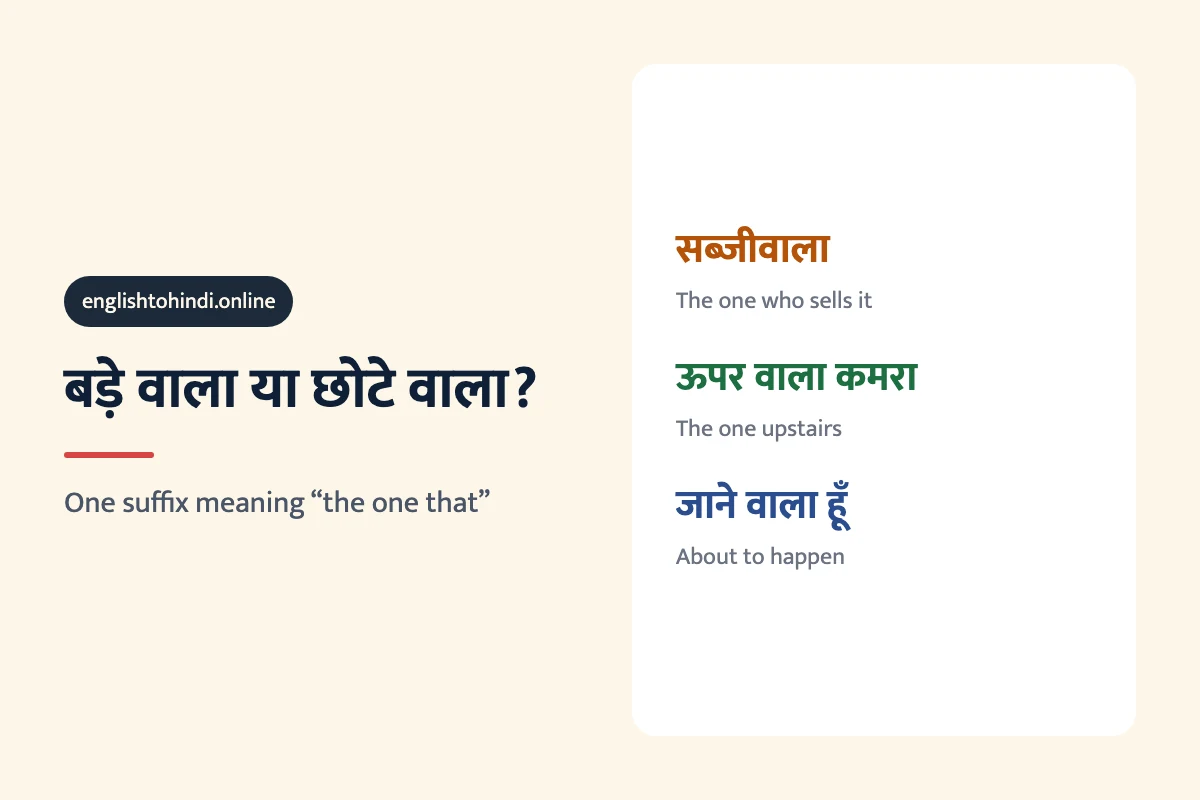
वाला (waala) means “the one that” or “the one who”. It attaches to the end of a word or phrase and turns it into a description of a person or thing: दूधवाला is the one who brings the milk, चश्मे वाला आदमी is the man with the glasses, and मैं जाने वाला हूँ is “I am about to go”. It changes shape with gender and number — वाला, वाली, वाले — because it behaves like an adjective.
There is no single English word that does this. English needs a relative clause (“the man who wears glasses”), a job title (“milkman”) or a whole construction (“about to leave”), and Hindi does all three with the same four letters. That is why वाला turns up in almost every conversation and why translation tools mangle it so regularly.
Everything below is one idea applied three ways: whatever sits in front of वाला identifies the thing.
वाला, वाली, वाले: the three forms
वाला agrees with the noun it describes, not with the word it is attached to. The pattern is the ordinary Hindi adjective pattern, the same one behind अच्छा, अच्छी and अच्छे.
| Form | Used for | Example |
|---|---|---|
| वाला | Masculine singular | दूध वाला आया — the milk man came |
| वाली | Feminine singular or plural | साड़ी वाली आंटी — the lady in the sari |
| वाले | Masculine plural, or before a postposition | दिल्ली वाले लोग — the Delhi people |
Which form you need depends on the gender of the noun being described, so Hindi noun gender decides it for you. चाय वाली दुकान is वाली because दुकान is feminine, even though चाय has nothing to do with the choice.
Job one: the person who sells or brings it
This is the use most learners meet first. A noun plus वाला names the person associated with that thing — usually the one who sells, carries or repairs it.
- दूधवाला (doodhwaala) — the milkman.
- सब्ज़ीवाला (sabziwaala) — the vegetable seller.
- रिक्शावाला (rikshawaala) — the rickshaw driver.
- अख़बारवाला (akhbaarwaala) — the newspaper boy.
- कबाड़ीवाला (kabaadiwaala) — the scrap buyer.
These words are ordinary and neutral when you are talking about someone, but using one to address a person to their face can sound curt. In practice people say भैया (bhaiya, brother) or आंटी instead — सब्ज़ी वाले भैया, एक किलो प्याज़ देना. The same instinct that governs Hindi honorifics applies here.
Job two: the relative clause Hindi does not have
This is the use that matters most and the one textbooks skip. English builds descriptions with “who”, “which” and “that”. Hindi mostly builds them by stacking a phrase in front of वाला.
| English | Hindi | Roman |
|---|---|---|
| The man with the glasses | चश्मे वाला आदमी | Chashme waala aadmi |
| The one in the red shirt | लाल शर्ट वाला | Laal shirt waala |
| The room upstairs | ऊपर वाला कमरा | Oopar waala kamra |
| Yesterday’s meeting | कल वाली मीटिंग | Kal waali meeting |
| The big one | बड़े वाला | Bade waala |
Notice how little the phrase in front has to be. A place (ऊपर), a time (कल), a colour, a whole clause — anything can sit there. This is why वाला feels so productive in speech: it converts any description at all into something you can point at. For longer descriptions that carry their own verb, Hindi switches to जो instead.
मुझे बड़े वाला दे दीजिए, छोटे वाला नहीं।
Mujhe bade waala de deejiye, chhote waala nahin.
In a shop that sentence does the work of an entire English clause. It is also the most natural way to answer “which one?”, which is one of the Hindi question words you will hear constantly.
Job three: something about to happen
Put a verb in front of वाला instead of a noun and it stops describing and starts predicting. The verb takes its oblique infinitive form — जाना becomes जाने, होना becomes होने, आना becomes आने — and the result means “about to”.
| Hindi | Roman | English |
|---|---|---|
| मैं जाने वाला हूँ | Main jaane waala hoon | I am about to go (said by a man) |
| मैं जाने वाली हूँ | Main jaane waali hoon | I am about to go (said by a woman) |
| ट्रेन आने वाली है | Train aane waali hai | The train is about to arrive |
| बारिश होने वाली है | Baarish hone waali hai | It is about to rain |
| फ़िल्म शुरू होने वाली थी | Film shuru hone waali thi | The film was about to start |
This is not the plain future. मैं जाऊँगा means “I will go”, at some point. मैं जाने वाला हूँ means the going is imminent — bag in hand, one foot out the door. The difference is the same one English draws between “I will leave” and “I am about to leave”, and it sits alongside the forms covered in Hindi verb tenses.
The form of वाला here follows the subject, which means it also follows the speaker’s own gender — exactly as Hindi verb gender describes. A woman saying “I am about to go” says जाने वाली हूँ, and a man says जाने वाला हूँ.
The noun in front changes shape
वाला behaves like a postposition in one respect: the masculine noun in front of it goes oblique. लड़का becomes लड़के, दूध stays दूध because it does not end in आ, and चश्मा becomes चश्मे. This is the same shape-change that Hindi postpositions force.
- चश्मा → चश्मे वाला, not चश्मा वाला.
- कोने → कोने वाली दुकान, the shop on the corner.
- गाँव → गाँव वाले, the village people — unchanged, because गाँव does not end in आ.
- जाना → जाने वाला, the infinitive going oblique in exactly the same way.
Written joined or written apart?
Both appear, and neither is wrong. The occupation words are conventionally written as one word — दूधवाला, रिक्शावाला — because they have hardened into nouns. Everything else is normally written apart: ऊपर वाला कमरा, जाने वाला हूँ. If you are unsure, writing it apart is never marked as an error.
Four mistakes worth avoiding
- Freezing it as वाला. It is an adjective — ट्रेन आने वाला है is wrong, because ट्रेन is feminine. Say आने वाली है.
- Leaving the noun direct. चश्मा वाला should be चश्मे वाला.
- Using the plain infinitive with it. जाना वाला हूँ is wrong; the infinitive goes oblique, giving जाने वाला हूँ.
- Reading it as the future tense. आने वाली है is “about to arrive”, not “will arrive” — the second is आएगी.
ऊपर वाला and other fixed expressions
A few वाला phrases have taken on meanings of their own. ऊपर वाला literally means “the one above” and is an everyday word for God — ऊपर वाला सब देख रहा है, “the one above sees everything”. घर वाले means the family, the people of the house. बाहर वाले means outsiders. These are worth learning whole rather than assembling.
मेरे घर वाले दिल्ली में रहते हैं।
Mere ghar waale Dilli mein rehte hain.
The short version
- वाला means “the one that” and attaches to the end of a word or phrase.
- It changes to वाली and वाले with the gender and number of the noun it describes.
- After a noun it names a person or picks out an object: सब्ज़ीवाला, ऊपर वाला कमरा, बड़े वाला.
- After an oblique infinitive it means “about to”: जाने वाला हूँ, बारिश होने वाली है.
- The masculine noun or infinitive in front of it goes oblique: चश्मे वाला, जाने वाला.
Frequently asked questions
What does वाला mean in Hindi?
वाला means “the one that” or “the one who”. It attaches to the end of a word or phrase and turns it into a description — दूधवाला is the man who brings the milk, ऊपर वाला कमरा is the room upstairs, and जाने वाला हूँ means “I am about to go”. वाला changes to वाली and वाले to match the gender and number of the thing being described.
What is the difference between वाला, वाली and वाले?
They are the same word agreeing with different nouns. वाला is masculine singular, वाली is feminine singular and plural, and वाले is masculine plural or the form used before a postposition. ट्रेन आने वाली है uses वाली because ट्रेन is feminine; आदमी आने वाला है uses वाला because आदमी is masculine.
How do you say “about to” in Hindi?
Put the verb in its oblique infinitive form in front of वाला and follow it with होना. जाना becomes जाने वाला हूँ, “I am about to go”. होना becomes होने वाली है, as in बारिश होने वाली है, “it is about to rain”. This is different from the plain future — मैं जाऊँगा means “I will go”, while मैं जाने वाला हूँ means the going is imminent.
Why is it चश्मे वाला and not चश्मा वाला?
Because a masculine noun ending in आ goes into its oblique form in front of वाला, the same way it does in front of a postposition. चश्मा becomes चश्मे, लड़का becomes लड़के and कमरा becomes कमरे. Nouns that do not end in आ, such as दूध or गाँव, keep their shape.
Is calling someone दूधवाला or रिक्शावाला rude?
The words themselves are neutral and are used constantly when talking about someone. Using one to address a person directly can sound curt, so in practice people say भैया or आंटी instead — सब्ज़ी वाले भैया rather than just सब्ज़ीवाला.
What does ऊपर वाला mean?
ऊपर वाला literally means “the one above” and is an everyday colloquial word for God, as in ऊपर वाला सब देख रहा है, “the one above sees everything”. In a purely physical context the same phrase can mean the upstairs one — ऊपर वाला कमरा is the room upstairs.
Should वाला be written joined to the previous word?
Occupation words are conventionally written joined, as in दूधवाला and रिक्शावाला, because they have become nouns in their own right. Everything else is normally written apart — ऊपर वाला कमरा, जाने वाला हूँ. Writing it apart is never treated as an error.
More guides
- Hindi plurals: लड़का, लड़के, लड़कों and which to use whenHindi has two plurals for every noun: one for the plain sentence and one for when a postposition follows. लड़के and लड़कों are both “boys”, and using the wrong one is the most common learner error.
- How to say “can” in Hindi: सकना, आना and पानामैं हिंदी बोल सकता हूँ. Ability, permission and “managed to” are three different verbs in Hindi, and picking the wrong one is the usual learner mistake.
- जो in Hindi: how to say “the one who” and “which”Hindi builds relative clauses with a pair — जो in the first half, वह in the second. Once you see the pattern, long Hindi sentences stop being unreadable.
Looking for a specific phrase? Browse the phrase guides.