Hindi verb tenses: present, past and future on one page
The englishtohindi.online editors · · 8 min read
A Hindi verb is a stem, an ending that agrees with the subject, and an auxiliary that carries the tense. Learn those three slots and the whole system opens.
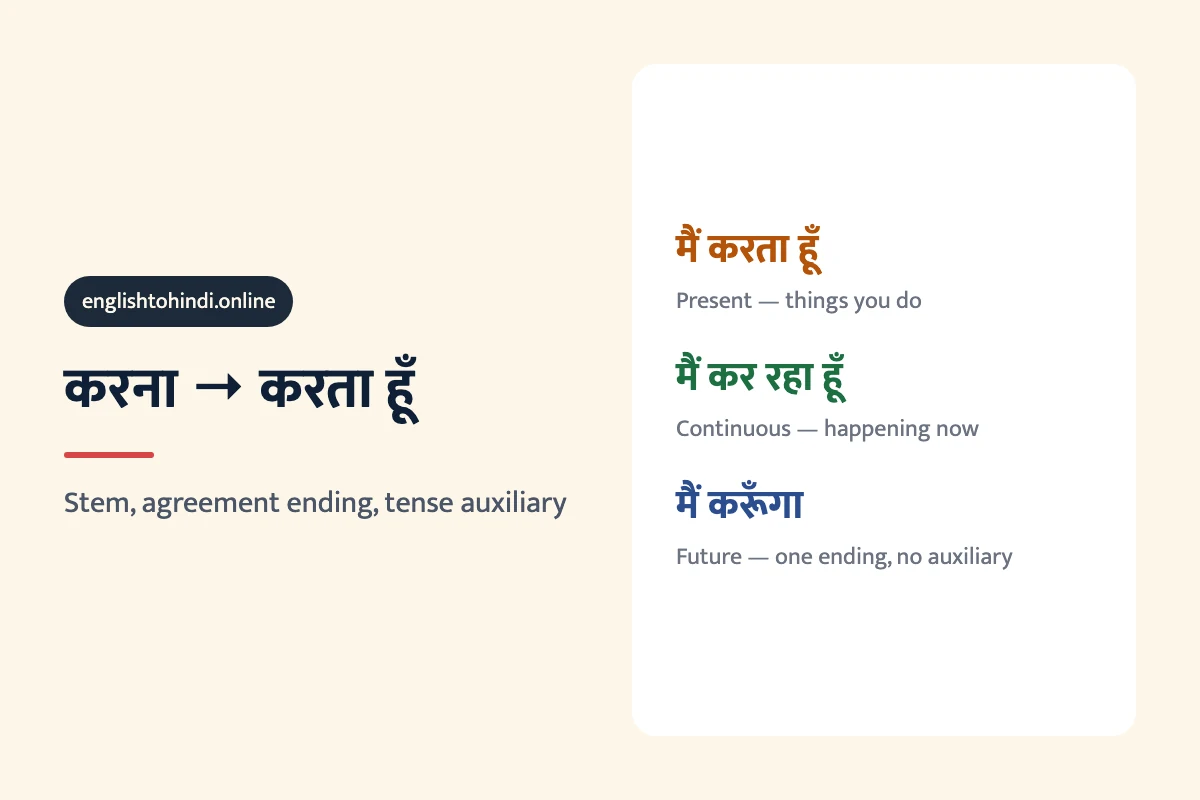
Hindi verbs are built from three pieces: a stem, an ending that agrees with the subject's gender and number, and an auxiliary that carries the tense. From करना (to do) you get मैं करता हूँ (I do), मैं कर रहा हूँ (I am doing), मैंने किया (I did), मैं करता था (I used to do) and मैं करूँगा (I will do). The stem कर never changes — everything after it does.
This is genuinely easier than English, which has to memorise go/went/gone. Hindi is regular almost everywhere. The catch is that the endings agree with the subject, so every tense comes in masculine and feminine forms.
Start with the infinitive
Every Hindi verb in a dictionary ends in -ना. Remove it and you have the stem, which is what you conjugate.
| Infinitive | Meaning | Stem |
|---|---|---|
| करना | to do | कर |
| जाना | to go | जा |
| खाना | to eat | खा |
| बोलना | to speak | बोल |
| देखना | to see | देख |
Present habitual: things you do
Stem + ता / ती / ते, then हूँ, है or हैं. This is the tense for routines, facts, and anything generally true.
| Subject | Form | Note |
|---|---|---|
| मैं (man) | मैं करता हूँ | -ता for a masculine speaker |
| मैं (woman) | मैं करती हूँ | -ती for a feminine speaker |
| तुम | तुम करते हो | -ते with तुम |
| आप | आप करते हैं | formal, and plural |
| वह | वह करता है / करती है | matches that person's gender |
The ending tracks the subject, which for मैं means it tracks the speaker. A woman saying the same sentence as a man changes the verb, and no translation engine can know which applies — that problem has its own guide.
Present continuous: things happening now
Stem + रहा / रही / रहे, then the same auxiliary. English uses '-ing' here; Hindi inserts a separate word.
मैं खाना खा रहा हूँ।
Main khaana khaa raha hoon.
Beginners often use the habitual where the continuous belongs. मैं जाता हूँ means 'I go' as a matter of habit; if you are leaving right now, you want मैं जा रहा हूँ.
Future: one ending, no auxiliary
The future is the tidiest tense in Hindi. The ending fuses onto the stem and there is no separate है or था at the end.
| Subject | Form | Roman |
|---|---|---|
| मैं | मैं करूँगा / करूँगी | main karoonga / karoongi |
| तुम | तुम करोगे | tum karoge |
| आप | आप करेंगे | aap karenge |
| वह | वह करेगा / करेगी | vah karega / karegi |
| हम | हम करेंगे | ham karenge |
Past: two kinds, and one complication
Hindi splits the past. For a completed action use the perfective — stem + आ / ई / ए. For something you used to do, use the habitual ending with था instead of है.
| English | Hindi | Which past |
|---|---|---|
| I went | मैं गया / गई | Completed |
| I used to go | मैं जाता था / जाती थी | Habitual |
| I was going | मैं जा रहा था | Continuous |
| I had gone | मैं गया था | Earlier than another past event |
The complication is ने. With a transitive verb in the perfective, the subject takes ने and the verb stops agreeing with the subject — it agrees with the object instead.
मैंने किताब पढ़ी।
Maine kitaab padhi.
This is the single hardest thing in Hindi grammar and it only appears in the perfective past. मैं गया has no ने because जाना is intransitive; मैंने खाया does, because खाना takes an object. Learners get it wrong for years, and are understood the entire time.
The whole system in one verb
| Tense | Masculine | Feminine |
|---|---|---|
| I do | मैं करता हूँ | मैं करती हूँ |
| I am doing | मैं कर रहा हूँ | मैं कर रही हूँ |
| I did | मैंने किया | मैंने किया |
| I used to do | मैं करता था | मैं करती थी |
| I was doing | मैं कर रहा था | मैं कर रही थी |
| I will do | मैं करूँगा | मैं करूँगी |
Read down the middle column and the pattern is obvious: the stem holds still, the ending agrees, the auxiliary marks time. Every one of these sentences also ends with the verb, which is the rule that governs Hindi word order.
The four irregular verbs
Hindi has almost no irregular verbs. In the perfective, these four do not follow the pattern, and they are among the most common words in the language.
| Verb | Expected | Actual |
|---|---|---|
| करना (to do) | करा | किया |
| जाना (to go) | जाया | गया |
| लेना (to take) | लिया | लिया |
| देना (to give) | दिया | दिया |
That is the entire irregular list worth memorising as a beginner. Compare the hundreds of irregular verbs an English learner has to absorb. Hindi front-loads its difficulty into agreement and then largely leaves you alone.
Frequently asked questions
How many tenses does Hindi have?
Three time frames — present, past and future — each with habitual, continuous and perfective aspects, giving around nine common combinations. All are built from the same three parts: stem, agreement ending, and auxiliary.
How do you conjugate Hindi verbs?
Drop the -ना from the infinitive to get the stem, add an ending that agrees with the subject's gender and number, then add an auxiliary for tense. करना becomes कर, then करता, then मैं करता हूँ.
What is the difference between करता हूँ and कर रहा हूँ?
करता हूँ is habitual — something you do regularly or as a rule. कर रहा हूँ is continuous — something happening at this moment. English 'I go' and 'I am going' make the same split.
What does ने do in Hindi?
It marks the subject of a transitive verb in the perfective past, and it changes agreement: the verb then agrees with the object rather than the subject. मैंने किताब पढ़ी uses the feminine पढ़ी because किताब is feminine, whoever is speaking.
Are Hindi verbs irregular?
Very rarely. Only a handful deviate, mostly in the perfective — करना gives किया and जाना gives गया rather than the expected forms. Otherwise the conjugation is fully predictable from the stem.
How do you say 'I will' in Hindi?
Add the future ending directly to the stem, with no auxiliary: मैं करूँगा (man speaking) or मैं करूँगी (woman speaking) for 'I will do'. आप करेंगे is the formal 'you will do'.
More guides
- Hindi plurals: लड़का, लड़के, लड़कों and which to use whenHindi has two plurals for every noun: one for the plain sentence and one for when a postposition follows. लड़के and लड़कों are both “boys”, and using the wrong one is the most common learner error.
- वाला in Hindi: what वाला, वाली and वाले actually meanवाला means “the one that” — the one who sells it, the one wearing it, the thing about to happen. One suffix doing three jobs English needs three constructions for.
- How to say “can” in Hindi: सकना, आना and पानामैं हिंदी बोल सकता हूँ. Ability, permission and “managed to” are three different verbs in Hindi, and picking the wrong one is the usual learner mistake.
Looking for a specific phrase? Browse the phrase guides.