How to say “can” in Hindi: सकना, आना and पाना
The englishtohindi.online editors · · 7 min read
मैं हिंदी बोल सकता हूँ. Ability, permission and “managed to” are three different verbs in Hindi, and picking the wrong one is the usual learner mistake.
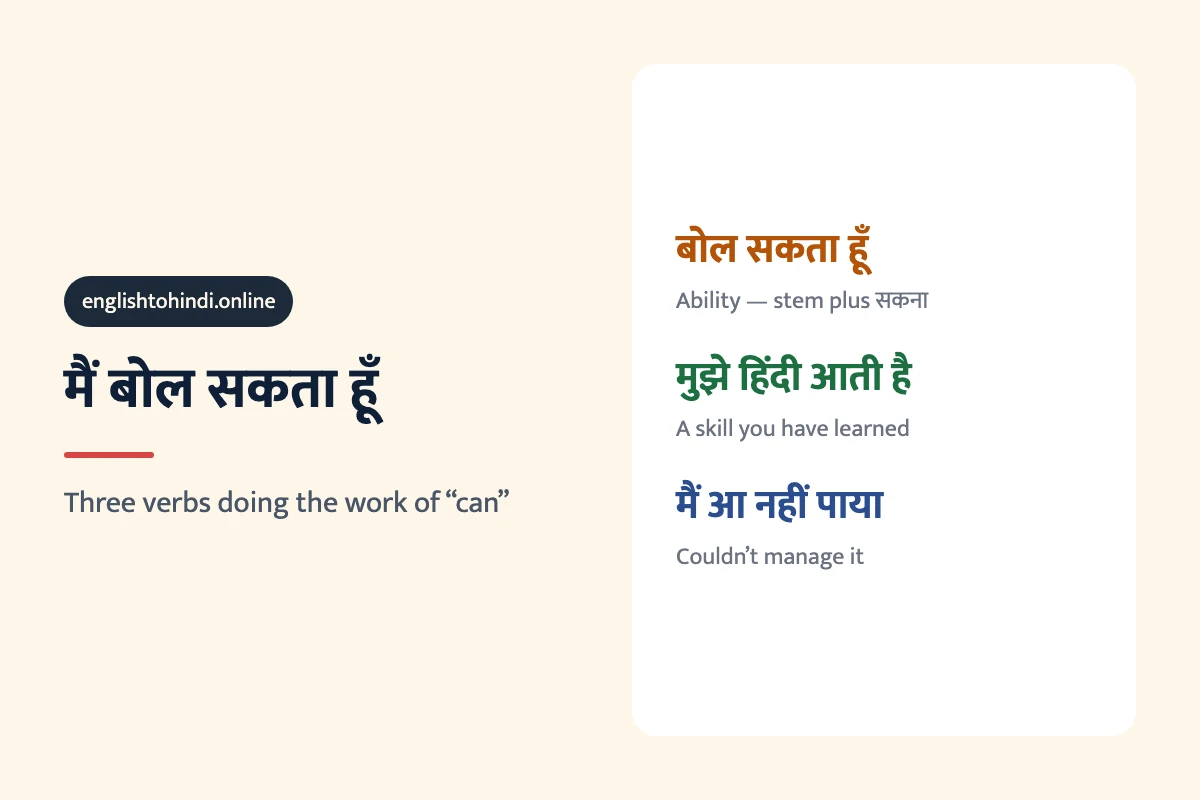
“Can” in Hindi is सकना (sakna). You put the bare stem of the main verb in front of it: मैं हिंदी बोल सकता हूँ means “I can speak Hindi”. सकना is never used on its own — it always follows another verb, and it takes all the endings while that verb stays in its shortest form. For a learned skill, Hindi usually prefers आना instead: मुझे हिंदी आती है.
English uses one word, “can”, for ability, permission, possibility and requests. Hindi splits that work across three verbs. Getting them apart is what separates a sentence that sounds native from one that is merely understood.
The basic pattern: stem + सकना
Take the verb, remove ना, and put सकता, सकती or सकते after it. बोलना becomes बोल, जाना becomes जा, करना becomes कर. The stem never changes again — no gender, no tense, nothing. सकना carries all of it.
| Hindi | Roman | English |
|---|---|---|
| मैं बोल सकता हूँ | Main bol sakta hoon | I can speak (said by a man) |
| मैं बोल सकती हूँ | Main bol sakti hoon | I can speak (said by a woman) |
| वह जा सकता है | Wah jaa sakta hai | He can go |
| हम कर सकते हैं | Hum kar sakte hain | We can do it |
| आप बैठ सकते हैं | Aap baith sakte hain | You can sit |
सकता, सकती and सकते follow the ordinary agreement rules — they change with the speaker’s own gender exactly as Hindi verb gender describes, not with the person you are talking to.
The single most common mistake is conjugating the main verb as well: मैं बोलता सकता हूँ or मैं बोलना सकता हूँ. Both are wrong. Only the bare stem goes in front — मैं बोल सकता हूँ.
Saying you cannot
नहीं goes in front of the whole verb group, not inside it. मैं नहीं आ सकता is “I can’t come”. In speech people often drop the हूँ or है at the end after नहीं, which is normal and not sloppy.
माफ़ कीजिए, मैं कल नहीं आ सकता।
Maaf kijiye, main kal nahin aa sakta.
Asking permission
The same construction turned into a question asks for permission, and it is the polite everyday way to do it. क्या sits at the front as a yes/no marker, exactly as in Hindi question words.
- क्या मैं अंदर आ सकता हूँ? — May I come in?
- क्या मैं यह ले सकती हूँ? — Can I take this?
- क्या हम यहाँ बैठ सकते हैं? — Can we sit here?
Adding जी or using आप-level verbs raises the politeness further, which is the territory of Hindi honorifics.
आना: the “can” for skills you have learned
This is the part textbooks bury. When “can” means a learned skill — a language, swimming, driving, cooking — Hindi does not use सकना at all. It uses आना, literally “to come”, with the person marked by को.
| English | Hindi | Literally |
|---|---|---|
| I know Hindi / I can speak Hindi | मुझे हिंदी आती है | To me Hindi comes |
| Can you swim? | क्या आपको तैरना आता है? | To you does swimming come? |
| He can’t drive | उसे गाड़ी चलानी नहीं आती | To him driving does not come |
| I can cook | मुझे खाना बनाना आता है | To me cooking comes |
मैं हिंदी बोल सकता हूँ is not wrong, but it means something narrower — that you are physically able to speak Hindi right now, in this situation. मुझे हिंदी आती है is the sentence that means you know the language. The को marking works exactly like the one in चाहिए, where the person is the recipient rather than the subject.
The verb in मुझे हिंदी आती है agrees with हिंदी, which is feminine, not with the speaker. This is why it is आती and not आता, regardless of who is talking.
पाना: managed to, was able to
पाना is the third one. It means succeeding in doing something despite circumstances, and it appears most often in the past and in the negative.
- मैं नहीं आ पाया — I couldn’t make it (something prevented me).
- वह समय पर पहुँच नहीं पाई — She wasn’t able to arrive on time.
- मैं सो नहीं पाया — I couldn’t sleep.
The contrast with सकना is real. मैं नहीं आ सका says you were unable to come. मैं नहीं आ पाया says you tried or intended to and did not manage it. In practice पाना sounds warmer and slightly apologetic, which is why it is the natural choice for excuses.
“Can” meaning possibility
सकना also covers the “might” sense, where nothing about ability is involved. बारिश हो सकती है means “it can rain” — that is, it might. यह हो सकता है is a complete sentence meaning “that’s possible”.
आज बारिश हो सकती है, छाता ले लो।
Aaj baarish ho sakti hai, chhaata le lo.
Which one to use
| Meaning of “can” | Verb | Example |
|---|---|---|
| Ability in this moment | सकना | मैं उठा सकता हूँ — I can lift it |
| A learned skill | आना | मुझे तैरना आता है — I can swim |
| Permission | सकना | क्या मैं जा सकता हूँ? — May I go? |
| Managed to, succeeded in | पाना | मैं आ नहीं पाया — I couldn’t make it |
| Possibility, might | सकना | हो सकता है — it’s possible |
The short version
- Bare stem plus सकता, सकती or सकते: मैं बोल सकता हूँ. Never बोलना सकता or बोलता सकता.
- सकना takes every ending; the main verb never changes.
- नहीं goes in front of the whole group: मैं नहीं आ सकता.
- For a skill you have learned, use आना with को: मुझे हिंदी आती है.
- For “managed to”, especially in an excuse, use पाना: मैं नहीं आ पाया.
Frequently asked questions
How do you say “can” in Hindi?
Use सकना after the bare stem of the main verb. मैं हिंदी बोल सकता हूँ means “I can speak Hindi” if a man is speaking, and मैं हिंदी बोल सकती हूँ if a woman is. The main verb loses its ना ending and never changes; सकना carries the gender, number and tense.
What is the difference between मुझे हिंदी आती है and मैं हिंदी बोल सकता हूँ?
मुझे हिंदी आती है means “I know Hindi” and is the normal way to state a learned skill. मैं हिंदी बोल सकता हूँ means you are able to speak Hindi in this particular situation. For languages, swimming, driving and cooking, Hindi speakers use आना with को rather than सकना.
How do you say “I cannot” in Hindi?
Put नहीं in front of the whole verb group: मैं नहीं आ सकता means “I can’t come”. नहीं never goes between the stem and सकना, so मैं आ नहीं सकता हूँ is unusual and मैं नहीं आ सकता is the standard form. In speech the final हूँ is often dropped.
What is the difference between सकना and पाना?
सकना states ability or permission, while पाना means managing or succeeding in doing something. मैं नहीं आ सका means you were unable to come; मैं नहीं आ पाया means you meant to and did not manage it. पाना sounds apologetic, which makes it the natural verb for excuses.
How do you ask for permission in Hindi?
Use क्या plus the सकना construction: क्या मैं अंदर आ सकता हूँ? means “may I come in?”. क्या sits at the front of the sentence as a yes/no marker. Using आप forms and adding जी makes the request more polite.
Does सकता change with gender?
Yes. सकता is masculine singular, सकती is feminine singular, and सकते is masculine plural or the आप form. It agrees with the subject, which means it follows the speaker’s own gender in a sentence starting with मैं — a man says मैं कर सकता हूँ and a woman says मैं कर सकती हूँ.
More guides
- Hindi plurals: लड़का, लड़के, लड़कों and which to use whenHindi has two plurals for every noun: one for the plain sentence and one for when a postposition follows. लड़के and लड़कों are both “boys”, and using the wrong one is the most common learner error.
- वाला in Hindi: what वाला, वाली and वाले actually meanवाला means “the one that” — the one who sells it, the one wearing it, the thing about to happen. One suffix doing three jobs English needs three constructions for.
- जो in Hindi: how to say “the one who” and “which”Hindi builds relative clauses with a pair — जो in the first half, वह in the second. Once you see the pattern, long Hindi sentences stop being unreadable.
Looking for a specific phrase? Browse the phrase guides.