चाहिए in Hindi: how to say “I want”, “I need” and “I should”
The englishtohindi.online editors · · 8 min read
चाहिए is not a verb you conjugate, and it means two different things depending on what stands in front of it. Wanting a thing and wanting to do something use entirely different constructions.
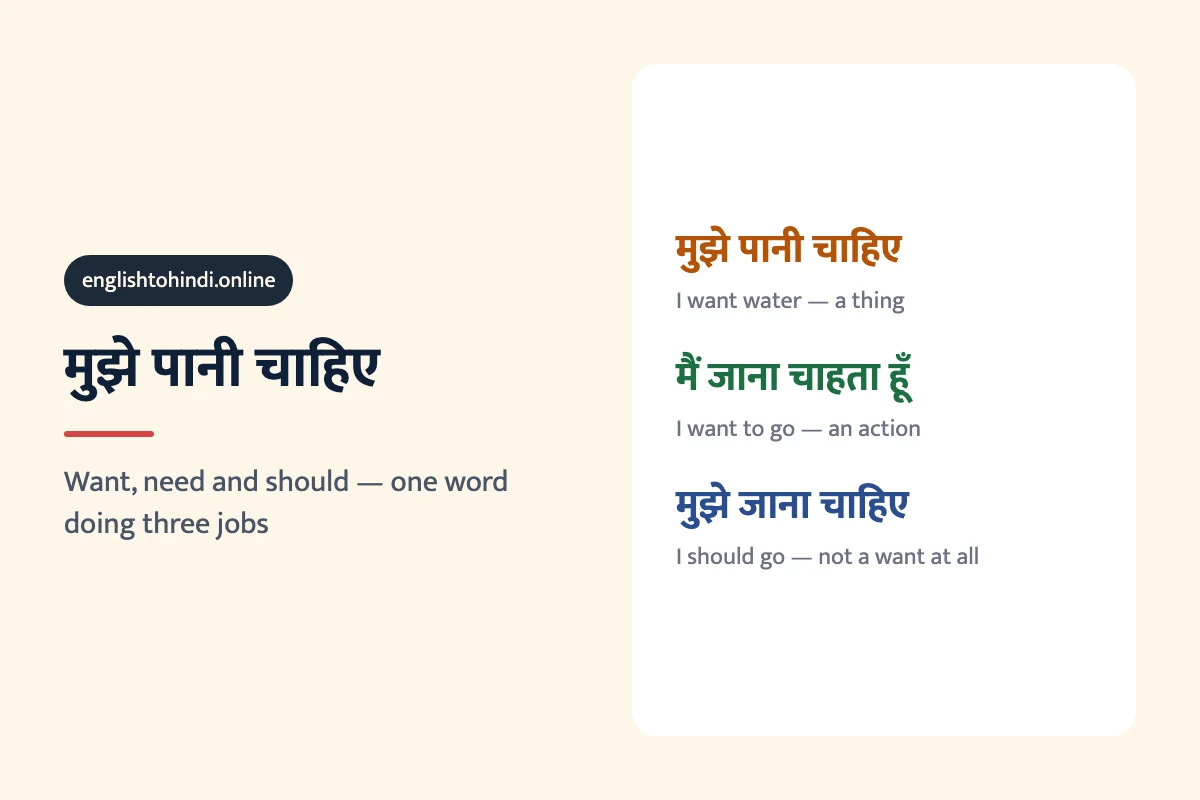
चाहिए means “is wanted” or “is needed”, and it never changes form for the person who wants something — the person is marked with को instead. मुझे पानी चाहिए is “I want water”. Put a verb in front of it instead of a noun and the meaning shifts completely: मुझे जाना चाहिए means “I should go”, not “I want to go”. To say you want to *do* something you need a different verb altogether, चाहना: मैं जाना चाहता हूँ.
English uses “want” for both a thing and an action — “I want water”, “I want to go”. Hindi splits those apart, and then reuses चाहिए for “should”, which is where most of the confusion comes from.
Wanting a thing: को + चाहिए
The thing wanted is the grammatical subject, and the person who wants it is marked with को — which fuses into मुझे, तुम्हें, आपको, उसे and हमें. चाहिए itself does no work beyond sitting at the end.
मुझे पानी चाहिए।
Mujhe paani chaahiye.
| English | Hindi | Roman |
|---|---|---|
| I want water | मुझे पानी चाहिए | mujhe paani chaahiye |
| What do you want? | आपको क्या चाहिए? | aapko kya chaahiye? |
| He needs money | उसे पैसे चाहिए | use paise chaahiye |
| I don't want it | मुझे नहीं चाहिए | mujhe nahin chaahiye |
| I wanted two books | मुझे दो किताबें चाहिए थीं | mujhe do kitaabein chaahiye theen |
चाहिए does not conjugate for the person — मुझे चाहिए, उसे चाहिए and हमें चाहिए all use the same form. Only the tense marker after it changes, as in चाहिए था for the past. This is the same को construction behind मुझे भूख लगी है, described in Hindi has no verb for “to have”.
Wanting to do something: चाहना, which does conjugate
For an action, चाहिए is simply wrong. You need the verb चाहना, the infinitive of what you want to do goes in front of it, and now the sentence behaves normally — मैं is the subject and the verb agrees with it.
| English | Hindi | Note |
|---|---|---|
| I want to go | मैं जाना चाहता हूँ | Said by a man |
| I want to go | मैं जाना चाहती हूँ | Said by a woman |
| She wants to eat | वह खाना चाहती है | Third person, feminine |
| We want to learn Hindi | हम हिंदी सीखना चाहते हैं | Plural |
| I don't want to go | मैं नहीं जाना चाहता | नहीं before the verb phrase |
Because चाहना is an ordinary verb, it takes the gender agreement every Hindi verb takes — चाहता for a man, चाहती for a woman, on the pattern in why the verb changes when a woman speaks.
The trap: मुझे जाना चाहिए means “I should go”
Here is the sentence pair that catches everyone. Both use जाना. One is a want and the other is advice, and the only difference is which construction surrounds it.
मैं जाना चाहता हूँ। मुझे जाना चाहिए।
Main jaana chaahta hoon. Mujhe jaana chaahiye.
So चाहिए has two jobs, decided by what precedes it: after a noun it means “wanted”, and after an infinitive verb it means “should”. This is genuinely useful once you see it, because it hands you the whole of Hindi advice-giving for free.
| Hindi | English | What precedes चाहिए |
|---|---|---|
| मुझे पानी चाहिए | I want water | पानी — a noun |
| मुझे जाना चाहिए | I should go | जाना — an infinitive |
| आपको आराम करना चाहिए | You should rest | करना — an infinitive |
| तुम्हें डॉक्टर से मिलना चाहिए | You should see a doctor | मिलना — an infinitive |
| मुझे जाना चाहिए था | I should have gone | Past marker added |
मुझे जाना चाहिए था is “I should have gone” — the regret form, and one of the most useful sentences in the language. Adding था to the advice construction shifts it into the past exactly as it does elsewhere, per Hindi verb tenses on one page.
And मुझे जाना है means “I have to go”
One more construction sits alongside these, and it is the one people use constantly. Drop चाहिए and use है instead, and the advice becomes a plan or an obligation.
| Hindi | English | Force |
|---|---|---|
| मैं जाना चाहता हूँ | I want to go | Desire |
| मुझे जाना चाहिए | I should go | Advice |
| मुझे जाना है | I have to go | Plan or obligation |
| मुझे जाना पड़ा | I had to go | Compulsion — no choice |
That table is the whole system on four lines. English needs “want”, “should”, “have to” and “had to” to cover it; Hindi keeps जाना in place and changes only what follows.
चाहिए or ज़रूरत — want against genuine need
चाहिए covers both wanting and needing, which is usually fine. When you mean necessity specifically, Hindi has ज़रूरत — a feminine noun, so it takes की.
| Hindi | English | Register |
|---|---|---|
| मुझे पानी चाहिए | I want some water | Everyday, slightly casual |
| मुझे पानी की ज़रूरत है | I need water | Stronger — a real requirement |
| मुझे तुम्हारी ज़रूरत है | I need you | Natural |
मुझे तुम चाहिए is grammatical but reads as a declaration of desire rather than a request for help. If you mean you need someone's assistance, use ज़रूरत.
Why translation tools get this wrong
| English | Correct Hindi | Common machine output |
|---|---|---|
| I want water | मुझे पानी चाहिए | मैं पानी चाहता हूँ |
| I want to go home | मैं घर जाना चाहता हूँ | मुझे घर जाना चाहिए |
| I should go | मुझे जाना चाहिए | मैं जाना चाहता हूँ |
| I need you | मुझे तुम्हारी ज़रूरत है | मुझे तुम चाहिए |
Row one is not ungrammatical, just stiff and unidiomatic — मैं पानी चाहता हूँ is the sort of thing nobody says at a dhaba. Rows two and three are worse, because they swap desire for obligation in both directions, which is the confident-and-wrong output described in why translation tools fail at Hinglish.
The short version
- Want a thing: को + noun + चाहिए — मुझे पानी चाहिए.
- Want to do something: चाहना, conjugated — मैं जाना चाहता हूँ.
- Infinitive + चाहिए does not mean want; it means should — मुझे जाना चाहिए.
- Infinitive + है means have to — मुझे जाना है.
- Add था for the past: मुझे जाना चाहिए था is “I should have gone”.
- चाहिए never changes for the person; the person is always marked with को.
- For real necessity use की ज़रूरत है rather than चाहिए.
Frequently asked questions
What does चाहिए mean in Hindi?
चाहिए means “is wanted” or “is needed”. मुझे पानी चाहिए means “I want water”, literally “to me water is wanted”. चाहिए never conjugates for the person — the person is marked with को, which fuses into मुझे, तुम्हें, आपको, उसे and हमें.
How do you say “I want to go” in Hindi?
मैं जाना चाहता हूँ (main jaana chaahta hoon) if you are a man, मैं जाना चाहती हूँ if you are a woman. Wanting to do something uses the verb चाहना, which conjugates normally. मुझे जाना चाहिए is not “I want to go” — it means “I should go”.
What is the difference between मुझे जाना चाहिए and मैं जाना चाहता हूँ?
मुझे जाना चाहिए means “I should go” and expresses advice or obligation. मैं जाना चाहता हूँ means “I want to go” and expresses desire. Both contain जाना, so the construction around it carries the entire difference in meaning.
How do you say “should” in Hindi?
Put the infinitive form of the verb in front of चाहिए and mark the person with को. आपको आराम करना चाहिए is “you should rest”; तुम्हें डॉक्टर से मिलना चाहिए is “you should see a doctor”. Adding था gives “should have” — मुझे जाना चाहिए था means “I should have gone”.
What is the difference between चाहिए and ज़रूरत है?
चाहिए covers wanting and needing in everyday speech, as in मुझे पानी चाहिए. मुझे पानी की ज़रूरत है is stronger and states a genuine requirement. ज़रूरत is a feminine noun, so it takes की in front of it.
Does चाहिए change with gender?
No. चाहिए is the same for every speaker, which makes it easier than most Hindi verbs. The verb चाहना does change — चाहता for a man and चाहती for a woman — because it is an ordinary verb agreeing with its subject.
More guides
- Hindi plurals: लड़का, लड़के, लड़कों and which to use whenHindi has two plurals for every noun: one for the plain sentence and one for when a postposition follows. लड़के and लड़कों are both “boys”, and using the wrong one is the most common learner error.
- वाला in Hindi: what वाला, वाली and वाले actually meanवाला means “the one that” — the one who sells it, the one wearing it, the thing about to happen. One suffix doing three jobs English needs three constructions for.
- How to say “can” in Hindi: सकना, आना and पानामैं हिंदी बोल सकता हूँ. Ability, permission and “managed to” are three different verbs in Hindi, and picking the wrong one is the usual learner mistake.
Looking for a specific phrase? Browse the phrase guides.