Hindi has no verb for 'to have' — what to say instead
The englishtohindi.online editors · · 6 min read
There is no Hindi word meaning 'have'. Possession splits into three separate patterns depending on what you own, and picking the wrong one is a giveaway.
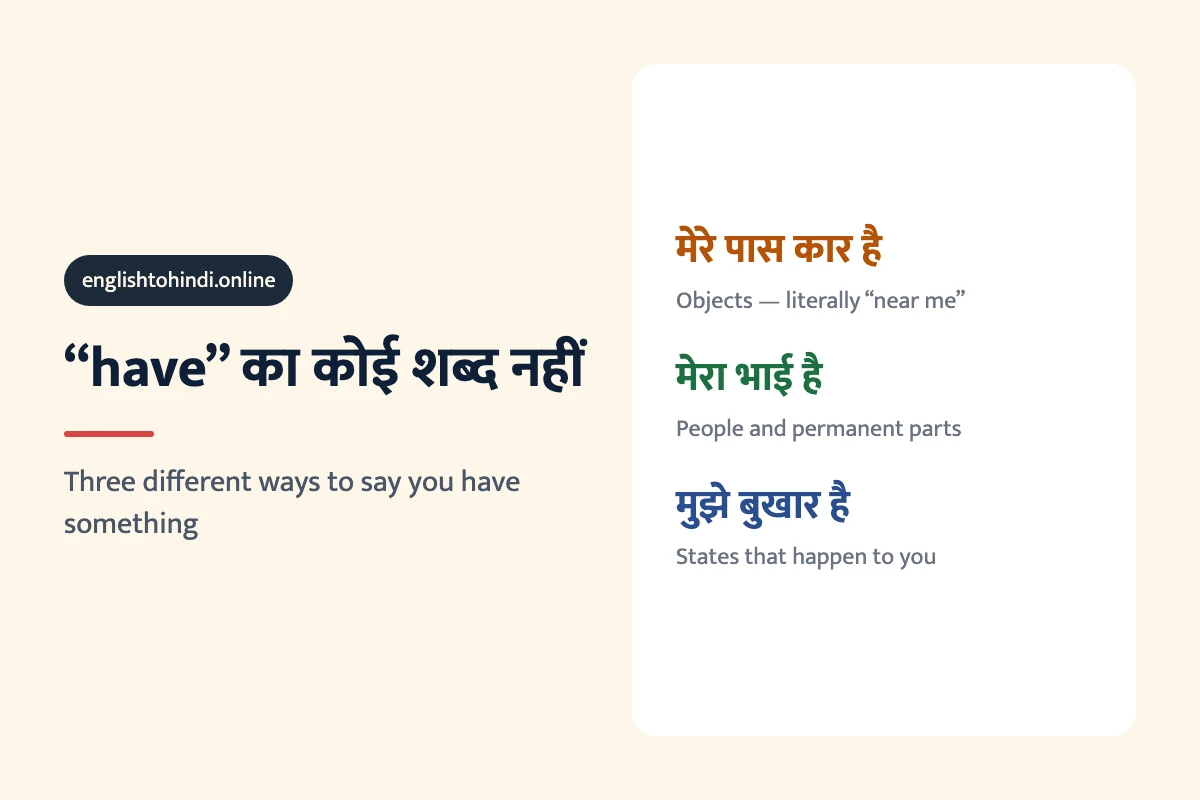
Hindi has no verb meaning 'to have'. Possession is expressed three different ways: के पास for objects you could put down (मेरे पास कार है — I have a car), का / के / की for people and permanent parts (मेरा भाई है — I have a brother), and को for states that happen to you (मुझे बुखार है — I have a fever). Which one you use depends on what is owned, not on who owns it.
English collapses all three into one word, which is why 'I have a car', 'I have a brother' and 'I have a fever' look like the same sentence. In Hindi they share almost nothing.
Pattern one: के पास, for things you could hand over
के पास literally means 'near' or 'in the vicinity of'. Hindi treats ownership of a physical object as a matter of proximity — the thing is near you, and the sentence says so.
मेरे पास कार है।
Mere paas kaar hai.
| English | Hindi | Roman |
|---|---|---|
| I have money | मेरे पास पैसे हैं | mere paas paise hain |
| Do you have time? | क्या आपके पास समय है? | kya aapke paas samay hai? |
| He has a phone | उसके पास फ़ोन है | uske paas phone hai |
| We do not have a ticket | हमारे पास टिकट नहीं है | hamaare paas ticket nahin hai |
The verb agrees with the thing owned, not with you. पैसे is plural, so the sentence takes हैं rather than है. This catches people who assume the verb follows मेरे.
Pattern two: का, for relationships and fixed parts
You cannot put your brother down and walk away, so के पास is wrong for him. Family, body parts, and anything permanently attached use the possessive का, which changes form to match the thing owned.
| English | Hindi | Why this form |
|---|---|---|
| I have a brother | मेरा भाई है | भाई is masculine singular — मेरा |
| I have a sister | मेरी बहन है | बहन is feminine — मेरी |
| I have two children | मेरे दो बच्चे हैं | plural — मेरे, and हैं |
| The house has three rooms | घर के तीन कमरे हैं | rooms are part of the house |
Saying मेरे पास भाई है is not a grammar error exactly, but it sounds as though your brother is a possession you happen to be carrying. Native speakers notice immediately.
Pattern three: को, for things that happen to you
Illness, hunger, fear, and needs are not owned in Hindi. They arrive. The person is marked with को (or the pronoun form मुझे, तुम्हें, उसे) and the state is the grammatical subject.
मुझे बुखार है।
Mujhe bukhaar hai.
| English | Hindi | Roman |
|---|---|---|
| I am hungry | मुझे भूख लगी है | mujhe bhookh lagi hai |
| I have a headache | मुझे सिरदर्द है | mujhe sirdard hai |
| I need water | मुझे पानी चाहिए | mujhe paani chaahiye |
| She is cold | उसे ठंड लग रही है | use thand lag rahi hai |
This is the pattern learners skip, and it is the one that appears most in daily conversation. Saying मैं भूखा हूँ ('I am a hungry person') is understood, but it describes your character rather than your afternoon.
Why translation tools mangle this
An engine translating 'I have' has to decide which of three unrelated structures applies, and that decision depends on the noun that follows. Get it wrong and the output is not slightly off — it is a different sentence.
| Input | Correct | Common machine output |
|---|---|---|
| I have a brother | मेरा भाई है | मेरे पास भाई है |
| I have a fever | मुझे बुखार है | मेरे पास बुखार है |
| I have time | मेरे पास समय है | मुझे समय है |
The middle row is the one to watch. मेरे पास बुखार है reads as though you are carrying a fever around in your bag to give to someone. It is the kind of output that is grammatically well-formed and completely wrong.
The short version
- Could you physically hand it to someone? Use के पास.
- Is it a person, or permanently part of something? Use मेरा / मेरी / मेरे.
- Is it an illness, a feeling, or a need? Use मुझे.
- In every case the verb agrees with the thing owned, not with the owner.
- There is no verb to conjugate — है and हैं are doing all the work.
All three patterns put the verb at the end, which is the general rule in Hindi and worth reading about separately if the sentence order still feels backwards — the verb goes last, always.
Frequently asked questions
How do you say 'I have' in Hindi?
It depends on what you have. For an object, मेरे पास ... है (mere paas ... hai). For a family member, मेरा / मेरी ... है. For an illness or a need, मुझे ... है. Hindi has no single verb meaning 'to have'.
What does मेरे पास mean literally?
'Near me' or 'in my vicinity'. Hindi treats owning a physical object as having it close to you, so मेरे पास कार है is literally 'near me a car is'.
Why is मेरे पास भाई है wrong?
It is not ungrammatical, but के पास is for things you could set down and walk away from. Applied to a person it sounds as though your brother is an object you are carrying. Relationships take the possessive instead: मेरा भाई है.
How do you say 'I am hungry' in Hindi?
मुझे भूख लगी है (mujhe bhookh lagi hai) — literally 'hunger has attached to me'. मैं भूखा हूँ is understood but describes you as a hungry sort of person rather than saying you want lunch.
Does the verb agree with the owner or the thing owned?
The thing owned. मेरे पास पैसे हैं uses the plural हैं because पैसे is plural, even though the owner is one person. The owner never controls the verb in these constructions.
More guides
- Hindi plurals: लड़का, लड़के, लड़कों and which to use whenHindi has two plurals for every noun: one for the plain sentence and one for when a postposition follows. लड़के and लड़कों are both “boys”, and using the wrong one is the most common learner error.
- वाला in Hindi: what वाला, वाली and वाले actually meanवाला means “the one that” — the one who sells it, the one wearing it, the thing about to happen. One suffix doing three jobs English needs three constructions for.
- How to say “can” in Hindi: सकना, आना and पानामैं हिंदी बोल सकता हूँ. Ability, permission and “managed to” are three different verbs in Hindi, and picking the wrong one is the usual learner mistake.
Looking for a specific phrase? Browse the phrase guides.