Hinglish translation: why tools fail at Hindi in Roman letters
The englishtohindi.online editors · · 5 min read
Type 'aap kaise ho' into a translator and you get nonsense. The reason is a design decision made before anyone typed Hindi in Roman letters.
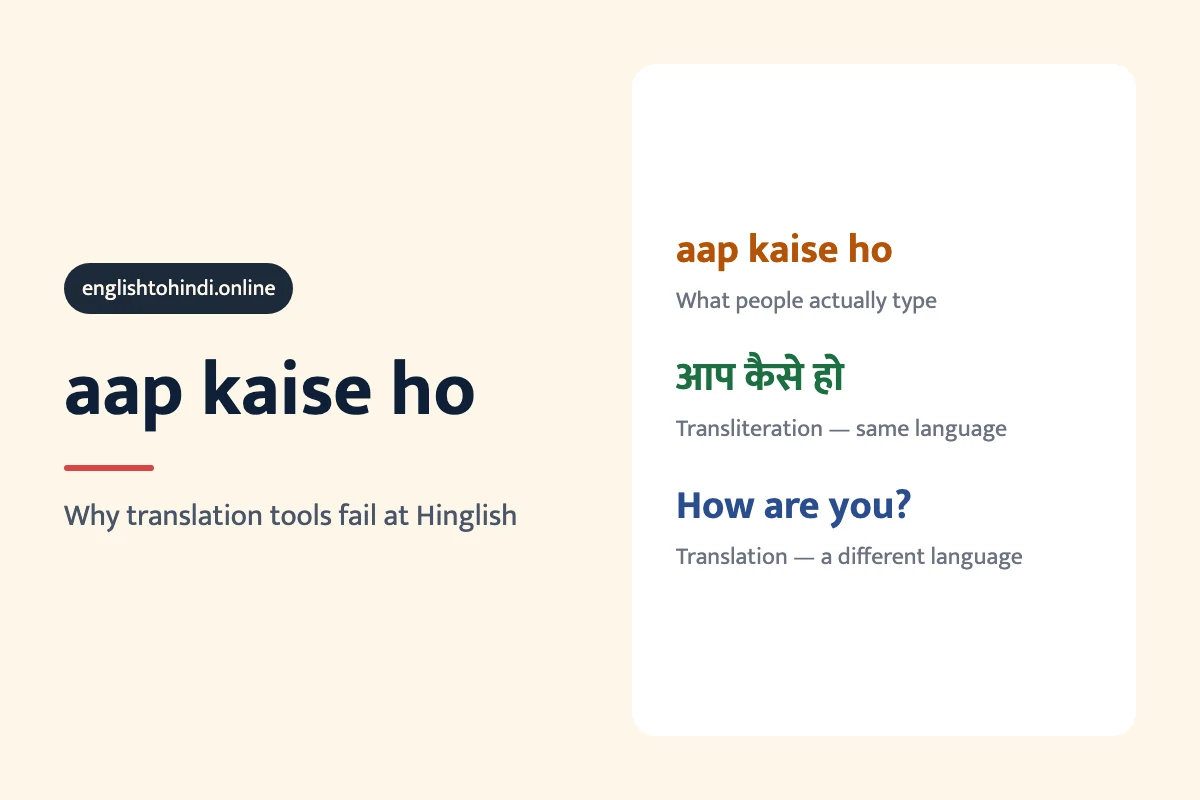
Hinglish is Hindi written in Roman letters — “aap kaise ho” instead of आप कैसे हो. Translation tools fail at it because they are built to detect a language from its script, and Roman-letter Hindi looks like misspelled English to that check. Converting between the two scripts is transliteration, a separate step from translation, and most engines do not do it.
Hundreds of millions of people write Hindi in Roman letters every day — WhatsApp messages, comments, search queries. Almost no translation tool handles it. Paste 'aap kaise ho' into one and it will either return the same Roman text unchanged, or translate it as though it were badly spelled English.
What is actually happening
A translation system starts by identifying the input language. That detection works on the script and the vocabulary. Roman letters plus words that are not in the English dictionary produces an ambiguous result, and most systems resolve it by guessing English.
Once it has decided the input is English, everything downstream is wrong. It looks for English meanings of 'aap', 'kaise', 'ho' and finds nothing useful.
Two different operations
Handling Hinglish properly requires transliteration before translation — two distinct steps that most pipelines do not separate.
| Step | Input | Output |
|---|---|---|
| Transliteration | aap kaise ho | आप कैसे हो |
| Translation | आप कैसे हो | How are you? |
Transliteration converts the script while keeping the language. Translation changes the language. Skip the first step and the second one has nothing sensible to work with.
Why it is harder than it looks
There is no standard spelling for Hinglish. The same word appears half a dozen ways depending on who is typing.
- क्या turns up as kya, kyaa, kia, or que.
- नहीं turns up as nahi, nahin, nahee, or nai.
- है and हैं are both written hai, and only context distinguishes them.
- English words sit inside Hindi sentences — 'meeting cancel ho gayi' is entirely normal speech.
A rule-based transliterator cannot cover that variation. It needs a system that understands context well enough to recognise that 'nai' means नहीं here and 'new' somewhere else.
How to work around it today
- Type in Devanagari if you can — a phone keyboard with Hindi installed removes the problem entirely, and turning it on takes about two minutes.
- If you must use Roman letters, write full standard spellings rather than chat shorthand.
- Translate short sentences one at a time. Long mixed-script paragraphs confuse language detection further.
- Check the output for register consistency, since transliteration errors often produce mixed आप and तुम.
This site currently translates Devanagari and English. Hinglish input is built and waiting on a translation engine that can do transliteration properly — we would rather leave it off than ship something that returns nonsense.
Frequently asked questions
What is Hinglish?
Hindi written in Roman letters, often mixed with English words — “aap kaise ho”, “kal milte hain”. It is how hundreds of millions of people write Hindi daily on WhatsApp, in comments and in search queries, despite having no standard spelling.
Why can't Google Translate handle Hinglish?
Language detection works from the script. Roman-letter Hindi reads as misspelled English to that check, so the engine either returns the text unchanged or translates it as though it were English. Converting Roman Hindi to Devanagari is transliteration, a separate step most engines skip.
What is the difference between transliteration and translation?
Transliteration changes the script but not the language: “aap kaise ho” becomes आप कैसे हो, still Hindi. Translation changes the language: आप कैसे हो becomes “How are you?”. Handling Hinglish needs both, in that order.
Is there a standard spelling for Hinglish?
No. The same word appears as “kya”, “kia” and “kyaa”, and vowel length is usually dropped entirely. Without a fixed spelling there is nothing stable for a translation engine to match against, which compounds the detection problem.
How can I get better translations of Hinglish text?
Convert it to Devanagari first, either by typing directly in Hindi or by using a transliteration tool, then translate. Writing full standard spellings rather than chat shorthand and translating short sentences one at a time both help as well.
More guides
- Hindi plurals: लड़का, लड़के, लड़कों and which to use whenHindi has two plurals for every noun: one for the plain sentence and one for when a postposition follows. लड़के and लड़कों are both “boys”, and using the wrong one is the most common learner error.
- वाला in Hindi: what वाला, वाली and वाले actually meanवाला means “the one that” — the one who sells it, the one wearing it, the thing about to happen. One suffix doing three jobs English needs three constructions for.
- How to say “can” in Hindi: सकना, आना and पानामैं हिंदी बोल सकता हूँ. Ability, permission and “managed to” are three different verbs in Hindi, and picking the wrong one is the usual learner mistake.
Looking for a specific phrase? Browse the phrase guides.