Hindi question words: क्या, कौन, कहाँ, कब, क्यों and कैसे
The englishtohindi.online editors · · 8 min read
Hindi question words stay where the answer would go instead of moving to the front, and क्या means two different things depending on where you put it.
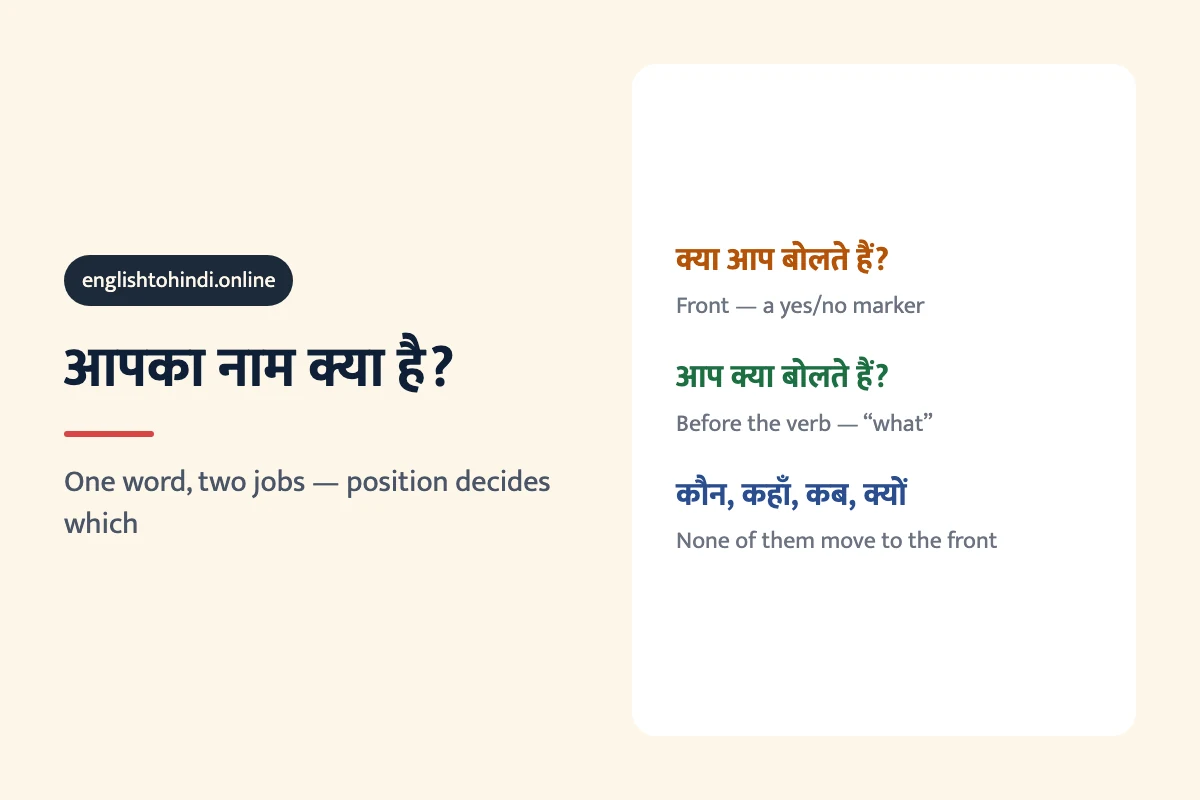
Hindi has six question words to learn first: क्या (what), कौन (who), कहाँ (where), कब (when), क्यों (why) and कैसे (how). Unlike English, they do not move to the front of the sentence — they sit exactly where the answer would sit, immediately before the verb. आप कहाँ जा रहे हैं? is “you where going are?”. And क्या is two different words depending on its position: at the front it turns a statement into a yes-or-no question, and before the verb it means “what”.
That second point is the one worth reading twice. आपका नाम क्या है? means “what is your name?”. क्या आपका नाम है? is a different question entirely, and not one you meant to ask.
The six question words
| Hindi | English | Example | Meaning |
|---|---|---|---|
| क्या | what | यह क्या है? | What is this? |
| कौन | who | वह कौन है? | Who is that? |
| कहाँ | where | तुम कहाँ हो? | Where are you? |
| कब | when | वह कब आएगा? | When will he come? |
| क्यों | why | आप क्यों गए? | Why did you go? |
| कैसे | how | यह कैसे हुआ? | How did this happen? |
They stay in place instead of moving to the front
English pulls its question word to the start of the sentence and rearranges everything behind it: “where are you going?” English moves “where”, then inverts “you are” into “are you”. Hindi does neither. The question word simply occupies the slot the answer would have occupied, and the rest of the sentence is untouched.
| Statement | Question | What moved |
|---|---|---|
| मैं दिल्ली जा रहा हूँ | तुम कहाँ जा रहे हो? | कहाँ replaced दिल्ली — nothing moved |
| यह किताब है | यह क्या है? | क्या replaced किताब |
| वह कल आएगा | वह कब आएगा? | कब replaced कल |
The verb still lands at the end, exactly as it does in a statement — the rule covered in why the verb always goes last. A Hindi question is a Hindi statement with one word swapped out.
क्या does two jobs, and position decides which
This is the single most useful thing on this page. When क्या stands at the very beginning of the sentence, it is not asking “what” — it is a marker that turns the whole sentence into a yes-or-no question, and it translates to nothing at all.
क्या आप हिंदी बोलते हैं?
Kya aap Hindi bolte hain?
आप क्या बोलते हैं?
Aap kya bolte hain?
Both sentences contain the identical four words. Moving क्या from the front to the pre-verb slot changes the question from “do you speak Hindi” to “what do you speak”.
| Front position — yes/no | Pre-verb position — “what” |
|---|---|
| क्या आप जानते हैं? (Do you know?) | आप क्या जानते हैं? (What do you know?) |
| क्या यह आपका है? (Is this yours?) | यह क्या है? (What is this?) |
| क्या उसने खाया? (Did he eat?) | उसने क्या खाया? (What did he eat?) |
In speech the front क्या is often dropped and rising intonation does the work instead — आप हिंदी बोलते हैं? with the pitch lifted at the end is a perfectly normal yes-or-no question. In writing, keep the क्या.
कौन changes shape when a postposition follows
कौन is the only one of the six that has other forms, and it does not look much like its base. The forms are built from किस rather than कौन.
| Form | Meaning | Example |
|---|---|---|
| कौन | who (subject) | वह कौन है? |
| किसे / किसको | whom, to whom | आपने किसे बुलाया? |
| किसका | whose | यह किसका घर है? |
| किससे | from whom, with whom | आप किससे मिले? |
| किसने | who (past transitive) | यह किसने किया? |
किसने is कौन carrying the ने marker, which is required whenever the verb is transitive and in the past tense — यह किसने किया? not यह कौन किया?. That marker and the shape-change in front of it are the subject of Hindi postpositions.
कैसा, कितना and कौन सा agree like adjectives
Three question words are adjectives rather than fixed words, so they change ending to match the noun they ask about.
| Base | Masculine | Feminine | Meaning |
|---|---|---|---|
| कैसा | यह कैसा है? | यह कैसी है? | What is it like? |
| कितना | कितना पैसा? | कितनी देर? | How much? |
| कौन सा | कौन सा कमरा? | कौन सी किताब? | Which one? |
This is why आप कैसे हैं? is addressed to a man and आप कैसी हैं? to a woman — the question word is agreeing with the person being asked, on the same gender pattern described in every Hindi noun has a gender. कैसे, without agreement, is the separate adverb meaning “by what means”: यह कैसे हुआ?
Answering, and the जी that softens it
- हाँ (yes) and नहीं (no) are the bare answers, and bare is slightly blunt with anyone senior.
- जी हाँ and जी नहीं are the polite versions, and जी on its own works as a respectful yes — see the Hindi words that carry respect.
- To negate the question itself, नहीं goes immediately before the verb: क्या आप नहीं जाएँगे? — “are you not going?”
Why translation tools get this wrong
The क्या ambiguity is the failure to watch for. An engine that puts क्या in the wrong slot produces a grammatical sentence asking something you did not ask.
| English | Correct Hindi | Common machine output |
|---|---|---|
| What is your name? | आपका नाम क्या है? | क्या आपका नाम है? |
| What do you want? | आपको क्या चाहिए? | क्या आपको चाहिए? |
| Where are you going? | आप कहाँ जा रहे हैं? | कहाँ आप जा रहे हैं? |
| Who did this? | यह किसने किया? | यह कौन किया? |
Row one is the common one, and it is worth recognising on sight, because “क्या आपका नाम है?” reads as a yes-or-no question about whether something is your name. Row three is not wrong so much as foreign — it is English word order wearing Hindi words, the pattern described in why translation tools fail at Hinglish.
A quick self-check before sending anything: if your sentence starts with क्या, you are asking a yes-or-no question. If you meant to ask “what”, क्या belongs later, just before the verb.
The short version
- Question words go where the answer would go, immediately before the verb — not at the front.
- Nothing else in the sentence moves, and the verb still ends it.
- क्या at the front = a yes-or-no marker that translates to nothing.
- क्या before the verb = “what”.
- कौन becomes किसे, किसका, किससे and किसने once a postposition is involved.
- कैसा, कितना and कौन सा agree with the noun; कैसे is the adverb.
- जी हाँ and जी नहीं are the polite answers.
Frequently asked questions
What are the question words in Hindi?
The six to learn first are क्या (what), कौन (who), कहाँ (where), कब (when), क्यों (why) and कैसे (how). Three more behave like adjectives and change ending with the noun: कैसा (what kind), कितना (how much) and कौन सा (which).
Why does क्या sometimes mean “what” and sometimes nothing?
Its position decides. At the start of a sentence क्या is a yes-or-no question marker with no English translation — क्या आप हिंदी बोलते हैं? means “do you speak Hindi?”. Immediately before the verb it means “what” — आप क्या बोलते हैं? means “what do you speak?”. The words are identical and only the position differs.
How do you ask “what is your name?” in Hindi?
आपका नाम क्या है? (aapka naam kya hai?), literally “your name what is?”. क्या sits before the verb, not at the front. क्या आपका नाम है? is a different and unintended question, because a sentence-initial क्या makes it yes-or-no.
Do Hindi question words go at the beginning of the sentence?
No. Unlike English, Hindi leaves the question word in the slot the answer would occupy, which is normally just before the verb. “Where are you going?” is आप कहाँ जा रहे हैं?, literally “you where going are?”. Nothing is moved or inverted.
What is the difference between कौन and किसने?
कौन is “who” as a plain subject — वह कौन है? means “who is that?”. किसने is कौन carrying the ने marker, required when the verb is transitive and in the past tense — यह किसने किया? means “who did this?”. कौन किया is incorrect there.
How do you say yes and no politely in Hindi?
जी हाँ for yes and जी नहीं for no. The bare हाँ and नहीं are correct but slightly blunt with elders, strangers or anyone senior, and जी on its own also works as a respectful yes.
More guides
- Hindi plurals: लड़का, लड़के, लड़कों and which to use whenHindi has two plurals for every noun: one for the plain sentence and one for when a postposition follows. लड़के and लड़कों are both “boys”, and using the wrong one is the most common learner error.
- वाला in Hindi: what वाला, वाली and वाले actually meanवाला means “the one that” — the one who sells it, the one wearing it, the thing about to happen. One suffix doing three jobs English needs three constructions for.
- How to say “can” in Hindi: सकना, आना and पानामैं हिंदी बोल सकता हूँ. Ability, permission and “managed to” are three different verbs in Hindi, and picking the wrong one is the usual learner mistake.
Looking for a specific phrase? Browse the phrase guides.