जी, साहब, भैया: the Hindi words that carry respect
The englishtohindi.online editors · · 6 min read
जी is the most useful syllable in Hindi. It turns a name into a courtesy, a yes into a polite yes, and its absence into something people notice.
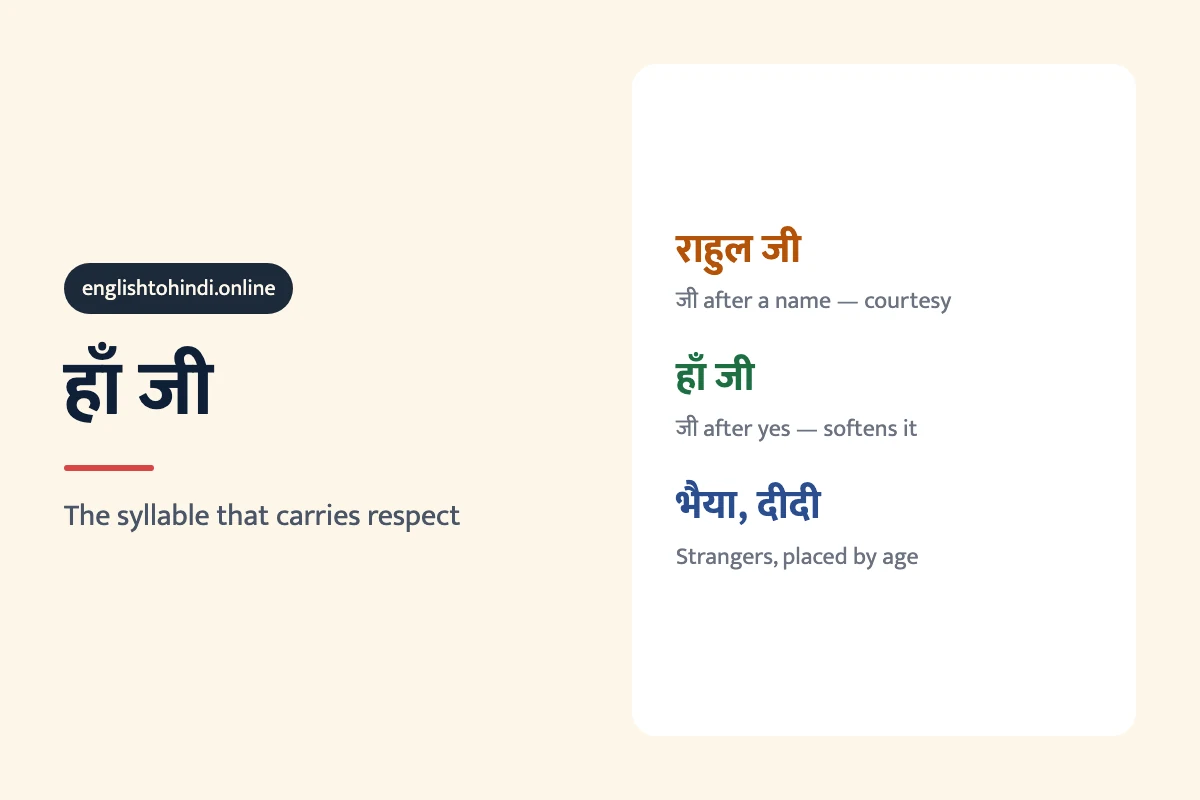
जी (ji) is a respect particle with no English equivalent. Added after a name it makes the name courteous — राहुल जी. Added after हाँ or नहीं it softens them — हाँ जी is a polite yes. Used alone it answers a call or invites someone to speak. Alongside it sit साहब and मैडम for formal address, and भैया, दीदी, अंकल and आंटी for strangers you place by age.
None of this is optional decoration. Hindi builds politeness into small words scattered through the sentence, and leaving them out produces speech that is grammatically fine and socially blunt.
What जी does
| Use | Example | Effect |
|---|---|---|
| After a name | राहुल जी, शर्मा जी | Courteous — the default for anyone senior |
| After हाँ / नहीं | हाँ जी, नहीं जी | Softens a bare yes or no |
| Alone | जी? | Pardon? — or 'yes, go on' |
| Alone, as an answer | जी | A polite yes, on its own |
| After a kinship term | भैया जी, आंटी जी | Extra deference |
A bare हाँ to someone senior sounds curt in a way English 'yes' does not. हाँ जी costs one syllable and removes the problem entirely. If you learn one thing from this page, learn to add जी.
Where जी does not go
- Never after your own name. जी is something you give, not claim.
- Rarely with close friends your own age — it creates distance, sometimes ironically.
- Not usually after a surname alone in writing, where श्री (Shri) does that job.
- Not with children. बेटा does that work instead.
Between friends, जी sometimes appears precisely because it is unnecessary — used to tease, in the way English 'sir' can be sarcastic. Read the tone before copying it.
साहब, मैडम, सर
| Term | Used for | Note |
|---|---|---|
| साहब | A man in authority, or a customer | From Urdu. Often heard as 'sahab' or 'saab' |
| मैडम | A woman in authority | English word, fully naturalised |
| सर | Teachers, officials, anyone senior at work | Extremely common in Indian English and Hindi alike |
| श्री / श्रीमती | Mr / Mrs in writing | Formal documents, invitations, name plates |
सर and मैडम are used far more widely in India than 'sir' and 'madam' are in Britain or America. A teacher is सर to their students for life, and a shopkeeper may call a customer सर without any irony.
Kinship terms for strangers
Hindi asks you to place a stranger by approximate age and address them as family. This is standard, and skipping it is what sounds odd.
| Say | To | Roughly |
|---|---|---|
| भैया | A man about your age or a little older | Brother |
| दीदी | A woman about your age or a little older | Elder sister |
| अंकल | A man a generation above | Uncle |
| आंटी | A woman a generation above | Aunt |
| बेटा | A child, or someone much younger | Son or daughter — used for both |
आंटी is the risky one. Applied to a woman only a few years older than you it can land as an accusation of age rather than a courtesy. दीदी is the safer default whenever the gap is not obviously generational — the wider family map is a guide of its own.
The plural that means respect
Hindi shows deference by making a single person grammatically plural. This is why आप takes plural verbs, and it extends to talking about someone in the third person.
पिताजी आ रहे हैं।
Pitaji aa rahe hain.
Using the singular आ रहा है for your own father is not ungrammatical, but in most families it would be noticed. This is the same mechanism that makes आप the respectful 'you' — addressing one person as many is the politeness strategy.
Putting it together
| Instead of | Say | Why |
|---|---|---|
| हाँ | हाँ जी | To anyone senior or unfamiliar |
| राहुल | राहुल जी | To someone older than you |
| सुनो | सुनिए | Polite verb form for getting attention |
| ए, इधर आओ | भैया, ज़रा सुनिए | Calling a stranger over |
| पिता आ रहा है | पिताजी आ रहे हैं | Respectful plural for a parent |
Every row in that table is one or two syllables longer than the version above it. That is the whole cost of sounding respectful in Hindi, and it is the cheapest improvement available to a learner.
Frequently asked questions
What does ji mean in Hindi?
जी is a particle of respect with no direct English translation. After a name it makes the name courteous (राहुल जी), after हाँ or नहीं it softens them, and used alone it works as a polite 'yes' or 'pardon?'.
Is it rude to say हाँ without जी?
To a friend, no. To someone older or in authority, a bare हाँ sounds curt in a way that English 'yes' does not. हाँ जी is the safe form with anyone you would address as आप.
Can you add ji to your own name?
No. जी is a courtesy you extend to others, so attaching it to your own name reads as claiming respect for yourself. Introduce yourself with the bare name.
What is the difference between साहब and सर?
साहब comes from Urdu and is used for a man in authority or, by shopkeepers, for a customer. सर is the English 'sir' and is used more broadly still — for teachers, officials and seniors at work. Both are extremely common.
Why do Hindi speakers use plural verbs for one person?
Because grammatical plurality signals respect. पिताजी आ रहे हैं uses a plural verb for one father. It is the same mechanism that makes आप, literally a plural, the respectful form of 'you'.
Should I call a stranger भैया or अंकल?
Judge by age. भैया for a man around your own age, अंकल for one a generation older. For women the pair is दीदी and आंटी, and दीदी is safer whenever the age gap is not clearly generational.
More guides
- Hindi plurals: लड़का, लड़के, लड़कों and which to use whenHindi has two plurals for every noun: one for the plain sentence and one for when a postposition follows. लड़के and लड़कों are both “boys”, and using the wrong one is the most common learner error.
- वाला in Hindi: what वाला, वाली and वाले actually meanवाला means “the one that” — the one who sells it, the one wearing it, the thing about to happen. One suffix doing three jobs English needs three constructions for.
- How to say “can” in Hindi: सकना, आना and पानामैं हिंदी बोल सकता हूँ. Ability, permission and “managed to” are three different verbs in Hindi, and picking the wrong one is the usual learner mistake.
Looking for a specific phrase? Browse the phrase guides.