Hindi family words: why there are four words for uncle
The englishtohindi.online editors · · 7 min read
English says 'uncle' and stops. Hindi asks whose brother, and whether he is older — and the answer changes the word. Here is the full map.
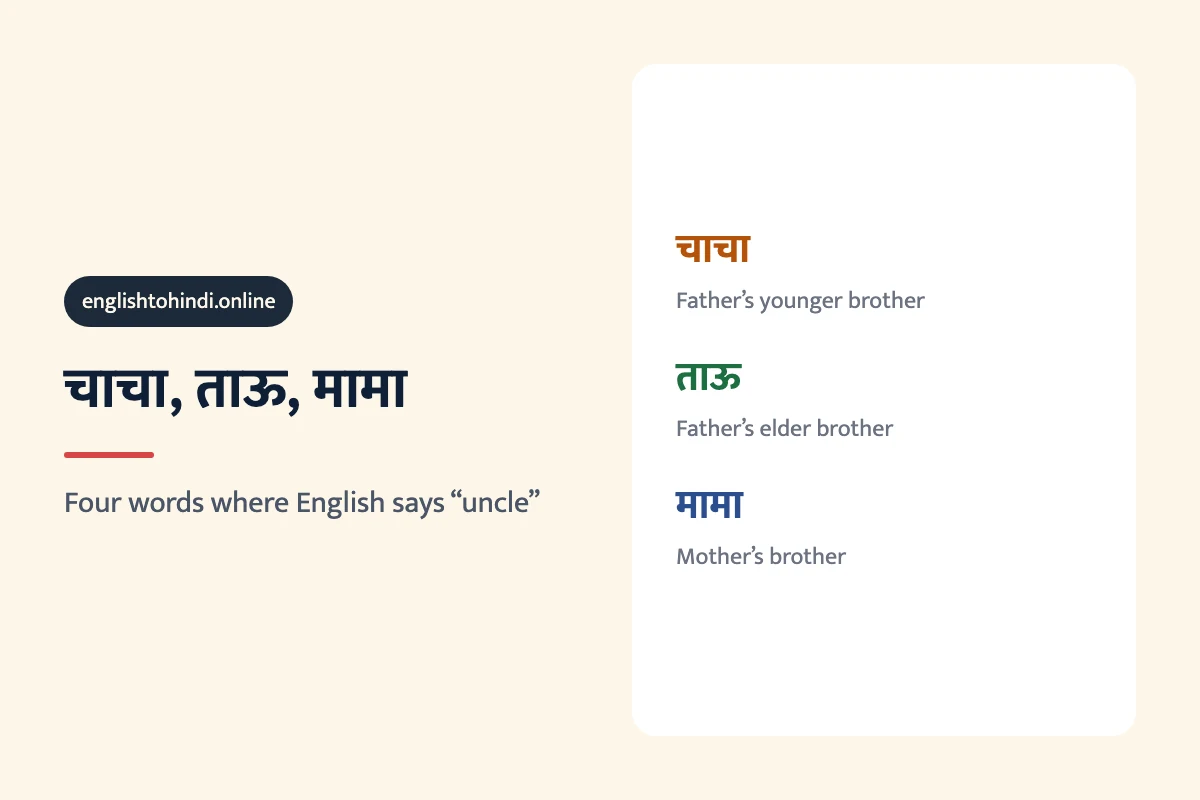
Hindi has separate words for relatives English lumps together. Your father's younger brother is चाचा, your father's elder brother is ताऊ, your mother's brother is मामा, and your father's sister's husband is फूफा — four words where English says 'uncle'. The pattern holds throughout: Hindi encodes which side of the family a relative is on, and often whether they are older or younger than your parent.
This is not decorative. In a joint family these distinctions carry real information about seniority and obligation, and using the wrong word is not a vocabulary slip so much as a claim about the family structure. The family phrases page pairs each relation with the sentence you would actually use it in.
The uncles
| Hindi | Roman | Who |
|---|---|---|
| चाचा | chacha | Father's younger brother |
| ताऊ | taau | Father's elder brother |
| मामा | maama | Mother's brother |
| फूफा | phoopha | Father's sister's husband |
| मौसा | mausa | Mother's sister's husband |
The aunts
| Hindi | Roman | Who |
|---|---|---|
| चाची | chachi | Wife of father's younger brother |
| ताई | taai | Wife of father's elder brother |
| मामी | maami | Wife of mother's brother |
| बुआ | bua | Father's sister |
| मौसी | mausi | Mother's sister |
Notice that बुआ and मौसी are blood relatives while चाची and मामी married in. Hindi marks that difference too — चाची is 'चाचा's wife' by derivation, whereas बुआ is her own word.
Grandparents split by side as well
| Hindi | Who | English |
|---|---|---|
| दादा / दादी | Father's parents | Grandfather / grandmother |
| नाना / नानी | Mother's parents | Grandfather / grandmother |
There is no neutral word for 'grandfather'. You have to know which one, which means a Hindi speaker asking about your grandfather has already told you something an English speaker would have to add a clause to say.
Siblings, and the age that comes with them
| Hindi | Roman | Who |
|---|---|---|
| भाई | bhai | Brother, any age |
| भैया | bhaiya | Elder brother — also how you address him |
| बहन | bahan | Sister, any age |
| दीदी | didi | Elder sister — also how you address her |
| छोटा भाई | chhota bhai | Younger brother, when the age matters |
Elder siblings are usually addressed by title rather than by name — भैया and दीदी, not their first names. Calling an elder brother by his bare name reads as pointedly casual in many families, in much the same way choosing तुम over आप does.
In-laws, where it gets dense
| Hindi | Who |
|---|---|
| सास / ससुर | Mother-in-law / father-in-law |
| जेठ | Husband's elder brother |
| देवर | Husband's younger brother |
| ननद | Husband's sister |
| भाभी | Brother's wife |
| साला / साली | Wife's brother / wife's sister |
साला doubles as a common insult when used outside the family, because calling a man your wife's brother implies something about your relationship to his sister. Learners meet the word in films first and use it in the wrong place at least once.
The words you use on strangers
Family terms extend well past the family. Addressing a stranger by a kinship word is standard, warm, and expected — using no term at all sounds cold.
| Say | To |
|---|---|
| भैया | A man roughly your age — shopkeeper, driver, waiter |
| दीदी | A woman roughly your age |
| अंकल / आंटी | Anyone a generation above, unrelated |
| बेटा | A child, or a much younger adult |
| सर / मैडम | Formal or professional settings |
अंकल and आंटी are English words used as Hindi kinship terms, and they are entirely standard — Indian English and Hindi share them. A shopkeeper calling you भैया is not being familiar; leaving it out would be the marked choice.
Cousin brother is not a mistake
Hindi has no single word for cousin. A paternal uncle's son is चचेरा भाई — literally 'chacha-ish brother' — and in English this comes out as 'cousin brother', which is standard Indian English rather than an error.
| Hindi | Relationship |
|---|---|
| चचेरा भाई | Father's brother's son |
| ममेरा भाई | Mother's brother's son |
| फुफेरा भाई | Father's sister's son |
| मौसेरा भाई | Mother's sister's son |
The same four prefixes apply to बहन for female cousins. Once you know चाचा, मामा, बुआ and मौसी, you can generate every cousin term without learning any of them separately.
Frequently asked questions
How do you say uncle in Hindi?
It depends which uncle. चाचा is your father's younger brother, ताऊ your father's elder brother, मामा your mother's brother, and फूफा your father's sister's husband. For an unrelated older man, अंकल is standard.
What is the difference between दादी and नानी?
दादी is your father's mother and नानी is your mother's mother. Hindi has no general word for 'grandmother' — you have to specify the side, and the same applies to दादा and नाना for grandfathers.
What does भैया mean?
Elder brother. It is also the normal way to address any man of roughly your own age whom you do not know — a shopkeeper, a driver, a waiter. Using it with a stranger is friendly and expected rather than presumptuous.
Why do Indians say 'cousin brother'?
Because Hindi distinguishes them: a father's brother's son is चचेरा भाई and a mother's brother's son is ममेरा भाई, both containing the word for brother. 'Cousin brother' is the natural English rendering and is standard Indian English.
Is it rude to call someone aunty in India?
Generally no — आंटी is the normal term for an unrelated woman a generation older, and omitting a kinship term sounds colder than using one. It can land badly with someone only slightly older than you, where दीदी is the safer choice.
What do you call your elder sister in Hindi?
दीदी. Elder siblings are usually addressed by title rather than by first name, so दीदी and भैया function as names within the family.
More guides
- Hindi plurals: लड़का, लड़के, लड़कों and which to use whenHindi has two plurals for every noun: one for the plain sentence and one for when a postposition follows. लड़के and लड़कों are both “boys”, and using the wrong one is the most common learner error.
- वाला in Hindi: what वाला, वाली and वाले actually meanवाला means “the one that” — the one who sells it, the one wearing it, the thing about to happen. One suffix doing three jobs English needs three constructions for.
- How to say “can” in Hindi: सकना, आना and पानामैं हिंदी बोल सकता हूँ. Ability, permission and “managed to” are three different verbs in Hindi, and picking the wrong one is the usual learner mistake.
Looking for a specific phrase? Browse the phrase guides.