Hindi postpositions: को, ने, से, में and पर explained
The englishtohindi.online editors · · 9 min read
Hindi has no prepositions — the words go after the noun, and the noun changes shape to accommodate them. One of them, ने, rewrites the verb agreement of the entire sentence.
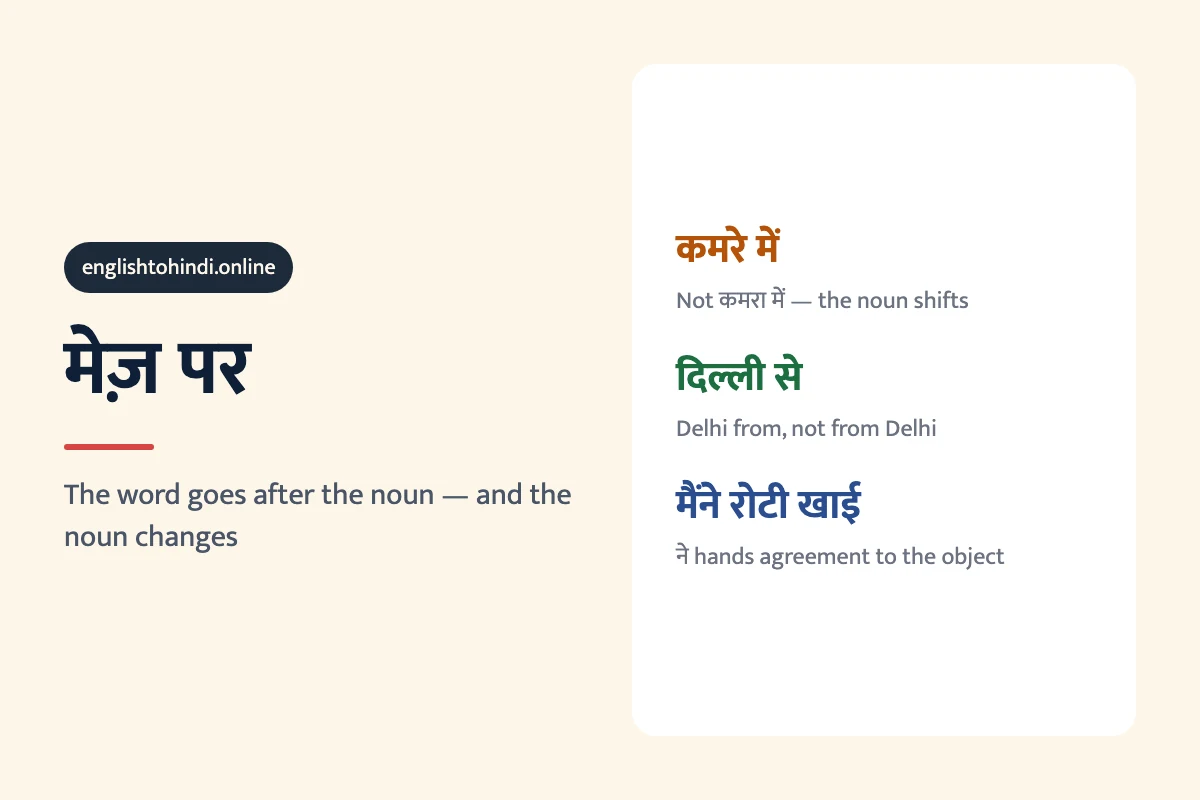
Hindi has no prepositions. It has postpositions, which do the same job but stand after the noun instead of before it: मेज़ पर is “table on”, दिल्ली से is “Delhi from”, घर में is “house in”. The five you need first are को (to), ने (the past-tense subject marker), से (from, with, by), में (in) and पर (on). Two things make them harder than they look — the noun in front of them changes form, and ने changes what the verb agrees with.
Learners usually get the meanings quickly and the two side-effects not at all. कमरा में is the single most common beginner error in written Hindi, and it is not a vocabulary mistake — the postposition is right and the noun is wrong.
The five to learn first
| Postposition | Meaning | Example | Literally |
|---|---|---|---|
| में | in, inside | घर में | house in |
| पर | on, at | मेज़ पर | table on |
| से | from, with, by | दिल्ली से | Delhi from |
| को | to, for | राम को | Ram to |
| ने | marks a past-tense subject | राम ने | Ram (did it) |
Because they follow the noun, a Hindi phrase reads back-to-front against English word by word — and then the verb arrives at the very end, as it always does in Hindi. The verb goes last, always covers that half of the pattern.
किताब मेज़ पर है।
Kitaab mez par hai.
The noun changes shape first
Any noun standing in front of a postposition shifts into what grammars call the oblique case. For most nouns nothing visible happens, but masculine nouns ending in -आ change that ending to -ए, and every plural noun takes -ओं.
| Plain noun | With a postposition | What changed |
|---|---|---|
| कमरा (room) | कमरे में | -आ became -ए |
| लड़का (boy) | लड़के को | -आ became -ए |
| कुर्सी (chair) | कुर्सी पर | Nothing — feminine singular is unchanged |
| घर (house) | घर में | Nothing — no -आ ending |
| लड़के (boys) | लड़कों को | Plural takes -ओं |
| कुर्सियाँ (chairs) | कुर्सियों पर | Plural takes -ओं |
This is why कमरा में is wrong and कमरे में is right. The -आ ending marks a masculine noun standing on its own, and a postposition means it is no longer standing on its own. If the -आ / -ई gender pattern is unfamiliar, every Hindi noun has a gender explains where those endings come from.
Pronouns have their own fused forms
Pronouns do not politely take a postposition on the end — they merge with it. These forms have to be learned as vocabulary, because you cannot build them from मैं and को.
| Pronoun | + को | + से | + ने |
|---|---|---|---|
| मैं (I) | मुझे | मुझसे | मैंने |
| तुम (you, casual) | तुम्हें | तुमसे | तुमने |
| आप (you, formal) | आपको | आपसे | आपने |
| वह (he, she, it) | उसे | उससे | उसने |
| हम (we) | हमें | हमसे | हमने |
| वे (they) | उन्हें | उनसे | उन्होंने |
मुझे is the form doing the work in मुझे भूख लगी है and मुझे पानी चाहिए — the pattern behind Hindi has no verb for “to have”.
ने, and why it rewrites the verb
ने is the one postposition with no English counterpart at all. It marks the subject of a transitive verb in the past tense — and once it appears, the verb stops agreeing with the subject and agrees with the object instead.
मैंने आम खाया। मैंने रोटी खाई।
Maine aam khaaya. Maine roti khaayi.
Both sentences have the same speaker. खाया becomes खाई purely because रोटी is feminine and आम is masculine. Nothing about the speaker's gender enters the sentence, which is the opposite of what happens in the present tense — see Hindi verbs change with gender.
| Hindi | English | Verb agrees with |
|---|---|---|
| मैंने आम खाया | I ate a mango | आम — masculine singular |
| मैंने रोटी खाई | I ate a roti | रोटी — feminine singular |
| मैंने आम खाए | I ate mangoes | आम — masculine plural |
| मैंने राम को देखा | I saw Ram | Nothing — को blocks it, so खाया-type default |
That last row is the escape hatch. When the object itself carries को, the verb cannot agree with anything, so it falls back to the default masculine singular form. मैंने लड़कियों को देखा keeps देखा even though लड़कियों is feminine plural.
ने appears only with transitive verbs — ones that take an object. Intransitive verbs never take it: मैं गया (I went), not मैंने गया. The pair to memorise is मैं गया against मैंने खाया, same speaker, same tense, different marking.
से does three unrelated jobs
| Job | Example | English |
|---|---|---|
| Source | मैं दिल्ली से आया हूँ | I have come from Delhi |
| Instrument | मैंने चाकू से काटा | I cut it with a knife |
| With a person | मैं राम से मिला | I met Ram |
| Comparison | यह उससे बड़ा है | This is bigger than that |
The third row catches English speakers, because “meet with” and “talk with” use से where English feels like it wants को. मैं राम से बात करूँगा is “I will talk to Ram”; राम को बात करूँगा is not a sentence.
का is a postposition too, and it agrees
का marks possession, and unlike the others it changes form to match the thing possessed rather than staying fixed.
| Hindi | English | Why this form |
|---|---|---|
| राम का घर | Ram's house | घर is masculine singular |
| राम की किताब | Ram's book | किताब is feminine |
| राम के बच्चे | Ram's children | बच्चे is masculine plural |
The के form is also the base for the compound postpositions, which are two words long and extremely common: के लिए (for), के साथ (with), के बाद (after), के पास (near), के बारे में (about). With a pronoun the first half becomes possessive — मेरे लिए, not मुझे लिए.
Why translation tools get this wrong
Postpositions are where machine output stops being subtly odd and starts being ungrammatical, because the errors are structural rather than lexical.
| English | Correct Hindi | Common machine output |
|---|---|---|
| In the room | कमरे में | कमरा में |
| I ate a roti | मैंने रोटी खाई | मैंने रोटी खाया |
| I met Ram | मैं राम से मिला | मैं राम को मिला |
| I saw the girls | मैंने लड़कियों को देखा | मैंने लड़कियों को देखी |
Every one of those is a single-letter difference, and every one of them is the kind of thing a reader notices immediately — the same failure mode described in why translation tools fail at Hinglish.
The short version
- The postposition goes after the noun: मेज़ पर, not पर मेज़.
- A masculine -आ noun becomes -ए in front of one: कमरा में is wrong, कमरे में is right.
- Every plural noun takes -ओं in front of one: लड़कों को, कुर्सियों पर.
- Pronouns fuse instead: मुझे, तुम्हें, उसे, हमें, उन्हें, and मैंने.
- ने marks a transitive past subject and hands verb agreement to the object.
- If the object carries को, the verb agrees with nothing and stays in its default form.
- से means from, with, by and than — four English words, one Hindi postposition.
Frequently asked questions
What is a postposition in Hindi?
A postposition is a word like में (in), पर (on), से (from) or को (to) that does the job of an English preposition but stands after the noun instead of before it. मेज़ पर means “on the table” and reads literally as “table on”. Hindi has postpositions and no prepositions.
Why is कमरा में wrong in Hindi?
Because a noun in front of a postposition takes the oblique case, and a masculine noun ending in -आ changes that ending to -ए. The correct form is कमरे में. The postposition में is right in both versions — only the noun is wrong.
What does ने do in a Hindi sentence?
ने marks the subject of a transitive verb in the past tense, and it makes the verb agree with the object rather than the subject. मैंने आम खाया and मैंने रोटी खाई have the same speaker; the verb ending changes because आम is masculine and रोटी is feminine. ने is never used with intransitive verbs, so “I went” is मैं गया, not मैंने गया.
What is the oblique case in Hindi?
The oblique case is the form a noun takes when a postposition follows it. Masculine nouns ending in -आ change to -ए (कमरा becomes कमरे में), all plural nouns take -ओं (लड़के becomes लड़कों को), and other nouns are unchanged (घर में, कुर्सी पर).
When do you use को and when do you use से in Hindi?
को marks a recipient or a specific object — राम को किताब दी, “gave the book to Ram”. से marks a source, an instrument, a comparison, or the person you interact with — दिल्ली से (from Delhi), चाकू से (with a knife), राम से मिला (met Ram). “Meet” and “talk” take से in Hindi even though English uses “to”.
Do Hindi pronouns take को and से directly?
No, they fuse into single words that have to be learned separately. मैं plus को is मुझे, मैं plus से is मुझसे, and मैं plus ने is मैंने. The same happens with तुम्हें, आपको, उसे, हमें and उन्हें.
More guides
- Hindi plurals: लड़का, लड़के, लड़कों and which to use whenHindi has two plurals for every noun: one for the plain sentence and one for when a postposition follows. लड़के and लड़कों are both “boys”, and using the wrong one is the most common learner error.
- वाला in Hindi: what वाला, वाली and वाले actually meanवाला means “the one that” — the one who sells it, the one wearing it, the thing about to happen. One suffix doing three jobs English needs three constructions for.
- How to say “can” in Hindi: सकना, आना and पानामैं हिंदी बोल सकता हूँ. Ability, permission and “managed to” are three different verbs in Hindi, and picking the wrong one is the usual learner mistake.
Looking for a specific phrase? Browse the phrase guides.