जो in Hindi: how to say “the one who” and “which”
The englishtohindi.online editors · · 7 min read
Hindi builds relative clauses with a pair — जो in the first half, वह in the second. Once you see the pattern, long Hindi sentences stop being unreadable.
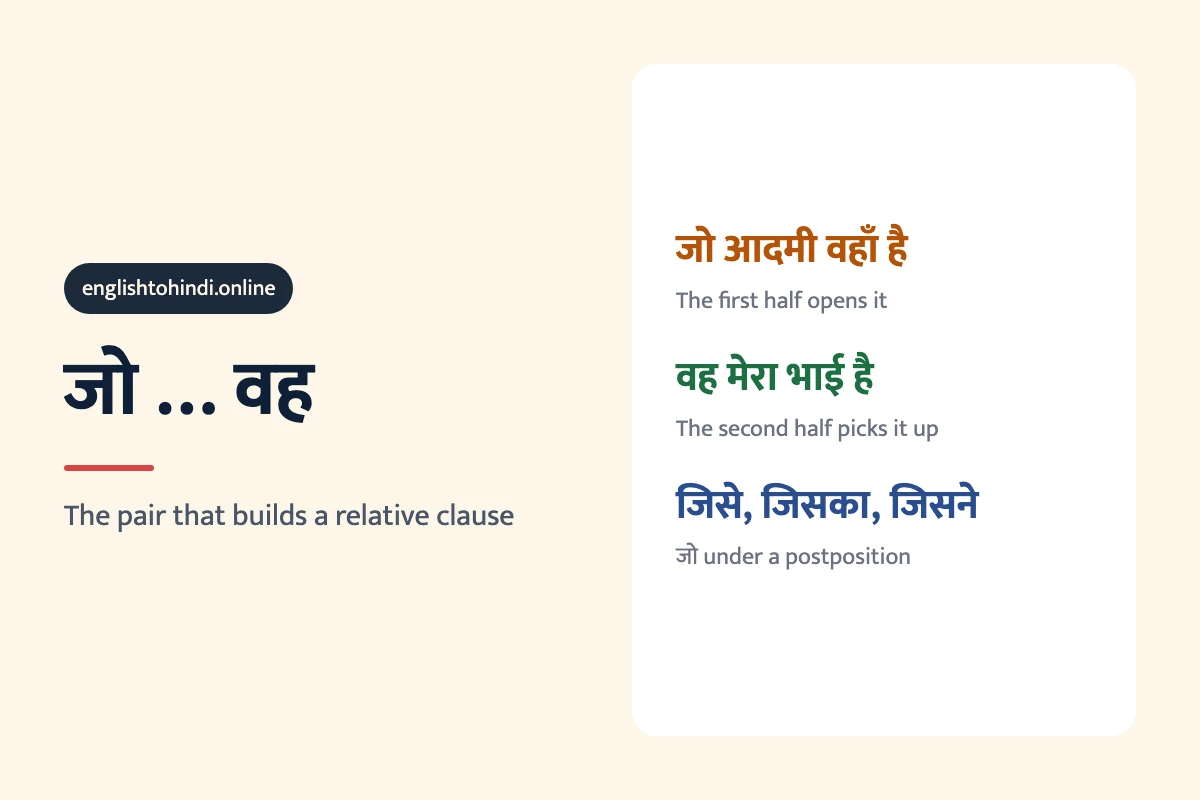
जो (jo) means “who”, “which” or “that” when you are joining two pieces of a sentence together. Hindi uses it in a pair: जो opens the description and वह picks it up afterwards. जो आदमी वहाँ खड़ा है, वह मेरा भाई है means “the man who is standing there is my brother” — literally “which man is standing there, that one is my brother”.
English hides the second half. Hindi says it out loud, and that single difference is why long Hindi sentences look impenetrable to learners until the pattern clicks.
जो also changes shape when a postposition follows it, giving जिसे, जिसका, जिसने and जिनको. That is the other half of the work.
The pair: जो … वह
Hindi relative clauses are correlative, which means both halves are marked. The first clause starts with जो, the second starts with वह (or वे for plurals). Neither half can be dropped in careful speech.
| Hindi | Roman | English |
|---|---|---|
| जो लड़की गा रही है, वह मेरी बहन है | Jo ladki gaa rahi hai, wah meri behen hai | The girl who is singing is my sister |
| जो किताब मेज़ पर है, वह मेरी है | Jo kitaab mez par hai, wah meri hai | The book that is on the table is mine |
| जो लोग देर से आए, वे बाहर बैठे | Jo log der se aaye, we baahar baithe | The people who came late sat outside |
The order is flexible. वह लड़की मेरी बहन है, जो गा रही है is also correct and sounds closer to English. Starting with जो is the more common and more natural Hindi rhythm, and it fits the general subject-object-verb shape described in Hindi word order.
The comma is doing real work here. जो … वह sentences are read as two beats, and native speakers pause where the comma sits. Reading them aloud with that pause is the fastest way to stop losing track of which half you are in.
जो changes shape: जिसे, जिसका, जिसने
As soon as a postposition attaches to जो, it goes oblique and becomes जिस in the singular and जिन in the plural — usually fusing into a single word. This is the same fusion that produces मुझे and उसे, covered in Hindi postpositions.
| Form | Meaning | Example |
|---|---|---|
| जो | who, which (subject) | जो आया, वह चला गया — the one who came has left |
| जिसे / जिसको | whom, to whom | जिसे मैंने बुलाया, वह नहीं आया |
| जिसका | whose | जिसका फ़ोन खोया, वह लड़का — the boy whose phone was lost |
| जिसने | who (transitive past) | जिसने यह किया, वह कौन है? |
| जिससे | with whom, from which | जिससे मैं मिला, वह डॉक्टर है |
| जिन / जिनको | plural forms | जिन लोगों को बुलाया था, वे आ गए |
जिसने is the one learners forget. If the verb in the जो clause is transitive and in the perfective past, ने is required — जिसने यह किया, not जो यह किया. It is the same ने rule that governs मैंने खाया.
जो without a noun: whatever, whoever
Used on its own, जो means “what” in the sense of “whatever” or “the thing which”. This is extremely common in everyday speech and much shorter than the English equivalent.
- जो चाहिए, ले लो — take whatever you need.
- जो हुआ, सो हुआ — what happened, happened.
- जो भी हो — whatever it may be.
- मुझे जो पसंद है, वह यह है — what I like is this one.
जो हुआ, सो हुआ। अब आगे की सोचो।
Jo hua, so hua. Ab aage ki socho.
जो or वाला? Both build descriptions
This is the choice that actually comes up. Both वाला and जो attach a description to a noun, and they are not interchangeable in register.
| Description | With वाला | With जो |
|---|---|---|
| The man with the glasses | चश्मे वाला आदमी | जो आदमी चश्मा पहनता है, वह |
| The room upstairs | ऊपर वाला कमरा | जो कमरा ऊपर है, वह |
| The one I bought yesterday | कल वाला | जो मैंने कल खरीदा, वह |
The rule of thumb: वाला for short descriptions, especially ones you could point at in a shop; जो for anything with its own verb, or anything long enough to need a clause. वाला is faster and far more common in speech. जो is what writing and careful explanation use.
Three mistakes to avoid
- Dropping वह. जो आदमी वहाँ खड़ा है, मेरा भाई है sounds unfinished — the second half needs its वह.
- Leaving जो in its direct form under a postposition. It is जिसको and जिसका, never जो को or जो का.
- Forgetting ने in the past. जिसने यह किया, not जो यह किया, whenever the verb is transitive and perfective.
The short version
- जो opens the description; वह or वे pick it up in the second half.
- Both halves are said out loud in Hindi, unlike English.
- Under a postposition जो becomes जिस, giving जिसे, जिसका, जिसने and जिससे.
- Plural oblique is जिन: जिन लोगों को.
- On its own जो means “whatever”: जो चाहिए, ले लो.
Frequently asked questions
What does जो mean in Hindi?
जो means “who”, “which” or “that” when joining two parts of a sentence. Hindi uses it as a pair with वह — जो आदमी वहाँ खड़ा है, वह मेरा भाई है means “the man who is standing there is my brother”. Used on its own, जो means “whatever”, as in जो चाहिए, ले लो, “take whatever you need”.
Why does a Hindi relative clause need both जो and वह?
Hindi relative clauses are correlative, meaning both halves carry a marker. जो opens the description and वह refers back to it in the main clause. English marks only the first half, which is why dropping वह feels acceptable to learners but sounds unfinished to a Hindi speaker.
What is the difference between जो and जिसे?
जिसे is जो with the postposition को attached, so it means “whom” or “to whom”. जो is used when the relative word is the subject — जो आया, वह चला गया. जिसे is used when it is the object — जिसे मैंने बुलाया, वह नहीं आया, “the one whom I invited did not come”.
When do you use जिसने instead of जो?
Use जिसने when the verb in the जो clause is transitive and in the perfective past, because that tense requires the ने marker. जिसने यह किया, वह कौन है? means “who is the one who did this?”. जो यह किया is incorrect there, for the same reason मैं यह किया is incorrect.
Should I use जो or वाला to describe something?
Use वाला for short descriptions you could almost point at — चश्मे वाला आदमी, ऊपर वाला कमरा. Use जो when the description contains its own verb or is long enough to need a full clause — जो आदमी चश्मा पहनता है, वह. वाला dominates in speech; जो is more common in writing.
What is the plural of जिस?
जिन. जिस is the singular oblique form and जिन is the plural, so “the people whom I invited” is जिन लोगों को मैंने बुलाया. The noun after जिन also takes its plural oblique form, which is why it is लोगों rather than लोग.
More guides
- Hindi plurals: लड़का, लड़के, लड़कों and which to use whenHindi has two plurals for every noun: one for the plain sentence and one for when a postposition follows. लड़के and लड़कों are both “boys”, and using the wrong one is the most common learner error.
- वाला in Hindi: what वाला, वाली and वाले actually meanवाला means “the one that” — the one who sells it, the one wearing it, the thing about to happen. One suffix doing three jobs English needs three constructions for.
- How to say “can” in Hindi: सकना, आना and पानामैं हिंदी बोल सकता हूँ. Ability, permission and “managed to” are three different verbs in Hindi, and picking the wrong one is the usual learner mistake.
Looking for a specific phrase? Browse the phrase guides.