Colours in Hindi: लाल, नीला and the ones that change form
The englishtohindi.online editors · · 6 min read
Half of Hindi's colour words change with gender and half do not — and the ones that change are the ones named after a fruit or a flower.
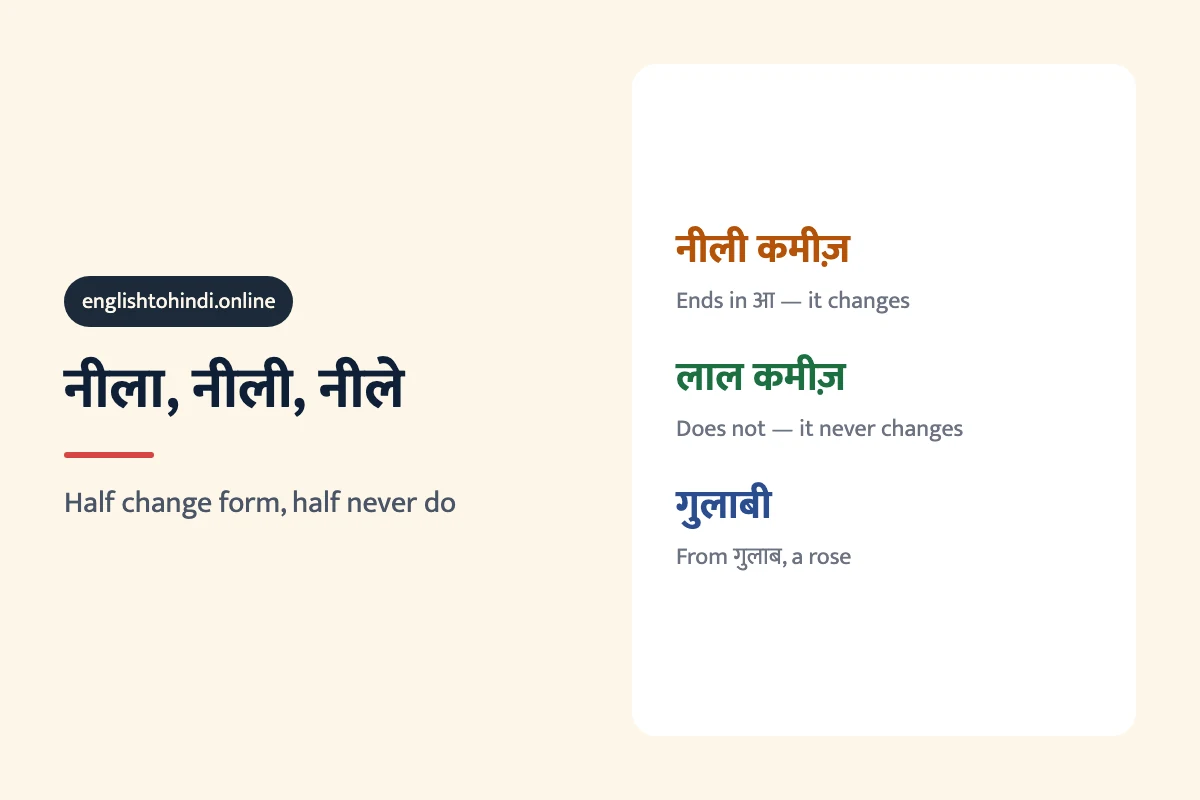
The Hindi word for colour is रंग (rang). The everyday colours are लाल (red), नीला (blue), हरा (green), पीला (yellow), काला (black), सफ़ेद (white), नारंगी (orange), गुलाबी (pink), भूरा (brown) and बैंगनी (purple). The ones ending in आ change form with the noun they describe — नीला, नीली, नीले — and the rest never change at all.
That split is the whole grammar of Hindi colours, and it is decided by the last letter of the word rather than by anything about the colour itself.
The colour words
| Hindi | Roman | English | Changes form? |
|---|---|---|---|
| लाल | laal | red | No |
| नीला | neela | blue | Yes |
| हरा | hara | green | Yes |
| पीला | peela | yellow | Yes |
| काला | kaala | black | Yes |
| सफ़ेद | safed | white | No |
| नारंगी | naarangi | orange | No |
| गुलाबी | gulaabi | pink | No |
| भूरा | bhoora | brown | Yes |
| बैंगनी | baingani | purple | No |
| सलेटी | saleti | grey | No |
| सुनहरा | sunahra | golden | Yes |
Which ones change, and how
A colour ending in आ behaves like any other Hindi adjective: आ for masculine singular, ई for feminine, ए for masculine plural. Which one you need depends on the noun, so Hindi noun gender decides it.
| Hindi | Roman | English |
|---|---|---|
| नीला घर | Neela ghar | Blue house (घर is masculine) |
| नीली कमीज़ | Neeli kameez | Blue shirt (कमीज़ is feminine) |
| नीले जूते | Neele joote | Blue shoes (masculine plural) |
| लाल घर, लाल कमीज़, लाल जूते | Laal ghar, laal kameez, laal joote | Red — one form for all three |
लाल, सफ़ेद, गुलाबी, नारंगी, बैंगनी and सलेटी are invariable, which makes them the easiest adjectives in the language. If a colour word does not end in आ, you can stop thinking about gender entirely.
Most colour names are borrowed from objects
Several Hindi colours are simply the name of a thing with an ending attached, which makes them far easier to remember than they look.
- गुलाबी (pink) comes from गुलाब, a rose.
- नारंगी (orange) comes from नारंगी, the orange fruit — the English word travelled the same route.
- बैंगनी (purple) comes from बैंगन, the aubergine.
- सुनहरा (golden) comes from सोना, gold.
- सलेटी (grey) comes from स्लेट, a writing slate.
Notice that four of the five end in ई and are therefore invariable. The object-derived colours are the ones you never have to inflect.
Light, dark and bright
हल्का means light and गहरा means dark. Both end in आ, so both change form — and they change alongside the colour, giving two agreeing words in a row.
- हल्का नीला — light blue.
- गहरा हरा — dark green.
- हल्की गुलाबी साड़ी — a light pink sari (हल्की is feminine because साड़ी is).
- चमकीला — bright, shiny.
Asking about colour
The standard question is यह किस रंग का है? — “what colour is this?”. किस is कौन in its oblique form, which is why it is किस रंग and not कौन रंग; the shift is explained in Hindi question words.
यह किस रंग का है? — यह गहरे नीले रंग का है।
Yah kis rang ka hai? — Yah gahre neele rang ka hai.
मेरा पसंदीदा रंग नीला है means “my favourite colour is blue”, and it is one of the first full sentences worth memorising because it comes up in every introduction.
Colours in a shop: the वाला trick
In practice, the most useful thing you can do with a colour word is point at one of two objects with it. Hindi does that by adding वाला, which turns the colour into “the one that is”.
- नीली वाली दे दीजिए — give me the blue one (feminine object).
- लाल वाला कितने का है? — how much is the red one?
- काले वाले जूते दिखाइए — show me the black shoes.
The short version
- रंग means colour.
- Colours ending in आ change form: नीला, नीली, नीले. Everything else is invariable.
- लाल, सफ़ेद, गुलाबी, नारंगी and बैंगनी never change.
- हल्का is light and गहरा is dark, and both agree with the noun as well.
- यह किस रंग का है? asks what colour something is.
- नीली वाली दे दीजिए is how you actually buy the blue one.
Frequently asked questions
What is the Hindi word for colour?
रंग (rang). यह किस रंग का है? means “what colour is this?”, and मेरा पसंदीदा रंग नीला है means “my favourite colour is blue”. The word is masculine, so it takes masculine agreement — गहरे रंग का, not गहरी रंग की.
Do colours change form in Hindi?
Only the ones ending in आ. नीला becomes नीली for a feminine noun and नीले for a masculine plural, and the same applies to हरा, पीला, काला, भूरा and सुनहरा. Colours that do not end in आ — लाल, सफ़ेद, गुलाबी, नारंगी, बैंगनी, सलेटी — never change at all.
How do you say the main colours in Hindi?
Red is लाल, blue is नीला, green is हरा, yellow is पीला, black is काला, white is सफ़ेद, orange is नारंगी, pink is गुलाबी, brown is भूरा, purple is बैंगनी and grey is सलेटी.
Why is pink गुलाबी in Hindi?
Because it is named after गुलाब, the rose. Several Hindi colours work this way — नारंगी comes from the orange fruit, बैंगनी from बैंगन the aubergine, सुनहरा from सोना meaning gold, and सलेटी from स्लेट, a writing slate. Most of these end in ई, which conveniently means they never change form.
How do you say light blue and dark blue in Hindi?
हल्का नीला is light blue and गहरा नीला is dark blue. Both हल्का and गहरा end in आ, so they agree with the noun too — हल्की गुलाबी साड़ी uses हल्की because साड़ी is feminine.
How do you ask for a particular colour in a shop?
Add वाला to the colour. नीली वाली दे दीजिए means “give me the blue one”, and लाल वाला कितने का है? means “how much is the red one?”. वाला means “the one that”, and it agrees with the gender of the object being pointed at.
More guides
- Hindi plurals: लड़का, लड़के, लड़कों and which to use whenHindi has two plurals for every noun: one for the plain sentence and one for when a postposition follows. लड़के and लड़कों are both “boys”, and using the wrong one is the most common learner error.
- वाला in Hindi: what वाला, वाली and वाले actually meanवाला means “the one that” — the one who sells it, the one wearing it, the thing about to happen. One suffix doing three jobs English needs three constructions for.
- How to say “can” in Hindi: सकना, आना and पानामैं हिंदी बोल सकता हूँ. Ability, permission and “managed to” are three different verbs in Hindi, and picking the wrong one is the usual learner mistake.
Looking for a specific phrase? Browse the phrase guides.