Seven Hindi mistakes English speakers keep making
The englishtohindi.online editors · · 7 min read
Word order, the missing verb 'to have', and why मैं भूखा हूँ sounds strange to a native ear. The errors that survive long after basic vocabulary is solid.
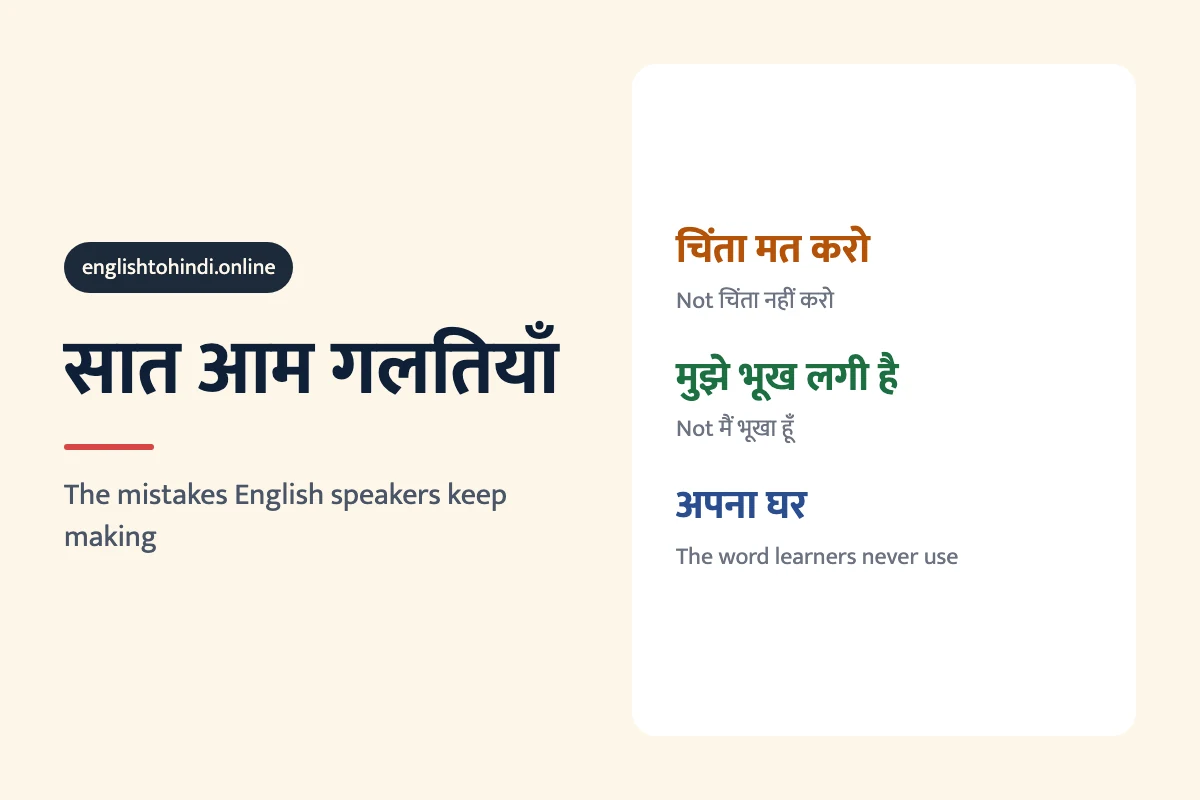
The mistakes English speakers make most often in Hindi are: putting the verb before the object instead of last, using मैं भूखा हूँ instead of मुझे भूख लगी है, translating “have” with के पास where a possessive belongs, negating a command with नहीं instead of मत, mixing आप and तुम in one sentence, ignoring the speaker's gender on the verb, and never using अपना for “my own”.
These are not beginner errors. They are the ones that persist after somebody has learned several hundred words, because each of them comes from an English structure that has no Hindi equivalent.
1. Putting the verb in the middle
English is subject-verb-object. Hindi is subject-object-verb. The verb goes at the end, always.
मैं खाना खाता हूँ
Main khaana khaata hoon
2. Using मेरा when it should be अपना
When the owner of something is also the subject of the sentence, Hindi uses the reflexive अपना instead of मेरा, तुम्हारा, or उसका. English has no equivalent, so learners skip it entirely.
मैं अपने घर जा रहा हूँ
Main apne ghar ja raha hoon
3. Translating 'to have' directly
Hindi has no verb meaning 'to have'. Possession is expressed with के पास (near) for objects, and with का for relationships and body parts.
| English | Hindi | Literally |
|---|---|---|
| I have a car | मेरे पास एक गाड़ी है | Near me a car is |
| I have two sisters | मेरी दो बहनें हैं | My two sisters are |
| I have a headache | मेरे सिर में दर्द है | In my head pain is |
4. Saying मैं भूखा हूँ for 'I am hungry'
It is grammatically correct and it sounds odd. Hindi treats hunger, thirst, cold, and fear as things that happen to you rather than states you are in.
मुझे भूख लगी है
Mujhe bhookh lagi hai
The same construction covers मुझे प्यास लगी है (thirsty), मुझे ठंड लग रही है (cold), and मुझे डर लग रहा है (afraid).
5. Using नहीं for negative commands
Statements take नहीं. Commands take मत. Mixing them is one of the most audible errors.
| Meaning | Correct | Wrong |
|---|---|---|
| I don't go | मैं नहीं जाता | — |
| Don't go! | मत जाओ | नहीं जाओ |
| Don't worry | चिंता मत करो | चिंता नहीं करो |
6. Ignoring noun gender
Every Hindi noun is masculine or feminine, and the adjectives and verbs around it change to match. There is no reliable rule — गाड़ी (car) is feminine, मकान (house) is masculine, and both have to be memorised with the word.
मेरी गाड़ी नई है। मेरा मकान बड़ा है।
Meri gaadi nayi hai. Mera makaan bada hai.
7. Being too polite
English scatters 'please' through every request. Hindi carries politeness in the verb ending, so adding कृपया to each sentence sounds like a public announcement rather than conversation.
| Register | Hindi | When |
|---|---|---|
| Polite | बैठिए | The normal polite way to say 'please sit' |
| Neutral | बैठो | To a friend or child |
| Formal written | कृपया बैठिए | Signage, announcements |
If you fix only one thing from this list, make it अपना. It appears constantly, English speakers almost never use it, and getting it right immediately makes a sentence sound native. If you fix two, make the second one word order — it is the error that survives the longest.
Frequently asked questions
What is the most common mistake English speakers make in Hindi?
Word order. English puts the verb before the object and Hindi puts it last, so “I eat an apple” becomes मैं सेब खाता हूँ, literally “I apple eat”. Building sentences in English order is the error that survives longest.
Why is मैं भूखा हूँ wrong?
It is not ungrammatical, but it describes you as a hungry sort of person rather than saying you want food now. Hindi treats hunger as something that happens to you: मुझे भूख लगी है, literally “hunger has attached to me”.
When do you use मत instead of नहीं?
मत negates commands and नहीं negates statements. चिंता मत करो is “don't worry”; चिंता नहीं करो is a common learner error. For a statement, नहीं sits immediately before the verb: मैं नहीं जाता.
What does अपना mean and why is it important?
अपना means “one's own” and refers back to the subject of the sentence. मैं अपना काम कर रहा हूँ is “I am doing my own work”. Using मेरा there is understood but sounds foreign, because Hindi expects अपना whenever the possessor is also the subject.
Do I need to say कृपया for please?
Usually not. Hindi carries politeness in the verb ending, so बैठिए already means “please sit”. Adding कृपया to every sentence sounds like a public announcement rather than conversation; save it for signage and formal writing.
More guides
- Hindi plurals: लड़का, लड़के, लड़कों and which to use whenHindi has two plurals for every noun: one for the plain sentence and one for when a postposition follows. लड़के and लड़कों are both “boys”, and using the wrong one is the most common learner error.
- वाला in Hindi: what वाला, वाली and वाले actually meanवाला means “the one that” — the one who sells it, the one wearing it, the thing about to happen. One suffix doing three jobs English needs three constructions for.
- How to say “can” in Hindi: सकना, आना and पानामैं हिंदी बोल सकता हूँ. Ability, permission and “managed to” are three different verbs in Hindi, and picking the wrong one is the usual learner mistake.
Looking for a specific phrase? Browse the phrase guides.