The Devanagari alphabet: how the Hindi script actually works
The englishtohindi.online editors · · 8 min read
Devanagari is not an alphabet in the English sense — every consonant already contains a vowel. Once that clicks, the 46 letters take a few days, not months.
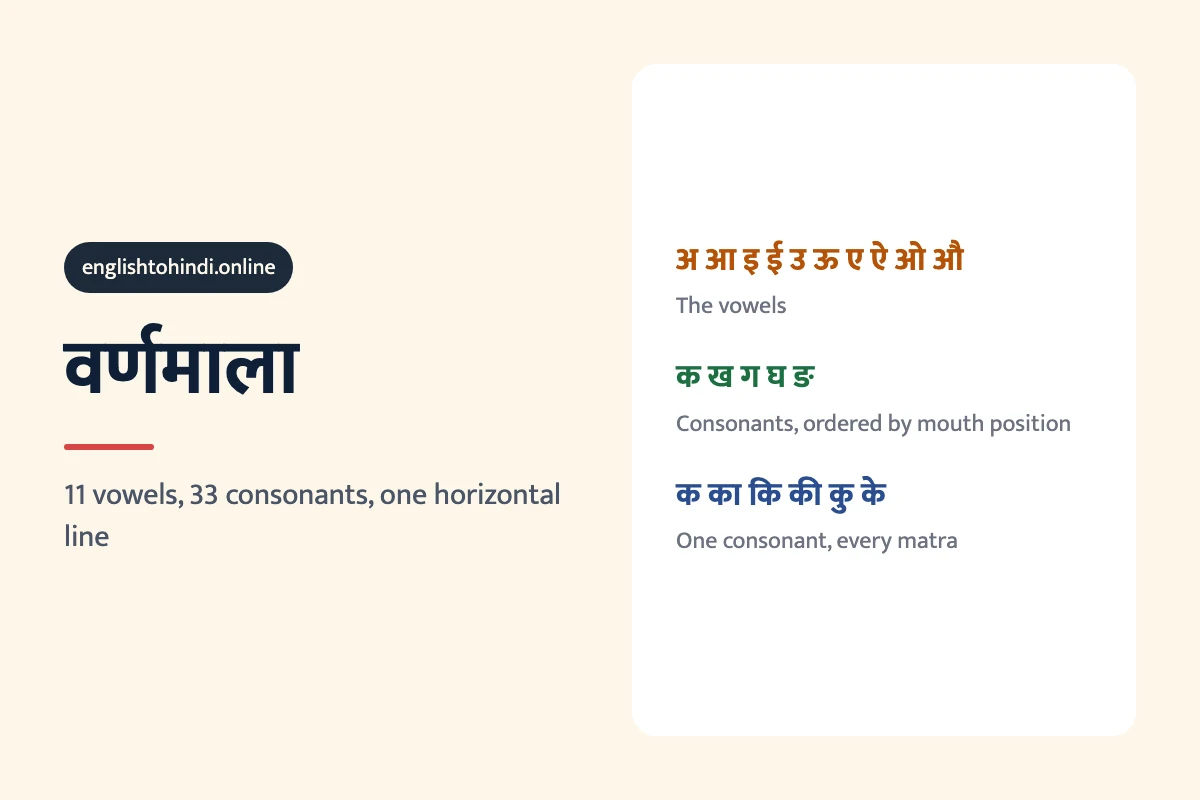
The Hindi alphabet, called वर्णमाला (varnamala), has 11 vowels and 33 consonants — 44 core letters, or 46 once the two extra signs are counted. It is written left to right, joined along a horizontal line across the top called the शिरोरेखा (shirorekha). Every consonant carries a built-in 'a' sound, and vowels attach to consonants as marks called मात्रा (matra) rather than as separate letters.
That last point is the one that decides whether the script feels hard. English speakers approach Devanagari expecting an alphabet, where letters sit side by side in a row. It is not one. It is an abugida, and the difference is worth five minutes of your attention because everything else follows from it.
Every consonant already has a vowel in it
The letter क is not 'k'. It is 'ka'. There is no separate vowel written, and none is needed — the 'a' is assumed. This is why Hindi words look shorter written than they sound.
कमल
kamal
To get any other vowel, you modify the consonant with a matra. To remove the vowel entirely — for a consonant at the end of a cluster — you add a small stroke underneath called a हलंत (halant): क् is a bare 'k'.
The vowels and their matra forms
| Vowel | Sound | As a matra on क |
|---|---|---|
| अ | a (as in 'about') | क — already there |
| आ | aa (long) | का |
| इ | i (short) | कि |
| ई | ee (long) | की |
| उ | u (short) | कु |
| ऊ | oo (long) | कू |
| ऋ | ri | कृ |
| ए | e (as in 'they') | के |
| ऐ | ai | कै |
| ओ | o | को |
| औ | au | कौ |
Notice कि and की. The short-i matra is written before the consonant but pronounced after it — the only mark in the script that sits to the left of the letter it belongs to. It trips up every beginner exactly once.
The consonants are arranged by mouth position
This is the part English never gives you. Devanagari's 25 core consonants form a grid: five rows of five, ordered by where in the mouth the sound is made and whether it is aspirated or voiced. The order is not arbitrary the way A-B-C is — it is a phonetic map.
| Row | Letters | Made where |
|---|---|---|
| Velar | क ख ग घ ङ | Back of the throat |
| Palatal | च छ ज झ ञ | Roof of the mouth |
| Retroflex | ट ठ ड ढ ण | Tongue curled back |
| Dental | त थ द ध न | Tongue on the teeth |
| Labial | प फ ब भ म | Lips |
Eight more follow the grid: य र ल व श ष स ह. Within each row, the second letter is the aspirated version of the first — क is 'k', ख is 'k' with a puff of air. English does not treat that difference as meaningful, which is why कल (tomorrow) and खल (a villain) sound identical to an untrained ear and completely different to a Hindi speaker.
The retroflex row is the hard one
ट ठ ड ढ ण have no English equivalent. The tongue curls back to touch the roof of the mouth, well behind where an English 'd' or 't' lands. Meanwhile त थ द ध are made with the tongue against the teeth, further forward than English.
English 'd' sits between the two, which is why Indian speakers hear an English 'd' as neither and why a learner who uses the English sound is understood but immediately marked as foreign. The distinction changes meaning: दाल (lentils) and डाल (branch) differ only in that one letter.
Conjuncts: two consonants with no vowel between
When consonants meet with no vowel between them, they fuse into a single joined shape. Most are recognisable once you know the parts, but a few have to be learned outright.
| Conjunct | Built from | Appears in |
|---|---|---|
| क्ष | क् + ष | क्षमा (forgiveness) |
| त्र | त् + र | त्रिशूल (trident) |
| ज्ञ | ज् + ञ | ज्ञान (knowledge), said 'gyaan' |
| श्र | श् + र | श्री (Shri) |
ज्ञ is worth memorising as a unit. Its parts say 'j' and 'ny', but in modern Hindi it is pronounced 'gy' — ज्ञान is 'gyaan', not 'jnyaan'. Deriving it from the components gives the wrong answer.
The dots that change everything
| Sign | Name | What it does |
|---|---|---|
| ं | anusvar | Nasalises the syllable — हिंदी |
| ँ | chandrabindu | Lighter nasal — हाँ (yes) |
| ः | visarg | A breath after the vowel — rare, mostly in Sanskrit loans |
| ़ | nukta | Marks a borrowed sound — ज़ (z), फ़ (f), ड़ (hard r) |
The nukta matters more than its size suggests. Hindi has no native 'z' or 'f', so words borrowed from Persian, Arabic and English use a dotted letter: ज़रूरी (zaroori, necessary) is not जरूरी. In casual typing people drop the dot constantly, so you will see both.
How long this actually takes
- Day one: the 11 vowels and their matra forms. This is the highest-value hour you will spend.
- Days two to four: the five-by-five consonant grid, one row at a time. The phonetic ordering makes it stick.
- Day five: the remaining eight consonants, plus anusvar and nukta.
- After that: conjuncts, learned as you meet them in real words rather than from a list.
- Read signage. Station names, shop boards and film titles are short, high-contrast, and you already know what they say.
Reading comes well before writing. Most learners can sound out a shop sign within a week and still write like a child for months, and that is the correct order — you need to recognise letters far more often than you need to draw them. Turning on a Devanagari keyboard removes the writing problem almost entirely.
Hindi is close to phonetic: with a handful of exceptions, a word is pronounced exactly as it is spelled. Compare English 'through', 'though' and 'tough'. The week you spend on the script buys you a lifetime of never guessing at a pronunciation again.
Frequently asked questions
How many letters are in the Hindi alphabet?
The Hindi varnamala has 11 vowels and 33 consonants, which is 44 core letters. Counting the two additional signs ं and ः gives the figure of 46 that most textbooks use. Conjunct forms like क्ष and ज्ञ are combinations, not separate letters, though many school charts list them.
Is Devanagari an alphabet?
No, it is an abugida. In an alphabet, vowels and consonants are separate letters written in sequence. In Devanagari every consonant carries a built-in 'a' sound, and other vowels are written as marks (matra) attached to the consonant rather than as standalone letters.
What is a matra in Hindi?
A matra is the mark that changes a consonant's built-in vowel. क is 'ka'; adding the aa-matra gives का 'kaa', adding the ee-matra gives की 'kee'. There are ten matra forms, one for each vowel other than अ, which needs no mark because it is already present.
What is the line on top of Hindi letters called?
The शिरोरेखा (shirorekha), literally 'head line'. It runs across the top of the letters and joins the words together. In handwriting it is usually drawn last, after the letters beneath it are complete.
How long does it take to learn the Hindi script?
Most learners can read simple words within one to two weeks of daily practice, because Hindi is close to phonetically regular — a word is pronounced as it is spelled. Fluent reading speed takes a few months. Writing by hand takes longer and is rarely the priority, since a phone keyboard handles it.
Why do some Hindi letters have a dot underneath?
That dot is the nukta, and it marks a sound Hindi borrowed from Persian, Arabic or English. ज is 'j' but ज़ is 'z'; फ is 'ph' but फ़ is 'f'; ड is a retroflex 'd' but ड़ is a flapped 'r'. In everyday typing the dot is often left off.
More guides
- Hindi plurals: लड़का, लड़के, लड़कों and which to use whenHindi has two plurals for every noun: one for the plain sentence and one for when a postposition follows. लड़के and लड़कों are both “boys”, and using the wrong one is the most common learner error.
- वाला in Hindi: what वाला, वाली and वाले actually meanवाला means “the one that” — the one who sells it, the one wearing it, the thing about to happen. One suffix doing three jobs English needs three constructions for.
- How to say “can” in Hindi: सकना, आना and पानामैं हिंदी बोल सकता हूँ. Ability, permission and “managed to” are three different verbs in Hindi, and picking the wrong one is the usual learner mistake.
Looking for a specific phrase? Browse the phrase guides.