ही and भी: the two small words that change what a Hindi sentence means
The englishtohindi.online editors · · 6 min read
मैं भी जाऊँगा and मैं ही जाऊँगा differ by one letter and mean opposite things. Both attach to the word in front of them, and position is everything.
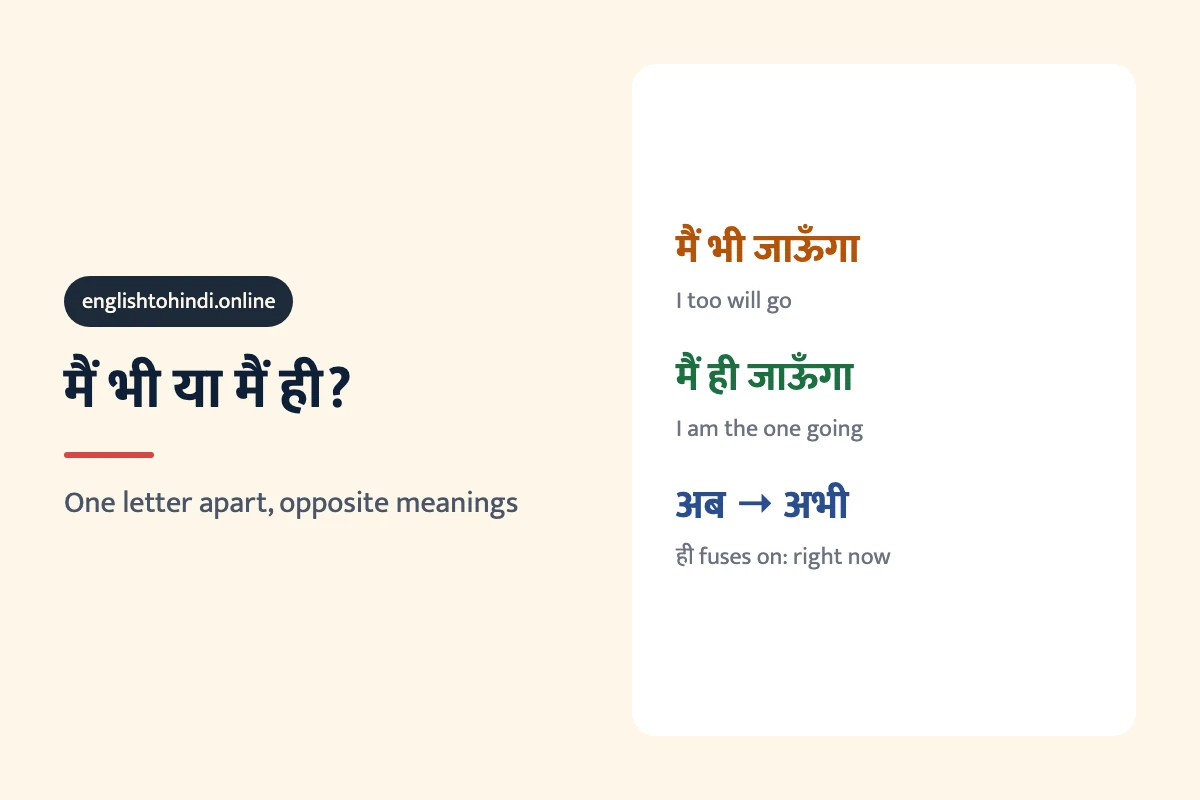
भी means “also” or “too”. ही means “only”, “exactly” or “precisely”. Both are placed immediately after the word they apply to, not at the front of the sentence: मैं भी जाऊँगा means “I too will go”, and मैं ही जाऊँगा means “I’m the one who will go — nobody else”. Moving either word moves the meaning with it.
English carries this work in stress and intonation, which is why learners tend to leave both words out entirely and sound oddly neutral. Hindi puts it in the word order instead, so it is visible on the page.
भी: also, too, even
भी sticks to the word in front of it, and that word is the one being added to the picture. The same four words in a different arrangement give four different sentences.
| Hindi | Roman | English |
|---|---|---|
| मैं भी कल जाऊँगा | Main bhi kal jaunga | I too will go tomorrow (others are going) |
| मैं कल भी जाऊँगा | Main kal bhi jaunga | I’ll go tomorrow as well (I’m going other days too) |
| वह भी आया | Wah bhi aaya | He came too |
| उसने कुछ भी नहीं कहा | Usne kuchh bhi nahin kaha | He didn’t say anything at all |
Putting भी at the head of the sentence, the way English puts “also”, is the standard learner error. भी कल जाऊँगा is not how the sentence works — भी must follow whatever it is adding.
भी also fuses with the indefinites to mean “any at all”: कुछ भी (anything), कोई भी (anyone), कहीं भी (anywhere), कभी भी (any time), जो भी (whatever). These are worth learning as units.
ही: only, exactly, the very one
ही narrows rather than adds. It marks the word in front of it as the only one that applies, or as precisely the right one.
| Hindi | Roman | English |
|---|---|---|
| मैं ही जाऊँगा | Main hi jaunga | I’m the one who’ll go |
| आज ही जाना है | Aaj hi jaana hai | It has to be today |
| एक ही रास्ता है | Ek hi raasta hai | There’s only one way |
| यह ही चाहिए | Yah hi chahiye | This is exactly what’s wanted |
In the perfective past, ही attaches to the ने form as well: मैंने ही किया, “I’m the one who did it”. The ने marker itself is covered in Hindi postpositions.
The fusions you have already met
ही fuses with common short words, and the results are so frequent that most learners use them long before knowing what they contain.
| Base | With ही | Meaning |
|---|---|---|
| यह | यही | this very one |
| वह | वही | that very one, the same one |
| यहाँ | यहीं | right here |
| वहाँ | वहीं | right there |
| अब | अभी | right now |
| तब | तभी | right then, only then |
| सब | सभी | all of them, every single one |
अभी is the clearest case. अब means “now” in a loose sense; अभी means “right now, this second”. Similarly यहीं रोक दीजिए means “stop right here”, which is why it is the phrase used with an auto driver rather than यहाँ रोकिए.
वही किताब चाहिए, यह नहीं।
Vahi kitaab chahiye, yah nahin.
ही or सिर्फ़?
सिर्फ़ and केवल also mean “only”, and they are not the same as ही. सिर्फ़ counts — it limits a quantity. ही selects — it insists on a particular one.
- सिर्फ़ दो लोग आए — only two people came (a count).
- दो ही लोग आए — only two people came, and that’s remarkably few (an attitude).
- मुझे सिर्फ़ चाय चाहिए — I only want tea, nothing else.
- मुझे यही चाहिए — this is the one I want.
Softening with ही
ही has a quieter use that does not translate at all. Dropped into a sentence, it can soften or gently insist, in the way English uses “do” in “do come”. आइए ही sounds warmer than आइए, and पास ही है means “oh, it’s close by” rather than a flat statement of distance.
The short version
- भी means also; ही means only. Both go after the word they apply to.
- मैं भी जाऊँगा — I too will go. मैं ही जाऊँगा — I’m the one going.
- Moving the word moves the meaning: मैं कल भी जाऊँगा is a different sentence from मैं भी कल जाऊँगा.
- भी builds the indefinites: कुछ भी, कोई भी, कहीं भी, जो भी.
- ही fuses: यही, वही, यहीं, अभी, सभी.
- सिर्फ़ limits a quantity; ही insists on a particular one.
Frequently asked questions
What does भी mean in Hindi?
भी means “also” or “too”, and it is placed immediately after the word it applies to. मैं भी जाऊँगा means “I too will go”. Putting भी at the front of the sentence, the way English places “also”, is incorrect — it must follow whatever is being added.
What does ही mean in Hindi?
ही means “only”, “exactly” or “precisely”, and it narrows attention to the word in front of it. मैं ही जाऊँगा means “I’m the one who will go, nobody else”, and आज ही जाना है means “it has to be today”.
What is the difference between मैं भी जाऊँगा and मैं ही जाऊँगा?
They are near opposites. मैं भी जाऊँगा means “I will go too”, implying others are going as well. मैं ही जाऊँगा means “I am the one who will go”, implying nobody else will. One adds to the group, the other excludes everyone from it.
Why does the position of भी change the meaning?
Because भी attaches to the word directly before it. मैं भी कल जाऊँगा means “I too will go tomorrow”, adding the speaker to a group of people going. मैं कल भी जाऊँगा means “I’ll go tomorrow as well”, adding tomorrow to a list of days. Same words, different attachment.
What is the difference between अब and अभी?
अभी is अब with the emphatic ही fused onto it. अब means “now” in a general sense, while अभी means “right now, this very moment”. The same fusion produces यहीं from यहाँ, वही from वह, and सभी from सब.
What is the difference between ही and सिर्फ़?
सिर्फ़ limits a quantity, while ही insists on a particular one. सिर्फ़ दो लोग आए simply counts — only two people came. दो ही लोग आए counts and adds an attitude, that two is remarkably few. For picking out a specific item, ही is the natural choice: मुझे यही चाहिए.
More guides
- Hindi plurals: लड़का, लड़के, लड़कों and which to use whenHindi has two plurals for every noun: one for the plain sentence and one for when a postposition follows. लड़के and लड़कों are both “boys”, and using the wrong one is the most common learner error.
- वाला in Hindi: what वाला, वाली and वाले actually meanवाला means “the one that” — the one who sells it, the one wearing it, the thing about to happen. One suffix doing three jobs English needs three constructions for.
- How to say “can” in Hindi: सकना, आना and पानामैं हिंदी बोल सकता हूँ. Ability, permission and “managed to” are three different verbs in Hindi, and picking the wrong one is the usual learner mistake.
Looking for a specific phrase? Browse the phrase guides.