Days, months and telling the time in Hindi
The englishtohindi.online editors · · 7 min read
The seven days are straightforward. Telling the time is not — Hindi has single words for half past, quarter past and quarter to, and two of them are irregular.
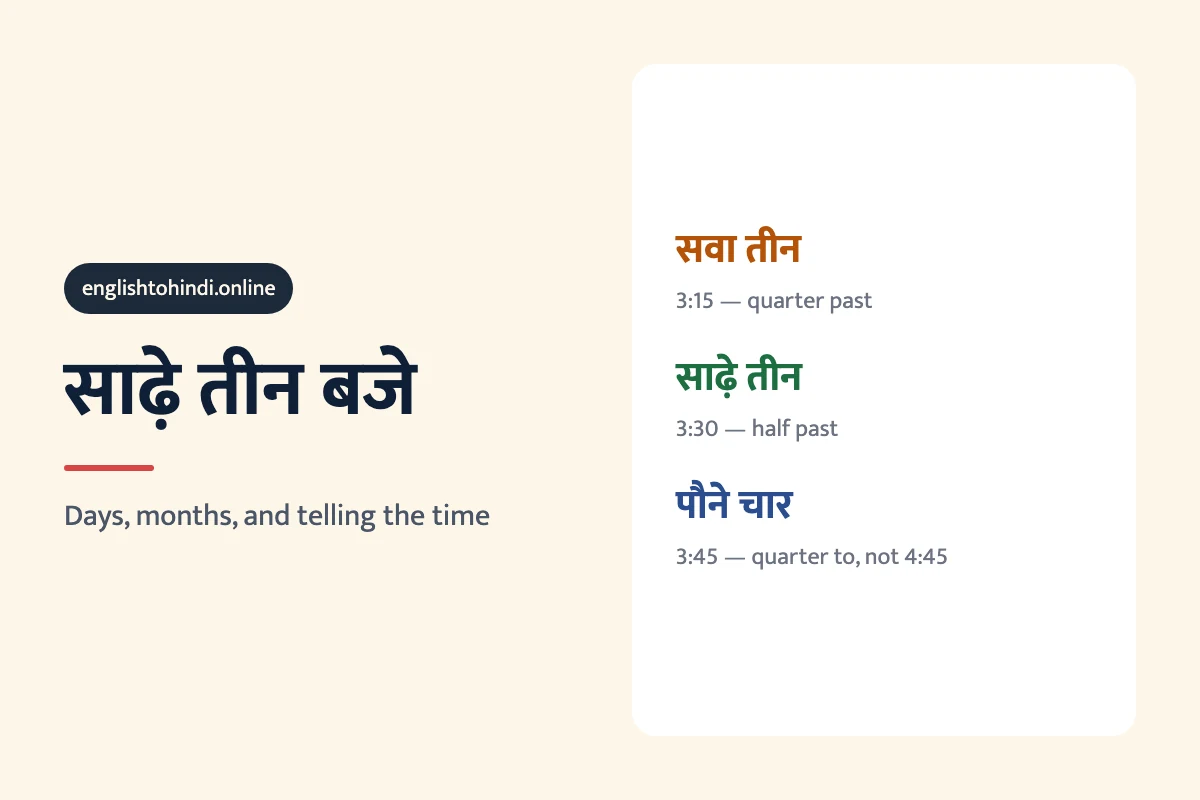
The days of the week in Hindi end in -वार: सोमवार (Monday) through रविवार (Sunday). Month names in everyday use are the English ones written in Devanagari — जनवरी, फ़रवरी, मार्च. To ask the time, say क्या समय हुआ है? and to answer, use बजे: तीन बजे is three o'clock. Half past is साढ़े, quarter past is सवा, quarter to is पौने.
Days and months take an afternoon. The time system is where the real content is, because Hindi packs 'half past' and 'quarter to' into single words that come before the number rather than after it.
The seven days
| English | Hindi | Roman | Named after |
|---|---|---|---|
| Monday | सोमवार | somvaar | Som — the moon |
| Tuesday | मंगलवार | mangalvaar | Mangal — Mars |
| Wednesday | बुधवार | budhvaar | Budh — Mercury |
| Thursday | गुरुवार | guruvaar | Guru — Jupiter |
| Friday | शुक्रवार | shukravaar | Shukra — Venus |
| Saturday | शनिवार | shanivaar | Shani — Saturn |
| Sunday | रविवार | ravivaar | Ravi — the sun |
The planets are the same ones English used, borrowed through a different route — Saturday from Saturn, Sunday from the sun. The two systems agree because both descend from the same Babylonian week.
You will also hear बृहस्पतिवार for Thursday and इतवार for Sunday. Both are common; गुरुवार and रविवार are what you will see printed.
Months: two systems, and only one you need
Everyday Hindi uses the Gregorian months, written in Devanagari. Calendars, newspapers, and every official form use these.
| English | Hindi | English | Hindi |
|---|---|---|---|
| January | जनवरी | July | जुलाई |
| February | फ़रवरी | August | अगस्त |
| March | मार्च | September | सितंबर |
| April | अप्रैल | October | अक्टूबर |
| May | मई | November | नवंबर |
| June | जून | December | दिसंबर |
The traditional Hindu calendar runs alongside it with its own twelve months — चैत्र, वैशाख, ज्येष्ठ, आषाढ़, श्रावण, भाद्रपद, आश्विन, कार्तिक, मार्गशीर्ष, पौष, माघ, फाल्गुन. You need these for festivals, which are set by that calendar and therefore fall on different Gregorian dates each year. For arranging a meeting, you do not.
Telling the time: बजे
बजे means 'o'clock' and comes after the number. The question is क्या समय हुआ है? or, more colloquially, कितने बजे हैं?
| Time | Hindi | Roman |
|---|---|---|
| One o'clock | एक बजे | ek baje |
| Four o'clock | चार बजे | chaar baje |
| At six o'clock | छह बजे | chhah baje |
| What time is it? | क्या समय हुआ है? | kya samay hua hai? |
Half past, quarter past, quarter to
These are single words placed before the number. This is the part worth memorising, because they are used constantly and there is no way to derive them.
| Word | Means | Example |
|---|---|---|
| सवा (sava) | Quarter past | सवा तीन — 3:15 |
| साढ़े (saadhe) | Half past | साढ़े तीन — 3:30 |
| पौने (paune) | Quarter to | पौने चार — 3:45 |
पौने चार is 3:45, not 4:45. The word means 'quarter less than', so it points at the number that follows. This is the single most common mistake with Hindi time, and it makes you 45 minutes early rather than 15 minutes late.
The two irregular ones
1:30 and 2:30 do not use साढ़े. They have their own words, and no amount of pattern-matching will produce them.
| Time | Hindi | Not |
|---|---|---|
| 1:30 | डेढ़ बजे (dedh baje) | साढ़े एक |
| 2:30 | ढाई बजे (dhai baje) | साढ़े दो |
| 3:30 | साढ़े तीन बजे | — regular from here on |
डेढ़ and ढाई are not only clock words. They mean one-and-a-half and two-and-a-half generally: डेढ़ किलो is a kilo and a half. This is the same irregularity that runs through Hindi numbers as a whole.
Morning, afternoon, night
Hindi has no am and pm in speech. You name the part of the day, and it goes before the time.
| Part of day | Hindi | Roughly |
|---|---|---|
| सुबह (subah) | Morning | Sunrise to about noon |
| दोपहर (dopahar) | Midday, afternoon | Noon to about 4 |
| शाम (shaam) | Evening | 4 until dark |
| रात (raat) | Night | After dark |
मैं सुबह आठ बजे आऊँगा।
Main subah aath baje aaunga.
Today, tomorrow, and the word that means both
कल means both tomorrow and yesterday. Which one is meant comes entirely from the verb tense, and Hindi speakers find this completely unambiguous.
| Hindi | Meaning | Note |
|---|---|---|
| आज | Today | |
| कल | Tomorrow or yesterday | The tense decides |
| परसों | Day after tomorrow, or day before yesterday | Same trick, two days out |
मैं कल आऊँगा। मैं कल आया था।
Main kal aaunga. Main kal aaya tha.
If a translation tool renders कल for you without the surrounding sentence, it is guessing. This is one of the clearest cases where a whole paragraph translates correctly and a single extracted word cannot.
Frequently asked questions
What are the days of the week in Hindi?
सोमवार (Monday), मंगलवार (Tuesday), बुधवार (Wednesday), गुरुवार (Thursday), शुक्रवार (Friday), शनिवार (Saturday), रविवार (Sunday). Each is named after a planet, the same way the English names are.
How do you ask what time it is in Hindi?
क्या समय हुआ है? (kya samay hua hai?) is the standard form. कितने बजे हैं? (kitne baje hain?) is the more colloquial version and is heard just as often.
How do you say 3:30 in Hindi?
साढ़े तीन बजे. साढ़े means 'half past' and goes before the number. The exceptions are 1:30 and 2:30, which have their own words: डेढ़ बजे and ढाई बजे.
What does पौने mean?
Quarter to. पौने चार is 3:45 — a quarter less than four. It points forward to the number that follows it, which is the opposite of what English speakers expect and a common cause of arriving an hour early.
Why does कल mean both yesterday and tomorrow?
कल refers to the day adjacent to today, and the verb tense tells you which direction. मैं कल आऊँगा is 'I will come tomorrow'; मैं कल आया था is 'I came yesterday'. परसों works the same way two days out.
Are Hindi months different from English months?
In everyday use, no — Hindi uses the Gregorian months written in Devanagari: जनवरी, फ़रवरी, मार्च. The traditional Hindu calendar has its own twelve months, starting with चैत्र, and those are what set festival dates.
More guides
- Hindi plurals: लड़का, लड़के, लड़कों and which to use whenHindi has two plurals for every noun: one for the plain sentence and one for when a postposition follows. लड़के and लड़कों are both “boys”, and using the wrong one is the most common learner error.
- वाला in Hindi: what वाला, वाली and वाले actually meanवाला means “the one that” — the one who sells it, the one wearing it, the thing about to happen. One suffix doing three jobs English needs three constructions for.
- How to say “can” in Hindi: सकना, आना and पानामैं हिंदी बोल सकता हूँ. Ability, permission and “managed to” are three different verbs in Hindi, and picking the wrong one is the usual learner mistake.
Looking for a specific phrase? Browse the phrase guides.