Hindi numbers 1 to 100: counting, lakh and crore explained
The englishtohindi.online editors · · 7 min read
Hindi numbers from 1 to 100 are close to a hundred separate words, not a pattern you can assemble. Here are the tables worth memorising, plus what lakh and crore actually mean.
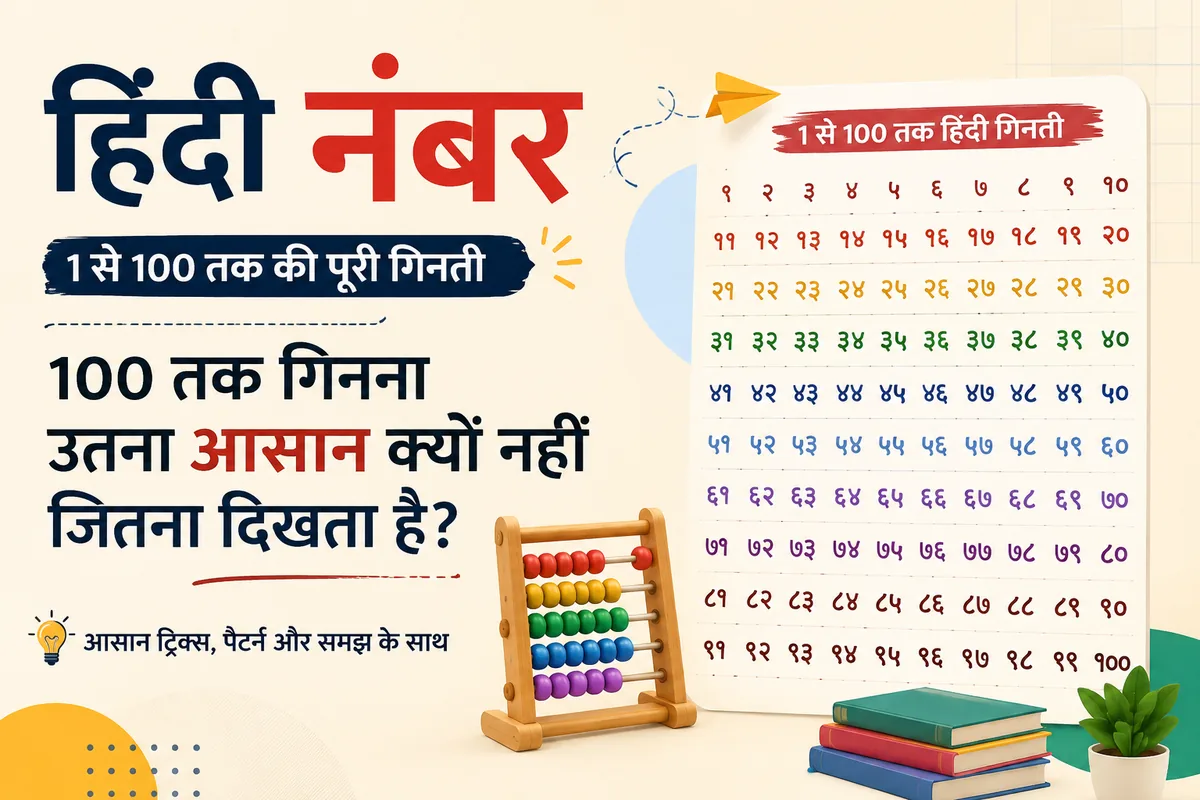
Hindi counts one (एक, ek), two (दो, do), three (तीन, teen), up to ten (दस, das) and a hundred (सौ, sau). Above that it stops grouping in thousands: one lakh (लाख) is 100,000 and one crore (करोड़) is 10,000,000. The numbers between 1 and 100 are largely irregular and have to be learned individually.
English learners usually treat numbers as the easy part of a language. Learn one to ten, learn the tens, and the rest assembles itself: twenty-one, twenty-two, thirty-one. Hindi does not work that way, and this is the first place most self-taught learners quietly give up.
In Hindi, the sound changes in ways you cannot predict from the parts. 21 is इक्कीस (ikkees) and 31 is इकतीस (ikatees) — both mean 'one and the tens', but neither is spelled or pronounced the way the pattern suggests. In practice, the numbers 1 to 100 are close to a hundred separate words.
One to ten
| Digit | Hindi | Roman |
|---|---|---|
| 1 | एक | ek |
| 2 | दो | do |
| 3 | तीन | teen |
| 4 | चार | chaar |
| 5 | पाँच | paanch |
| 6 | छह | chhah |
| 7 | सात | saat |
| 8 | आठ | aath |
| 9 | नौ | nau |
| 10 | दस | das |
These ten are worth knowing cold, because they turn up inside prices, phone numbers, and dates far more often than anything above twenty.
The tens are the real backbone
| Number | Hindi | Roman |
|---|---|---|
| 20 | बीस | bees |
| 30 | तीस | tees |
| 40 | चालीस | chaalees |
| 50 | पचास | pachaas |
| 60 | साठ | saath |
| 70 | सत्तर | sattar |
| 80 | अस्सी | assee |
| 90 | नब्बे | nabbe |
| 100 | सौ | sau |
Learn these nine and you can already handle most everyday amounts by rounding — पचास रुपये for fifty rupees, सौ रुपये for a hundred. Shopkeepers round to these numbers constantly, so they carry more weight than the exact values in between.
Why the numbers in between are irregular
Hindi puts the unit before the ten, the opposite of English. So 21 is roughly 'one-twenty', not 'twenty-one'. But centuries of spoken shortening have eroded the join, and what survives is a set of forms you have to learn one at a time.
| Number | Hindi | Roman | Literally |
|---|---|---|---|
| 21 | इक्कीस | ikkees | one + twenty |
| 29 | उनतीस | unatees | one-less-than thirty |
| 39 | उनतालीस | unataalees | one-less-than forty |
| 49 | उनचास | unachaas | one-less-than fifty |
That last group is the pattern worth noticing: numbers ending in 9 are usually built as 'one less than the next ten', not 'nine plus this ten'. It is the one piece of structure hiding in an otherwise irregular list.
Lakh and crore — the part that trips up money
Above a thousand, Indian numbering stops grouping in thousands and millions. It groups in lakhs and crores, and the digit separators move with it.
| Hindi | Value | In English terms |
|---|---|---|
| हज़ार (hazaar) | 1,000 | one thousand |
| लाख (laakh) | 1,00,000 | one hundred thousand |
| करोड़ (karod) | 1,00,00,000 | ten million |
| अरब (arab) | 1,00,00,00,000 | one billion |
इस फ्लैट की कीमत पचास लाख रुपये है।
Is flat ki keemat pachaas laakh rupaye hai.
Machine translation regularly converts लाख to 'lakh' and leaves it there, or worse, renders it as 'million'. If you are reading Indian property or salary figures, do the arithmetic yourself: one lakh is 100,000 and one crore is 100 lakh.
Numbers behave like adjectives
A number sits before the noun, and the noun usually takes its plural form — but the number itself never changes for gender, which makes it one of the few easy corners of Hindi grammar.
मुझे दो किताबें चाहिए।
Mujhe do kitaabein chaahiye.
For counting people, Hindi often adds लोग (log) or a counter word: तीन लोग for three people. Saying just तीन and stopping sounds clipped, the way 'give me three' does in English.
The Devanagari digits
You will still see the original digits on older signage, in exam papers, and on some government forms, so they are worth recognising even though most printed material now uses 0–9. To type them yourself you need a Devanagari keyboard.
| Arabic | Devanagari |
|---|---|
| 0 1 2 3 4 | ० १ २ ३ ४ |
| 5 6 7 8 9 | ५ ६ ७ ८ ९ |
How to actually learn these
- Memorise 1–20 properly. Below twenty there is no shortcut, and these cover most daily use.
- Memorise the nine tens. With those plus 1–20 you can approximate almost any amount.
- Fill in the gaps by use, not by drilling — learn 47 the day you need to say 47.
- Practise with money. Prices are where numbers show up most, and rupee amounts give you instant feedback.
- Learn lakh and crore before anything above 100. You will meet them long before you meet 63.
If a number is critical — a price, an address, a phone number — say it back to the other person. Indian speakers do this routinely among themselves, so repeating a figure to confirm reads as careful, not as poor Hindi.
Frequently asked questions
How much is 1 lakh?
One lakh (लाख) is 100,000 — one hundred thousand. It is written 1,00,000 in the Indian digit grouping, where the separators fall after the first three digits and then every two digits.
How much is 1 crore in millions?
One crore (करोड़) is 10,000,000 — ten million, or one hundred lakh. So fifty crore is 500 million, and one hundred crore is one billion.
How do you count from 1 to 10 in Hindi?
एक (ek) 1, दो (do) 2, तीन (teen) 3, चार (chaar) 4, पाँच (paanch) 5, छह (chhah) 6, सात (saat) 7, आठ (aath) 8, नौ (nau) 9, दस (das) 10.
Why are Hindi numbers so irregular?
Hindi places the unit before the ten, so 21 is built as 'one and twenty'. Centuries of spoken shortening eroded the join between the two parts, so the result is no longer predictable: 21 is इक्कीस (ikkees) but 31 is इकतीस (ikatees). In practice each number from 1 to 100 is close to its own word.
Do Hindi numbers change with gender?
No. Unlike Hindi adjectives and verbs, numbers never change form for gender or case. दो (do, two) is दो regardless of whether the noun it counts is masculine or feminine.
What are the Hindi numerals?
Devanagari has its own digits: ० १ २ ३ ४ ५ ६ ७ ८ ९ for 0 to 9. Most printed Hindi now uses the Arabic digits 0–9, but the Devanagari forms still appear on older signage and on some government forms.
More guides
- Hindi plurals: लड़का, लड़के, लड़कों and which to use whenHindi has two plurals for every noun: one for the plain sentence and one for when a postposition follows. लड़के and लड़कों are both “boys”, and using the wrong one is the most common learner error.
- वाला in Hindi: what वाला, वाली and वाले actually meanवाला means “the one that” — the one who sells it, the one wearing it, the thing about to happen. One suffix doing three jobs English needs three constructions for.
- How to say “can” in Hindi: सकना, आना and पानामैं हिंदी बोल सकता हूँ. Ability, permission and “managed to” are three different verbs in Hindi, and picking the wrong one is the usual learner mistake.
Looking for a specific phrase? Browse the phrase guides.