Thank you in Hindi: धन्यवाद, शुक्रिया, and when to say neither
The englishtohindi.online editors · · 6 min read
Both words mean thank you, and neither is what most people actually say. Thanking close family in Hindi can create distance rather than warmth.
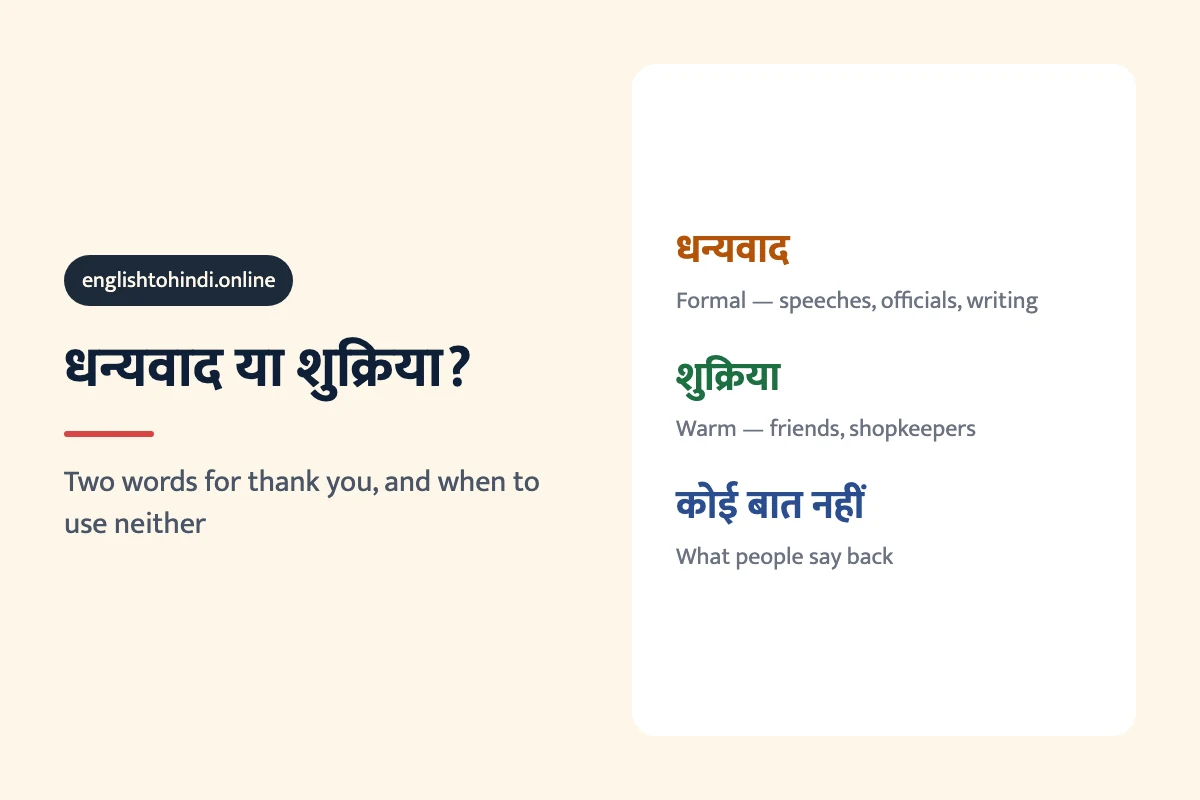
धन्यवाद (dhanyavaad) and शुक्रिया (shukriya) both mean thank you. धन्यवाद comes from Sanskrit and sounds formal, almost written. शुक्रिया comes from Urdu and is warmer and more conversational. In practice, urban speakers most often say 'thanks' in English — and within a close family, Hindi speakers frequently say nothing at all, because thanking a family member for an everyday favour can imply a distance that is not there.
That last point is the one no phrasebook mentions, and it is the reason a learner who thanks everyone profusely comes across as oddly formal rather than polite.
Which word, and when
| Say | Register | Fits |
|---|---|---|
| धन्यवाद | Formal | Speeches, writing, officials, strangers you want to be correct with |
| शुक्रिया | Warm, casual | Friends, shopkeepers, anyone you have a rapport with |
| थैंक्स / thanks | Neutral, very common | Everyday urban speech, any age |
| बहुत बहुत धन्यवाद | Emphatic formal | Genuine gratitude, formally expressed |
| आपका बहुत शुक्रिया | Emphatic warm | Genuine gratitude, personally expressed |
शुक्रिया carries a slight Urdu and north-Indian Muslim association for some speakers, though it is used far beyond that. It is never wrong; it simply sounds a little more Delhi and a little less news broadcast than धन्यवाद.
Why thanking family sounds strange
In English, 'thanks' lubricates every small interaction, including with people you live with. In Hindi, thanking your mother for dinner or your brother for passing the salt can read as marking the act as a favour between separate parties — which is not how family obligations are framed.
Nobody will be offended if you say it. But watch a Hindi-speaking household and you will hear far fewer thank-yous than in an equivalent English one, and the absence is warmth rather than rudeness.
- A shopkeeper, a driver, a waiter: शुक्रिया or thanks is normal and appreciated.
- A colleague or a stranger who helped: शुक्रिया, or धन्यवाद if the setting is formal.
- A close friend doing you a small favour: often nothing, or a nod, or 'thanks yaar'.
- Your own family: usually nothing at all for everyday acts.
- Anything significant, from anyone: say it properly, in whichever word fits the relationship.
Replying to thanks
| Reply | Roman | Feel |
|---|---|---|
| कोई बात नहीं | koi baat nahin | It's nothing — the everyday reply |
| स्वागत है | swaagat hai | You're welcome — formal, a bit stiff |
| कोई ज़रूरत नहीं थी | koi zaroorat nahin thi | There was no need — warm deflection |
| अरे, इसमें क्या | are, isme kya | Oh, it's nothing — casual |
स्वागत है is what dictionaries give for 'you're welcome', and it is the least common of these in speech. It literally means 'there is welcome' and is more at home greeting a guest than answering a thank-you. कोई बात नहीं is what people actually say.
Sorry, which works the same way
| Say | Roman | When |
|---|---|---|
| माफ़ कीजिए | maaf keejiye | Polite apology, or excuse me to a stranger |
| क्षमा करें | kshama karein | Formal, Sanskrit-derived, written |
| सॉरी | sorry | Everyday, extremely common |
| मुझे माफ़ कर दो | mujhe maaf kar do | A real apology, to someone close |
माफ़ कीजिए also does the work of 'excuse me' when you need to get past someone or interrupt politely. The verb ending shifts with formality exactly as it does everywhere else in Hindi — कीजिए is the polite form, करो the casual one.
What translation tools get wrong here
Ask any engine for 'thank you' in Hindi and you will get धन्यवाद, every time. It is not incorrect, but it is the most formal option, and applying it to a friend is like ending a text to your flatmate with 'yours sincerely'.
| Situation | Engine gives | People say |
|---|---|---|
| Thanking a friend | धन्यवाद | शुक्रिया, or thanks |
| Thanking a shopkeeper | धन्यवाद | शुक्रिया, or nothing |
| You're welcome | स्वागत है | कोई बात नहीं |
| Sorry, to a friend | क्षमा करें | सॉरी |
The right-hand column is not slang. It is what fluent adults say to each other in ordinary situations, and the left-hand column is what you would find in a government circular.
Frequently asked questions
How do you say thank you in Hindi?
धन्यवाद (dhanyavaad) is the formal word and शुक्रिया (shukriya) the warmer, more conversational one. In everyday urban speech, the English 'thanks' is at least as common as either.
What is the difference between dhanyavaad and shukriya?
धन्यवाद derives from Sanskrit and sounds formal, closer to written Hindi and public speech. शुक्रिया derives from Urdu and sounds warmer and more personal. Both are correct; शुक्रिया fits friends and shopkeepers, धन्यवाद fits officials and speeches.
Do Indians say thank you to family?
Often not, for everyday acts. Thanking a family member can frame the act as a favour between separate people rather than something taken for granted within a household. Saying it is never offensive, but its absence is normal and not rude.
How do you say you're welcome in Hindi?
कोई बात नहीं (koi baat nahin), literally 'it's no matter', is what people actually say. स्वागत है appears in dictionaries as the direct translation of 'you're welcome' but sounds stiff and belongs more to greeting a guest.
How do you say sorry in Hindi?
माफ़ कीजिए (maaf keejiye) for a polite apology, which also serves as 'excuse me'. क्षमा करें is the formal written equivalent. In conversation, the English 'sorry' is extremely common.
More guides
- Hindi plurals: लड़का, लड़के, लड़कों and which to use whenHindi has two plurals for every noun: one for the plain sentence and one for when a postposition follows. लड़के and लड़कों are both “boys”, and using the wrong one is the most common learner error.
- वाला in Hindi: what वाला, वाली and वाले actually meanवाला means “the one that” — the one who sells it, the one wearing it, the thing about to happen. One suffix doing three jobs English needs three constructions for.
- How to say “can” in Hindi: सकना, आना and पानामैं हिंदी बोल सकता हूँ. Ability, permission and “managed to” are three different verbs in Hindi, and picking the wrong one is the usual learner mistake.
Looking for a specific phrase? Browse the phrase guides.