कर देना, कर लेना: what the second verb in a Hindi sentence is doing
The englishtohindi.online editors · · 7 min read
मैंने खाया and मैंने खा लिया both mean “I ate”. The second verb adds no new action — it says who the action was for and whether it is finished.
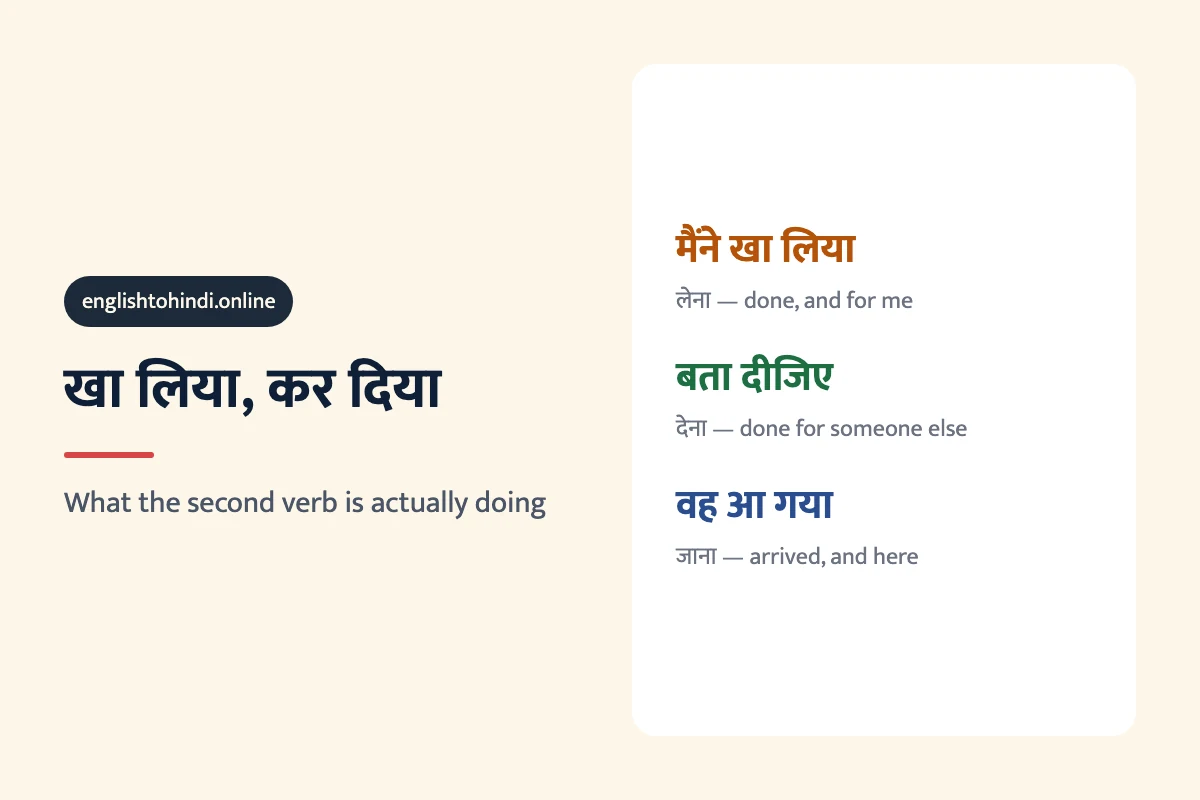
Hindi frequently puts two verbs together where English uses one: खा लेना, कर देना, ले जाना, आ जाना. The first verb carries the meaning and stays in its bare stem; the second loses its own meaning entirely and instead marks who benefits from the action and whether it is complete. मैंने खाया and मैंने खा लिया both mean “I ate”, but the second says the eating is done and settled.
These are called compound verbs, and they are everywhere in natural speech. Leaving them out is not a grammar error — it is what makes otherwise correct Hindi sound flat and slightly foreign.
The shape: stem plus a second verb
The main verb drops ना and never changes again. The second verb takes all the tense and agreement, exactly as सकना does in how to say “can” in Hindi.
| Simple | Compound | What changed |
|---|---|---|
| मैंने खाया | मैंने खा लिया | The eating is finished |
| मैंने बताया | मैंने बता दिया | I told them, for their benefit |
| वह आया | वह आ गया | He has arrived, and is here |
| उसने लिखा | उसने लिख डाला | He wrote it out, decisively |
लेना: the action comes back to you
लेना on its own means “to take”. As a second verb it means the action was done by you, for you. खा लो is not just “eat” — it is “go ahead and eat, get it done”.
- मैंने कर लिया — I’ve done it (and it’s sorted, for me).
- आप बैठ लीजिए — do sit down.
- पानी पी लो — drink the water, finish it.
- मैंने सोच लिया — I’ve made up my mind.
देना: the action goes outward
देना means “to give”, and as a second verb it points the action away from you, usually towards the person you are talking to. This is why it dominates in requests and offers.
| Hindi | Roman | English |
|---|---|---|
| बता दीजिए | Bata dijiye | Please tell me / let me know |
| दे दीजिए | De dijiye | Please give it (hand it over) |
| मैंने पैसे दे दिए | Maine paise de diye | I’ve paid (handed the money over) |
| दरवाज़ा खोल दो | Darwaaza khol do | Open the door (for me) |
The pair to feel the difference on is बता देना against बता लेना. बता दीजिए asks someone to tell you something. बता लीजिए would mean they told it for their own benefit, which is why you almost never hear it. Direction is the whole distinction.
जाना: the action completes and stays completed
जाना means “to go”, and as a second verb it marks a change of state that has settled. It attaches mostly to intransitive verbs — ones with no object.
- वह आ गया — he’s arrived (and he’s here now).
- मैं भूल गया — I forgot.
- पानी ख़त्म हो गया — the water has run out.
- वह सो गई — she fell asleep.
हो गया is worth learning as a unit. It means “it’s done” and answers a huge number of everyday questions on its own.
ले जाना and ले आना: take and bring
These two are the compound English speakers meet first, because English happens to have separate words for them. ले जाना is “take away” — carry and go. ले आना is “bring” — carry and come.
यह छाता ले जाइए, और कल ले आइएगा।
Yah chhaata le jaiye, aur kal le aaiyega.
The same logic builds लेकर आना, लेकर जाना and, with people rather than objects, ले चलना — “come along and take me with you”.
The rule nobody tells you: they vanish in the negative
Compound verbs mostly disappear when a sentence goes negative. मैंने खा लिया becomes मैंने नहीं खाया, not मैंने नहीं खा लिया. The completion sense is incompatible with saying the thing did not happen.
| Positive | Negative | Note |
|---|---|---|
| मैंने कर लिया | मैंने नहीं किया | Not नहीं कर लिया |
| वह आ गया | वह नहीं आया | Not नहीं आ गया |
| बता दीजिए | मत बताइए | Negative commands take मत |
The negative command form is covered in Hindi imperatives, where मत rather than नहीं is the marker.
ने still applies
In the perfective past, a transitive compound still takes ने and still hands agreement to the object: मैंने चिट्ठी लिख दी, with दी feminine because चिट्ठी is. That marker is explained in Hindi postpositions.
The short version
- First verb in bare stem, second verb takes all the endings.
- लेना — the action is for the doer: मैंने कर लिया.
- देना — the action is for someone else: बता दीजिए.
- जाना — a completed change of state: वह आ गया, मैं भूल गया.
- ले जाना is take away; ले आना is bring.
- They drop out in the negative: मैंने नहीं खाया, never मैंने नहीं खा लिया.
Frequently asked questions
What is a compound verb in Hindi?
A compound verb is two verbs used together where the second adds nuance rather than a second action. The first verb stays in its bare stem and the second takes all the tense and agreement — खा लिया, कर दिया, आ गया. The second verb marks who the action was for and whether it is complete.
What is the difference between मैंने खाया and मैंने खा लिया?
Both mean “I ate”. मैंने खाया simply reports the action. मैंने खा लिया adds that the eating is finished and settled, and that the speaker did it for themselves. The compound version is far more common in everyday speech.
What is the difference between कर देना and कर लेना?
Direction. कर देना means the action was done for someone else — कर दीजिए asks someone to do it for you. कर लेना means it was done by and for the doer — मैंने कर लिया means “I’ve got it done”. देना points outward and लेना points back at the doer.
What does आ गया mean?
आ गया means “has arrived” or “is here now”. जाना as a second verb marks a completed change of state, so वह आ गया says he arrived and is present, while वह आया simply reports that he came. हो गया, meaning “it’s done”, works the same way.
What is the difference between ले जाना and ले आना?
ले जाना means to take something away — to carry it and go. ले आना means to bring something — to carry it and come. यह छाता ले जाइए means “take this umbrella”, and कल ले आइएगा means “bring it back tomorrow”.
Why do compound verbs disappear in negative sentences?
Because they mark completion, which conflicts with saying something did not happen. मैंने खा लिया becomes मैंने नहीं खाया in the negative, not मैंने नहीं खा लिया. The same applies to वह आ गया, which becomes वह नहीं आया.
More guides
- Hindi plurals: लड़का, लड़के, लड़कों and which to use whenHindi has two plurals for every noun: one for the plain sentence and one for when a postposition follows. लड़के and लड़कों are both “boys”, and using the wrong one is the most common learner error.
- वाला in Hindi: what वाला, वाली and वाले actually meanवाला means “the one that” — the one who sells it, the one wearing it, the thing about to happen. One suffix doing three jobs English needs three constructions for.
- How to say “can” in Hindi: सकना, आना and पानामैं हिंदी बोल सकता हूँ. Ability, permission and “managed to” are three different verbs in Hindi, and picking the wrong one is the usual learner mistake.
Looking for a specific phrase? Browse the phrase guides.