कीजिए, करो or कर: giving orders and requests in Hindi
The englishtohindi.online editors · · 7 min read
Hindi has four different ways to tell someone to do something, and which one you pick is decided before you open your mouth — by who you are talking to.
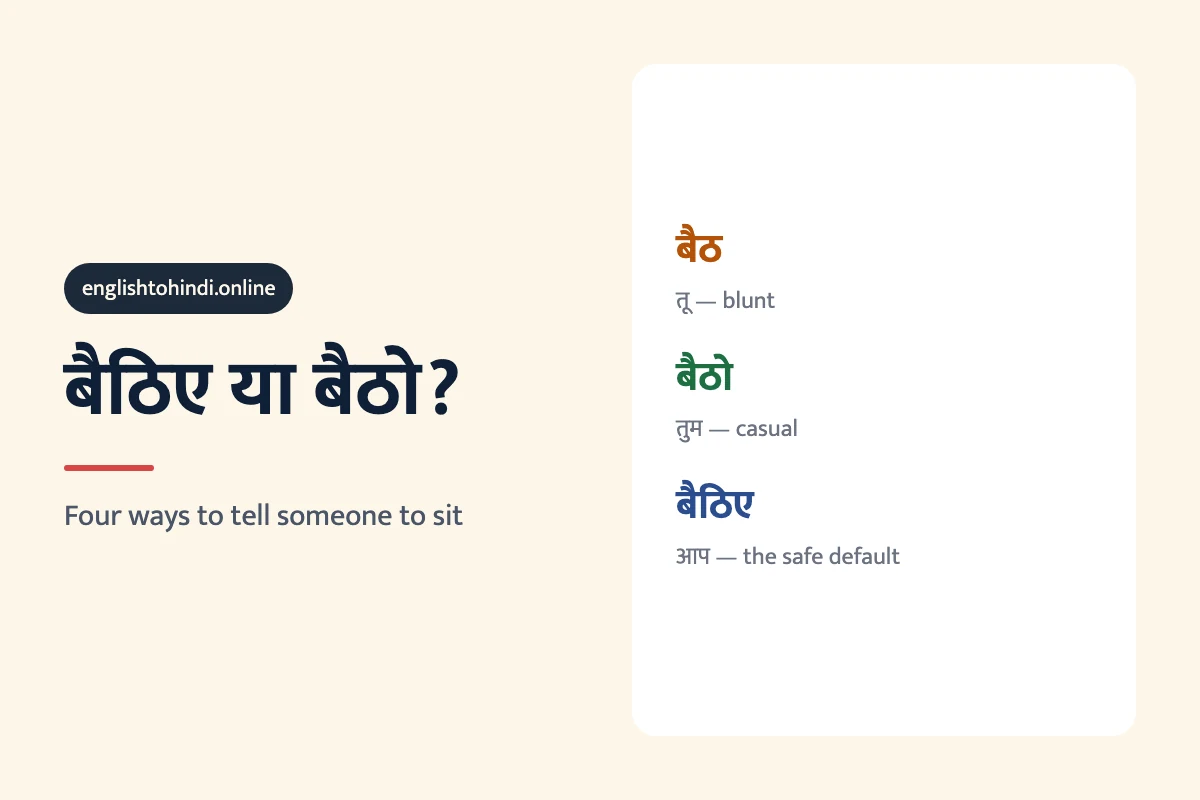
Hindi has four imperative forms and they line up with the words for “you”. बैठ is the तू form, बैठो is the तुम form, बैठिए is the आप form, and बैठना is a softer instruction for something to be done later. All four mean “sit”, and the difference between them is entirely social. With anyone you do not know well, use the आप form: बैठिए.
English marks politeness by adding words — “please”, “could you”, “would you mind”. Hindi marks it in the verb ending itself, which means there is no neutral option. Every command you give places you and the listener on a scale, whether you intended it or not.
The four forms
| Form | Goes with | Example | Feel |
|---|---|---|---|
| बैठ | तू | बैठ! | Blunt — intimates, small children, or anger |
| बैठो | तुम | बैठो। | Casual — friends, siblings, juniors |
| बैठिए | आप | बैठिए। | Polite — the safe default |
| बैठना | आप or तुम | कल बैठना। | Soft, for later — an instruction, not an order |
The choice is the same one you already made when picking a pronoun, so the reasoning in आप, तुम or तू applies unchanged. Mixing levels is the giveaway — आप बैठो puts a formal pronoun with a casual command and sounds wrong to every native speaker.
How to build them
Take the verb, drop ना to get the stem, and add the ending. The तू form is just the bare stem, the तुम form adds ओ, and the आप form adds इए.
| Verb | तू | तुम | आप |
|---|---|---|---|
| आना (to come) | आ | आओ | आइए |
| जाना (to go) | जा | जाओ | जाइए |
| बोलना (to speak) | बोल | बोलो | बोलिए |
| सुनना (to listen) | सुन | सुनो | सुनिए |
| खाना (to eat) | खा | खाओ | खाइए |
| रुकना (to stop) | रुक | रुको | रुकिए |
आइए is the single most useful word on this page. It means “please come in” and is what you say the moment someone appears at your door. It is almost always followed by बैठिए.
Four verbs that break the pattern
The आप form is irregular for four extremely common verbs. These have to be memorised, because the regular rule would give करिए, लेइए and so on.
| Verb | आप form | Meaning |
|---|---|---|
| करना | कीजिए | please do |
| लेना | लीजिए | please take |
| देना | दीजिए | please give |
| पीना | पीजिए | please drink |
करिए is heard in casual speech and is not exactly wrong, but कीजिए is the standard form and the one to learn. दीजिए and लीजिए in particular do enormous work in shops: एक किलो दीजिए, चाय लीजिए.
Softening a command further
Even the आप form can be softened. Hindi has several ways to do it, and native speakers stack them freely.
- ज़रा before the verb — ज़रा सुनिए, “just listen a second”. This is the most natural softener in the language and far more common than कृपया.
- ज़रा सा for a small quantity — ज़रा सी चीनी डालिए, “add a little sugar”.
- The गा ending — कीजिएगा, दीजिएगा. This is extra-polite and slightly deferred, the verbal equivalent of “if you would”.
- A question with सकना — क्या आप मदद कर सकते हैं?, covered in how to say “can” in Hindi.
ज़रा पानी दीजिएगा।
Zara paani dijiyega.
कृपया is the dictionary translation of “please”, but it belongs to signs, announcements and formal writing rather than conversation — a point covered in common Hindi mistakes. Saying ज़रा, or simply using the आप form, is what politeness sounds like in speech.
The infinitive as a gentle instruction
Using the plain infinitive — करना, आना, लेना — as a command is a form English has no equivalent of. It softens the order and pushes it into the future, which makes it the standard way parents, doctors and hosts give instructions.
- कल ज़रूर आना — do come tomorrow.
- दवा खाना मत भूलना — don’t forget to take the medicine.
- पहुँच कर फ़ोन करना — call when you arrive.
It carries warmth rather than authority. A friend saying फ़ोन करना is not ordering you to call; they are asking you to remember to.
Negative commands take मत
A negative command uses मत, never नहीं — मत जाओ, not नहीं जाओ. मत sits directly before the verb: चिंता मत करो, “don’t worry”. This is one of the errors listed in common Hindi mistakes, and it is worth checking every time, because नहीं is the reflex English speakers bring with them.
| Hindi | Roman | English |
|---|---|---|
| चिंता मत कीजिए | Chinta mat kijiye | Please don’t worry |
| यहाँ मत बैठो | Yahan mat baitho | Don’t sit here |
| देर मत करना | Der mat karna | Don’t be late |
The short version
- Four levels: बैठ (तू), बैठो (तुम), बैठिए (आप), बैठना (soft, for later).
- Build them from the stem: bare for तू, plus ओ for तुम, plus इए for आप.
- Four irregulars in the आप form: कीजिए, लीजिए, दीजिए, पीजिए.
- Soften with ज़रा, or with the गा ending — ज़रा दीजिएगा.
- Negative commands take मत, not नहीं.
- Keep the pronoun and the verb at the same level. आप बैठो is a mismatch.
Frequently asked questions
What is the difference between करो and कीजिए?
They are the same command at two levels of politeness. करो is the तुम form, used with friends, siblings and people junior to you. कीजिए is the आप form, used with strangers, elders and anyone senior. कीजिए is the safer choice with someone you have just met, because over-formality is a minor mistake while under-formality is a real one.
How do you form the polite imperative in Hindi?
Drop ना from the verb and add इए. बोलना becomes बोलिए, आना becomes आइए, and सुनना becomes सुनिए. Four common verbs are irregular — करना becomes कीजिए, लेना becomes लीजिए, देना becomes दीजिए, and पीना becomes पीजिए.
How do you say “please” in Hindi?
Usually by using the polite verb form rather than a separate word. बैठिए already means “please sit”. To soften further, add ज़रा before the verb — ज़रा सुनिए. कृपया is the dictionary word for “please” but belongs to signs and formal writing, not conversation.
How do you say “don’t” in Hindi?
Use मत before the verb, not नहीं. चिंता मत करो means “don’t worry”, यहाँ मत बैठो means “don’t sit here”. नहीं negates statements rather than commands, so चिंता नहीं करो is a common learner error.
What does it mean when a Hindi command uses the infinitive, like कल आना?
The plain infinitive used as a command is a gentle instruction, usually about something to be done later. कल आना means “do come tomorrow” and carries warmth rather than authority. It is how parents, doctors and hosts commonly give instructions, and English has no direct equivalent.
What does कीजिएगा mean?
कीजिएगा is an extra-polite and slightly deferred version of कीजिए, roughly “if you would do it”. The गा ending can be added to any आप imperative — दीजिएगा, आइएगा, बताइएगा. It is common in requests where you do not want to sound like you are issuing an instruction.
More guides
- Hindi plurals: लड़का, लड़के, लड़कों and which to use whenHindi has two plurals for every noun: one for the plain sentence and one for when a postposition follows. लड़के and लड़कों are both “boys”, and using the wrong one is the most common learner error.
- वाला in Hindi: what वाला, वाली and वाले actually meanवाला means “the one that” — the one who sells it, the one wearing it, the thing about to happen. One suffix doing three jobs English needs three constructions for.
- How to say “can” in Hindi: सकना, आना and पानामैं हिंदी बोल सकता हूँ. Ability, permission and “managed to” are three different verbs in Hindi, and picking the wrong one is the usual learner mistake.
Looking for a specific phrase? Browse the phrase guides.