Hindi greetings: namaste, and what people actually say
The englishtohindi.online editors · · 6 min read
नमस्ते works at any hour with anyone, which is why it is the only greeting you strictly need. But almost nobody uses it with their own friends.
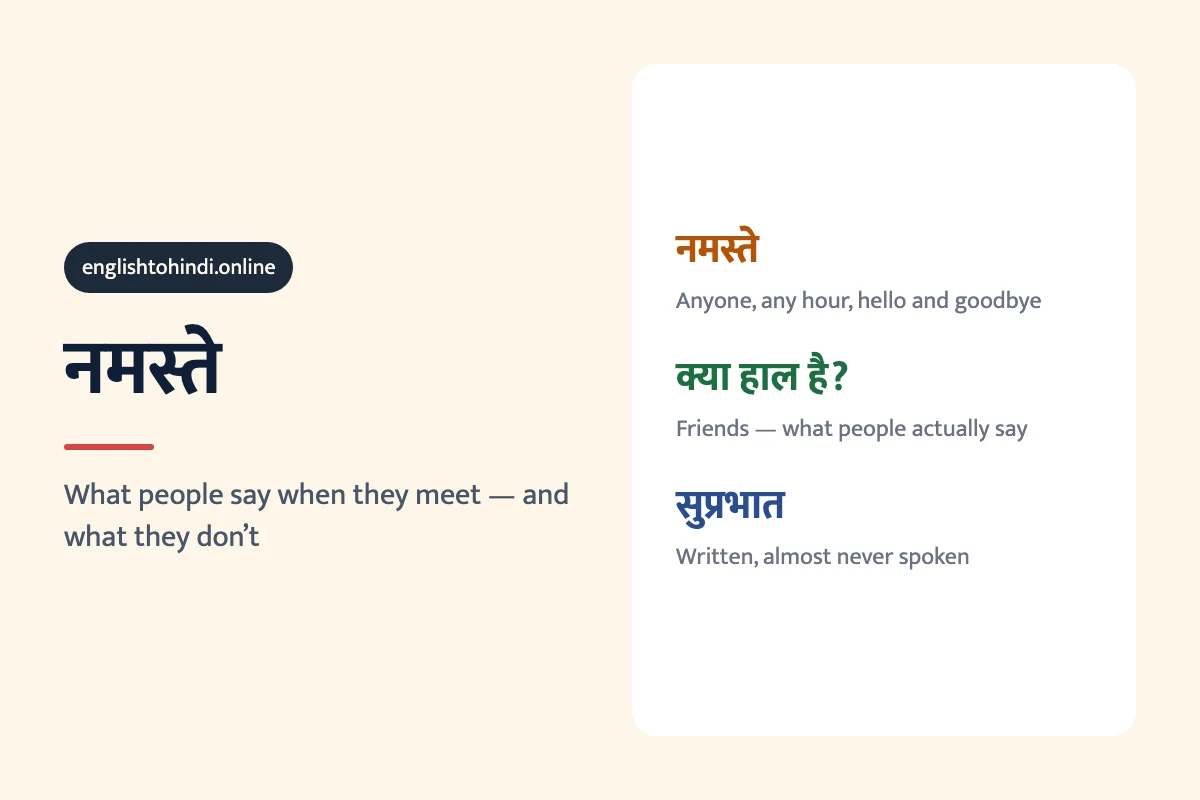
नमस्ते (namaste) is the standard Hindi greeting and works at any time of day, for hello and for goodbye, with anyone. नमस्कार (namaskaar) is its more formal version. There is no everyday equivalent of 'good morning' — सुप्रभात exists but is written, not spoken. Among friends, most people say कैसे हो? or simply और? rather than any formal greeting at all.
That last line is the gap between the phrasebook and the street. नमस्ते is correct everywhere, but using it with a close friend is a bit like greeting your flatmate with 'good day to you'. Each of the Hindi greetings is listed with the register it belongs to, so you can see which ones survive contact with actual friends.
What to say, and to whom
| Greeting | Roman | When |
|---|---|---|
| नमस्ते | namaste | Anyone, any hour. The safe default. |
| नमस्कार | namaskaar | More formal — an audience, an older stranger, writing. |
| कैसे हो? | kaise ho? | A friend or someone younger. Casual. |
| आप कैसे हैं? | aap kaise hain? | Polite 'how are you' to anyone senior. |
| और भाई! | aur bhai! | Close friends. Roughly 'so, mate?' |
| क्या हाल है? | kya haal hai? | Casual 'how's it going', very common. |
Note that कैसे हो and आप कैसे हैं are the same question at two different levels of formality — the verb changes because the pronoun does. Getting that level right matters more than the greeting itself.
The hands, and whether you need them
नमस्ते is traditionally said with palms pressed together at the chest, a gesture called नमस्कार मुद्रा. In practice it is optional and situational: common when meeting elders, greeting a host, or entering a temple; less common between colleagues, who will often just nod or shake hands.
The gesture is never wrong. If you are unsure whether to offer a handshake — especially when greeting a woman you have not met, where a handshake may or may not be expected — नमस्ते with folded hands sidesteps the question entirely and is read as respectful.
Greetings that are not Hindi-neutral
Several greetings you will hear constantly in India carry a religious or regional identity. Using them is friendly when matched correctly and slightly odd when not.
| Greeting | Used by | Notes |
|---|---|---|
| सत श्री अकाल | Sikhs, and widely in Punjab | Sat Sri Akal — expected in Punjabi settings |
| आदाब | Urdu speakers, Muslim contexts | Aadaab — often with a raised hand gesture |
| राम राम | Rural north India, older speakers | Both a hello and a goodbye |
| जय श्री कृष्ण | Gujarat, Vaishnav communities | Regionally specific |
None of these are off-limits to a learner, but they are not defaults. नमस्ते is the one that carries no assumption about who the other person is.
Morning, evening, and the सुप्रभात trap
Hindi does have time-specific greetings — सुप्रभात (good morning), शुभ संध्या (good evening) — and almost nobody says them. They belong to news broadcasts, formal letters, and the pious message your relative forwards at 6 a.m.
- Speaking to someone in the morning: नमस्ते, or 'good morning' in English, which is extremely common.
- Writing a formal letter or greeting an audience: सुप्रभात is appropriate.
- Saying it to a friend at breakfast: they will assume you are being funny.
English greetings are fully naturalised in urban Hindi. 'Hi', 'hello' and 'good morning' are used constantly by people speaking otherwise entirely in Hindi, and none of it reads as showing off.
Goodbye, and the phone
| Situation | Say | Notes |
|---|---|---|
| Leaving | नमस्ते | Same word as hello |
| Leaving, casually | चलता हूँ / चलती हूँ | 'I'll be off' — ending matches your own gender |
| See you later | फिर मिलते हैं | phir milte hain |
| Answering the phone | हैलो | Not नमस्ते — 'hello' is standard |
| Formal farewell | अलविदा | alvida — dramatic, implies a long parting |
चलता हूँ versus चलती हूँ depends on the speaker, not the listener — a man says the first, a woman the second, exactly as with every other Hindi verb.
अलविदा is not the everyday goodbye that dictionaries imply. It carries the weight of a real farewell, closer to English 'farewell' than 'bye'. For leaving a shop, नमस्ते is what people actually say.
Frequently asked questions
What is the most common Hindi greeting?
नमस्ते (namaste). It works at any time of day, for both hello and goodbye, with strangers and elders alike. नमस्कार is a more formal variant used in speeches and writing.
How do you say good morning in Hindi?
सुप्रभात (suprabhaat) is the literal translation, but it is almost never spoken — it belongs to broadcasts and formal writing. In conversation people say नमस्ते, or simply 'good morning' in English, which is very common in Indian Hindi.
What is the difference between namaste and namaskar?
They mean the same thing. नमस्कार is the more formal and slightly more traditional of the two, used when addressing an audience, in writing, or with someone considerably senior. नमस्ते fits everywhere else.
Do you have to put your hands together when saying namaste?
No. The folded-hands gesture is common when greeting elders, hosts, or entering a temple, and optional otherwise. It is never wrong, which makes it a useful default when you are unsure whether a handshake is expected.
How do Indians answer the phone in Hindi?
हैलो — the English 'hello'. नमस्ते on a call sounds unusually formal. Many people follow it with हाँ जी or कहिए, which invites the caller to say what they need.
How do you say goodbye in Hindi?
नमस्ते again, since it serves for both. Casually, चलता हूँ (man speaking) or चलती हूँ (woman speaking) means 'I'll be off', and फिर मिलते हैं means 'see you later'. अलविदा exists but implies a long or final parting.
More guides
- Hindi plurals: लड़का, लड़के, लड़कों and which to use whenHindi has two plurals for every noun: one for the plain sentence and one for when a postposition follows. लड़के and लड़कों are both “boys”, and using the wrong one is the most common learner error.
- वाला in Hindi: what वाला, वाली and वाले actually meanवाला means “the one that” — the one who sells it, the one wearing it, the thing about to happen. One suffix doing three jobs English needs three constructions for.
- How to say “can” in Hindi: सकना, आना and पानामैं हिंदी बोल सकता हूँ. Ability, permission and “managed to” are three different verbs in Hindi, and picking the wrong one is the usual learner mistake.
Looking for a specific phrase? Browse the phrase guides.