अगर … तो: how to say “if” in Hindi
The englishtohindi.online editors · · 6 min read
अगर opens the condition and तो opens the result. Hindi says both halves out loud, and the तो is the half you cannot drop.
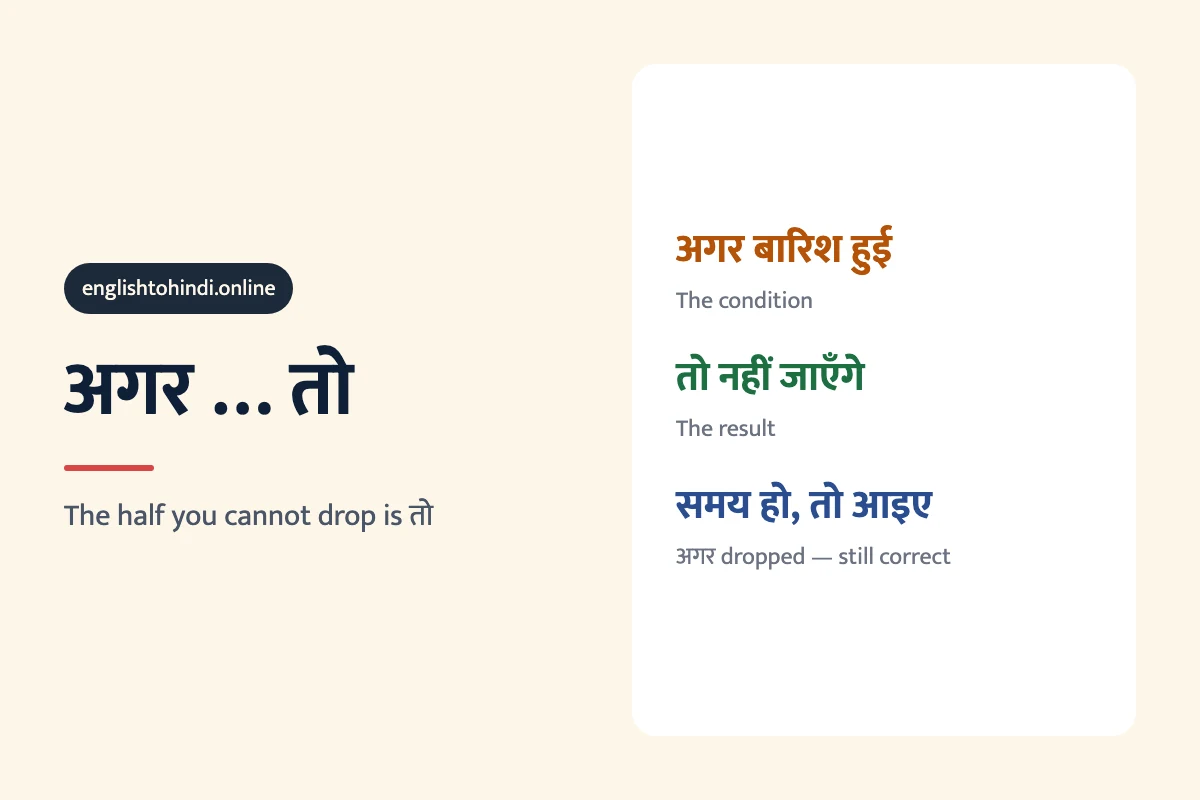
“If” in Hindi is अगर (agar), and it works as a pair with तो (to), which introduces the result. अगर बारिश हुई, तो हम नहीं जाएँगे means “if it rains, we won’t go”. The surprise for English speakers is which half is optional: अगर can be dropped and the sentence still works, but तो cannot.
This is the same two-marker structure Hindi uses everywhere — जो with वह, जितना with उतना. A conditional is just one more correlative pair, and recognising it as one makes the whole family easier.
The basic conditional
| Hindi | Roman | English |
|---|---|---|
| अगर तुम आओगे, तो मैं भी आऊँगा | Agar tum aaoge, to main bhi aaunga | If you come, I’ll come too |
| अगर बारिश हुई, तो हम घर पर रहेंगे | Agar baarish hui, to hum ghar par rahenge | If it rains, we’ll stay home |
| अगर आपको समय हो, तो बताइए | Agar aapko samay ho, to bataiye | If you have time, let me know |
| समय हो, तो आइए | Samay ho, to aaiye | If you have time, do come |
That last row is the point. अगर has vanished and the sentence is still a perfectly ordinary conditional, because तो is carrying it. Native speakers drop अगर constantly in speech. Dropping तो instead leaves the sentence sounding cut in half.
यदि is the formal written equivalent of अगर, the way अधिक is the formal ज़्यादा. You will meet यदि in news, textbooks and official notices, and almost never in conversation.
The verb in the “if” half
English uses the present tense after “if” even when talking about the future — “if it rains tomorrow”. Hindi does not. The condition takes either the subjunctive or the perfective, depending on how likely you think it is.
| Condition verb | Sense | Example |
|---|---|---|
| Subjunctive (आओ, हो, मिले) | Open possibility | अगर वह आए, तो बता देना |
| Perfective (हुआ, आया, मिला) | Likely, treated as settled | अगर बारिश हुई, तो नहीं जाएँगे |
| Future (आओगे, करोगे) | Common in speech, slightly looser | अगर तुम आओगे, तो अच्छा होगा |
अगर बारिश हुई uses a past-looking form for a future event, which reads as strange until you see the logic: the speaker is treating the rain as a done thing and describing what follows from it. The tense forms themselves are covered in Hindi verb tenses.
The unreal conditional: होता … होता
For something that did not happen or cannot happen — “if I were rich”, “if I had known” — Hindi uses the habitual form ending in ता in both halves. It is one of the tidiest constructions in the language, because both clauses take the same shape.
- अगर मैं अमीर होता, तो यह घर खरीदता — if I were rich, I would buy this house.
- अगर मुझे पता होता, तो मैं ज़रूर आता — if I had known, I would definitely have come.
- अगर तुम कहते, तो मैं रुक जाता — if you had said so, I would have stayed.
The ता ending agrees with the speaker’s gender, so a woman says अगर मुझे पता होता, तो मैं ज़रूर आती. That agreement is the subject of Hindi verb gender.
अगर मुझे पता होता, तो मैं ज़रूर आता।
Agar mujhe pata hota, to main zaroor aata.
वरना and नहीं तो: otherwise
The negative flip side of a conditional is वरना or नहीं तो, both meaning “otherwise” or “or else”. They join two clauses without needing अगर at all.
- जल्दी चलो, वरना ट्रेन छूट जाएगी — hurry up, or we’ll miss the train.
- अभी खा लो, नहीं तो ठंडा हो जाएगा — eat now, otherwise it’ll go cold.
- दवा लीजिए, वरना तबीयत और बिगड़ेगी — take the medicine, or you’ll get worse.
तो does other jobs too
तो outside a conditional is a small emphasis particle, and this is where learners get confused hearing it mid-sentence. मैं तो जा रहा हूँ means “I, for one, am going”. यह तो बहुत महँगा है means “this is really expensive”. Same word, no “if” anywhere in sight.
तो with this emphatic sense is placed after the word it emphasises, not at the head of a clause. Position is what separates the two uses, in the same way it separates the two jobs of क्या in Hindi question words.
The short version
- अगर opens the condition, तो opens the result.
- अगर can be dropped; तो cannot.
- यदि is the formal written version of अगर.
- For real conditions use the subjunctive or perfective — अगर वह आए, अगर बारिश हुई.
- For unreal ones use ता in both halves — अगर मैं अमीर होता, तो खरीदता.
- वरना and नहीं तो mean “otherwise”.
Frequently asked questions
How do you say “if” in Hindi?
Use अगर for the condition and तो for the result. अगर बारिश हुई, तो हम नहीं जाएँगे means “if it rains, we won’t go”. Hindi states both halves of the pair, and while अगर is often dropped in speech, तो is the half that cannot be left out.
What is the difference between अगर and यदि?
They mean exactly the same thing. अगर is the everyday spoken word and यदि is its formal written equivalent, found in news reports, textbooks and official notices. In conversation, अगर is used almost every time.
Can you drop अगर in a Hindi conditional?
Yes. समय हो, तो आइए is a complete and natural sentence meaning “if you have time, do come”, with no अगर in it at all. तो alone is enough to mark the sentence as a conditional, which is why dropping तो instead makes the sentence sound unfinished.
How do you say “if I were” or “if I had known” in Hindi?
Use the ता form in both halves of the sentence. अगर मैं अमीर होता, तो यह घर खरीदता means “if I were rich, I would buy this house”, and अगर मुझे पता होता, तो मैं ज़रूर आता means “if I had known, I would certainly have come”. The ता ending agrees with the speaker’s gender, so a woman would say आती.
What does वरना mean in Hindi?
वरना means “otherwise” or “or else”, and joins a warning to an instruction. जल्दी चलो, वरना ट्रेन छूट जाएगी means “hurry up, or we’ll miss the train”. नहीं तो means the same thing and is used interchangeably.
Why does तो appear in sentences that have no “if” in them?
तो has a second job as an emphasis particle. मैं तो जा रहा हूँ means “I, for one, am going”, and यह तो बहुत महँगा है means “this is really expensive”. Position tells the two uses apart: emphatic तो follows the word it emphasises, while conditional तो opens the result clause.
More guides
- Hindi plurals: लड़का, लड़के, लड़कों and which to use whenHindi has two plurals for every noun: one for the plain sentence and one for when a postposition follows. लड़के and लड़कों are both “boys”, and using the wrong one is the most common learner error.
- वाला in Hindi: what वाला, वाली and वाले actually meanवाला means “the one that” — the one who sells it, the one wearing it, the thing about to happen. One suffix doing three jobs English needs three constructions for.
- How to say “can” in Hindi: सकना, आना and पानामैं हिंदी बोल सकता हूँ. Ability, permission and “managed to” are three different verbs in Hindi, and picking the wrong one is the usual learner mistake.
Looking for a specific phrase? Browse the phrase guides.