लगना in Hindi: “seem”, “feel”, “take” and six other jobs
The englishtohindi.online editors · · 7 min read
मुझे लगता है, भूख लगी है, दो घंटे लगेंगे, चोट लग गई. One verb covers ground that English needs nine different verbs for.
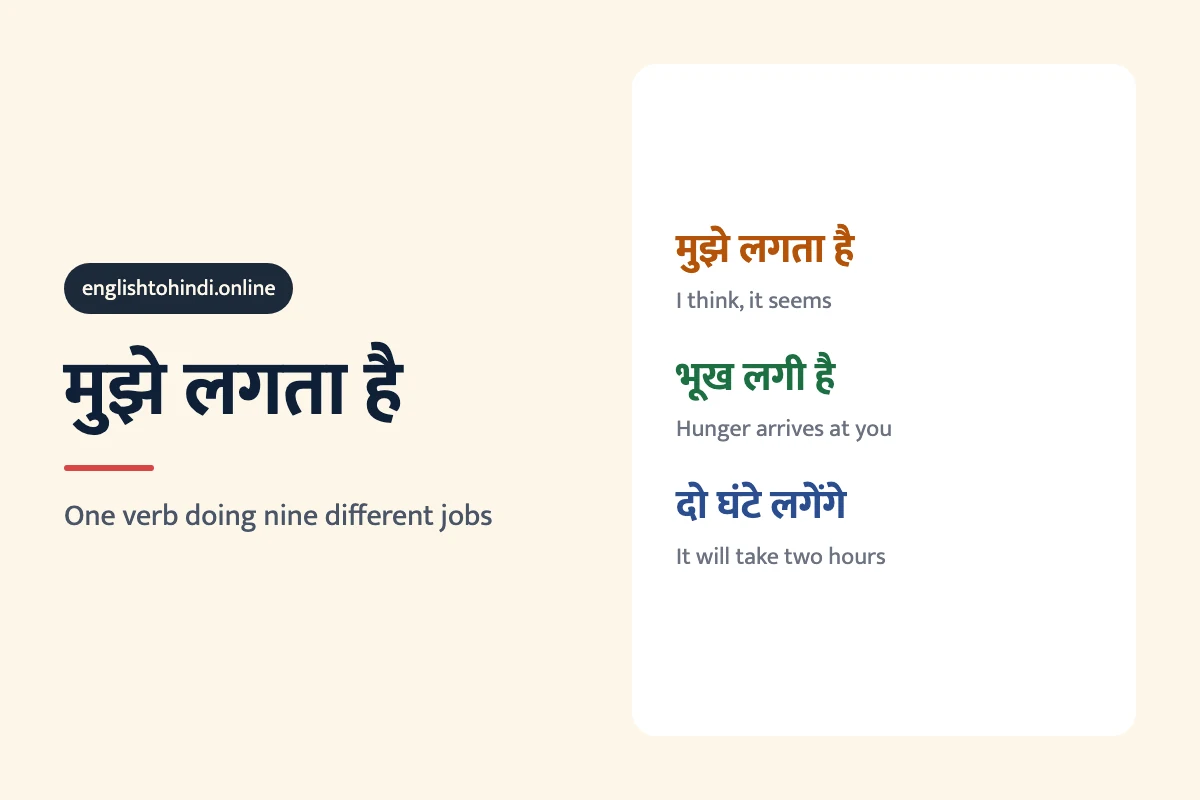
लगना (lagna) is one of the most common verbs in Hindi and it has no single English translation. Its core sense is “to be applied to” or “to attach”, and from that it covers seeming (मुझे लगता है, “it seems to me”), feeling (भूख लगी है, “I’m hungry”), taking time (दो घंटे लगेंगे, “it’ll take two hours”), costing, getting hurt, liking, and starting to do something.
The thread running through all of them is that something happens to you rather than being done by you. That is why the person is almost always marked with को — मुझे, तुम्हें, उसे — and never appears as a plain subject. It is the pattern under most of the phrases for illness and pain, where the symptom does the acting and you are on the receiving end.
The rule that unlocks all of them
In a लगना sentence, the verb does not agree with the person. It agrees with the thing being felt, seemed or taken. This is the same dative pattern behind चाहिए and it trips up every learner at least once.
| Hindi | Roman | Verb agrees with |
|---|---|---|
| मुझे भूख लगी है | Mujhe bhookh lagi hai | भूख — feminine, so लगी |
| मुझे डर लगता है | Mujhe dar lagta hai | डर — masculine, so लगता |
| मुझे किताबें अच्छी लगती हैं | Mujhe kitaabein achchhi lagti hain | किताबें — feminine plural |
| दो घंटे लगेंगे | Do ghante lagenge | घंटे — masculine plural |
मुझे लगती हूँ is never correct. The speaker is not the subject of लगना, so the verb can never take a हूँ ending in agreement with मैं. If you find yourself reaching for a first-person ending, the sentence has gone wrong.
1. To think, to seem
मुझे लगता है is how Hindi says “I think” in the sense of “it seems to me”. It is softer than सोचना, which is thinking as a deliberate activity, and it is what people actually use to offer an opinion.
- मुझे लगता है कि वह नहीं आएगा — I think he won’t come.
- आपको क्या लगता है? — what do you think?
- ऐसा लगता है कि बारिश होगी — it looks like it’ll rain.
Without को it means “to seem” about a thing rather than to a person: वह बीमार लगता है, “he looks ill”. यह अच्छा लगता है, “this looks good”.
2. Hunger, thirst, fear, cold
Physical and emotional states are things that happen to you in Hindi, and लगना is the verb that delivers them. मैं भूखा हूँ is the classic learner error — the natural sentence is मुझे भूख लगी है.
| Hindi | Roman | English |
|---|---|---|
| मुझे भूख लगी है | Mujhe bhookh lagi hai | I’m hungry |
| मुझे प्यास लगी है | Mujhe pyaas lagi hai | I’m thirsty |
| मुझे डर लग रहा है | Mujhe dar lag raha hai | I’m scared |
| मुझे ठंड लग रही है | Mujhe thand lag rahi hai | I’m cold |
| मुझे नींद लग रही है | Mujhe neend lag rahi hai | I’m getting sleepy |
This is one of the seven errors listed in common Hindi mistakes, and it belongs to the same family as the possession patterns in Hindi has no verb “to have” — states arrive at you, they are not things you are.
3. To like
अच्छा लगना means “to feel good to someone”, which is how Hindi says you like something. It sits alongside पसंद होना, and the difference is real: अच्छा लगना is the momentary feeling, पसंद है is the settled preference.
मुझे यह गाना बहुत अच्छा लगता है।
Mujhe yah gaana bahut achchha lagta hai.
अच्छा agrees with the thing liked, not with you — मुझे यह किताब अच्छी लगती है, because किताब is feminine.
4. To take time
For duration, लगना is the only natural verb. There is no Hindi equivalent of “it takes” using करना.
- कितना समय लगेगा? — how long will it take?
- दो घंटे लगेंगे — it’ll take two hours.
- मुझे आने में देर लगी — it took me a while to get here.
5. To cost
पैसे लगना is what something costs you in effort or money, distinct from asking a price. कितने पैसे लगेंगे? means “how much will it come to?”, while कितने का है? asks what an item is priced at.
6. To get hurt
चोट लगना is the standard way to say someone was injured. The person takes को and the injury does the arriving: उसे चोट लग गई, “he got hurt”. There is no way to say it that makes the person the agent, which is arguably more accurate about how injuries work.
7. To begin — the one that changes the grammar
Put an oblique infinitive in front of लगना and it stops meaning anything about feeling and means “started to”. जाना becomes जाने, so वह जाने लगा means “he started to go”. This is the same oblique-infinitive shape that वाला takes.
| Hindi | Roman | English |
|---|---|---|
| बारिश होने लगी | Baarish hone lagi | It started raining |
| वह रोने लगा | Wah rone laga | He started crying |
| मुझे समझ आने लगा | Mujhe samajh aane laga | I started to understand |
In this use there is no को on the person, because the subject really is doing the action — वह रोने लगा, not उसे रोने लगा. It is the one लगना construction that behaves like an ordinary verb.
The short version
- The person takes को; the verb agrees with the thing, never with the person.
- मुझे लगता है — I think, it seems to me.
- मुझे भूख लगी है — I’m hungry. Not मैं भूखा हूँ.
- मुझे अच्छा लगता है — I like it.
- दो घंटे लगेंगे — it’ll take two hours.
- चोट लगना — to get hurt.
- Oblique infinitive plus लगना — started to: वह जाने लगा.
Frequently asked questions
What does लगना mean in Hindi?
लगना has no single English equivalent. Its core sense is “to be applied to” or “to attach”, and it covers seeming (मुझे लगता है), feeling hungry or afraid (मुझे भूख लगी है), taking time (दो घंटे लगेंगे), costing, getting hurt (चोट लगना), liking (अच्छा लगना) and starting to do something (वह जाने लगा).
How do you say “I think” in Hindi?
मुझे लगता है, literally “it seems to me”. मुझे लगता है कि वह नहीं आएगा means “I think he won’t come”. सोचना also means to think, but it describes deliberate thinking rather than offering an opinion, so मुझे लगता है is what people use in conversation.
Why is it मुझे भूख लगी है and not मैं भूखा हूँ?
Because Hindi treats hunger as something that arrives at you rather than something you are. मुझे भूख लगी है literally means “hunger has attached to me”. मैं भूखा हूँ is understood but sounds unnatural, and it is one of the most common mistakes English speakers make.
Why does the verb in a लगना sentence not agree with the speaker?
Because the speaker is not the subject. The thing being felt is. In मुझे किताबें अच्छी लगती हैं, the verb agrees with किताबें, which is feminine plural, and the speaker is marked with को as मुझे. This is why मुझे लगती हूँ is never correct.
What is the difference between अच्छा लगना and पसंद होना?
अच्छा लगना is the momentary feeling — मुझे यह गाना अच्छा लग रहा है means you are enjoying it right now. पसंद होना is the settled preference — मुझे यह गाना पसंद है means it is a song you like generally. Both make the liked thing the grammatical subject.
How do you say “it started raining” in Hindi?
बारिश होने लगी. Putting an oblique infinitive in front of लगना means “started to” — होना becomes होने, रोना becomes रोने, and वह रोने लगा means “he started crying”. In this construction the person is a normal subject and takes no को.
More guides
- Hindi plurals: लड़का, लड़के, लड़कों and which to use whenHindi has two plurals for every noun: one for the plain sentence and one for when a postposition follows. लड़के and लड़कों are both “boys”, and using the wrong one is the most common learner error.
- वाला in Hindi: what वाला, वाली and वाले actually meanवाला means “the one that” — the one who sells it, the one wearing it, the thing about to happen. One suffix doing three jobs English needs three constructions for.
- How to say “can” in Hindi: सकना, आना and पानामैं हिंदी बोल सकता हूँ. Ability, permission and “managed to” are three different verbs in Hindi, and picking the wrong one is the usual learner mistake.
Looking for a specific phrase? Browse the phrase guides.