English idioms in Hindi: 20 common phrases and what they actually become
The englishtohindi.online editors · · 8 min read
English idioms cannot be translated word for word — Hindi answers them with its own मुहावरे. Here are 20 everyday idioms and the Hindi phrase a native speaker would use instead.
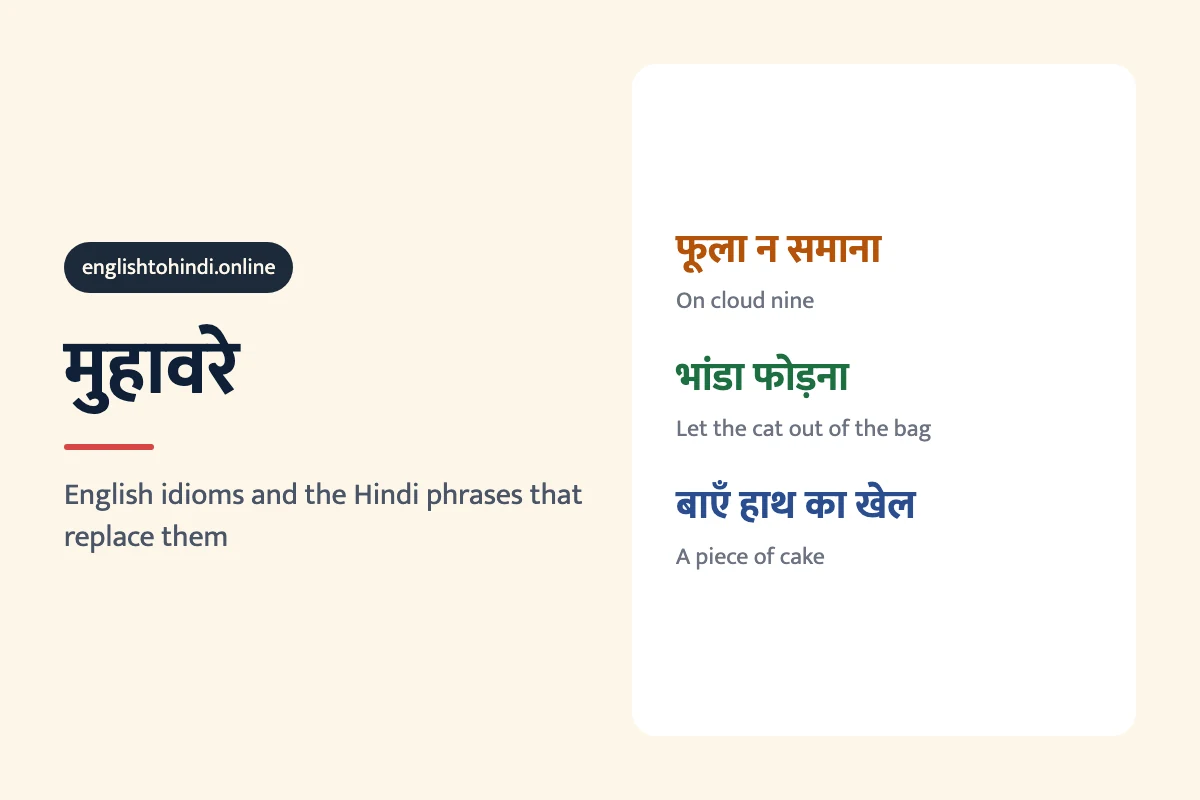
An English idiom almost never survives a word-for-word translation into Hindi. “On cloud nine” becomes फूला न समाना, literally “swelling so much you cannot contain yourself”. “Let the cat out of the bag” becomes भांडा फोड़ना, “to break the pot”. “Add fuel to the fire” becomes आग में घी डालना, “to pour ghee on the fire”. In every case Hindi already has its own idiom — a मुहावरा — that carries the same meaning through a completely different image.
This is the single hardest thing to get right when moving between the two languages, and the place where translation tools fail most visibly. Translate the words and you get नौ बादल पर for “on cloud nine”, which means nothing at all to a Hindi speaker. Translate the meaning and you have to know which मुहावरा the situation calls for.
The table below pairs 20 common English idioms with the Hindi phrase a native speaker would actually reach for, and shows what each Hindi phrase says literally — because the literal reading is what makes them memorable.
Idioms about luck, joy and misfortune
| English idiom | Hindi equivalent | What the Hindi says |
|---|---|---|
| On cloud nine | फूला न समाना | Swelling with joy beyond containing |
| Every cloud has a silver lining | हर रात की सुबह होती है | Every night has its morning |
| Once in a blue moon | ईद का चाँद होना | To be the Eid moon — seen once a year |
| Go down in flames | औंधे मुँह गिरना | To fall flat on your face |
| Add fuel to the fire | आग में घी डालना | To pour ghee on the fire |
परीक्षा का नतीजा सुनकर वह फूला न समाया।
Pareeksha ka nateeja sunkar vah phoola na samaaya.
फूला न समाना changes with the speaker’s gender, like most Hindi verbs — वह फूला न समाया for a man, वह फूली न समाई for a woman. If that agreement is unfamiliar, Hindi verbs and gender covers the rule.
Idioms about secrets and speaking plainly
| English idiom | Hindi equivalent | What the Hindi says |
|---|---|---|
| Let the cat out of the bag | भांडा फोड़ना | To break the pot |
| Spill the beans | पेट की बात बाहर निकालना | To let out what is in the stomach |
| Beat around the bush | घुमा-फिराकर बात करना | To talk in circles |
| Hit the nail on the head | तीर निशाने पर लगना | The arrow struck the target |
| Pot calling the kettle black | उल्टा चोर कोतवाल को डाँटे | The thief scolds the constable instead |
सीधे बताओ, घुमा-फिराकर बात मत करो।
Seedhe batao, ghuma-phirakar baat mat karo.
Idioms about difficulty, cost and giving up
| English idiom | Hindi equivalent | What the Hindi says |
|---|---|---|
| A piece of cake | बाएँ हाथ का खेल | A game for the left hand |
| Cost an arm and a leg | कमर तोड़ देना | To break your back |
| Throw in the towel | हथियार डाल देना | To lay down your weapons |
| Back to square one | ढाक के तीन पात | The dhak tree still has three leaves — nothing changed |
| In the same boat | एक ही नाव में सवार होना | Riding in the same boat |
यह सवाल उसके लिए बाएँ हाथ का खेल है।
Yah sawaal uske liye baayen haath ka khel hai.
Idioms about people and behaviour
| English idiom | Hindi equivalent | What the Hindi says |
|---|---|---|
| Head in the clouds | ख़्याली पुलाव पकाना | To cook an imaginary pulao |
| Jump on the bandwagon | भेड़चाल | Sheep-walk — following the herd |
| Once bitten, twice shy | दूध का जला छाछ भी फूँक-फूँककर पीता है | Burnt by milk, he blows on buttermilk too |
| Under the weather | तबीयत नासाज़ होना | The health is out of tune |
| Break the ice | झिझक तोड़ना | To break the hesitation |
Where Hindi has no equivalent at all
Two entries in that last table are honest approximations rather than real मुहावरे, and it is worth knowing which.
- “Break the ice” has no idiomatic Hindi counterpart. झिझक तोड़ना is a plain description of the act, not a fixed phrase, and बात शुरू करना — simply “to start talking” — is what most speakers say.
- “Under the weather” is usually not idiomatic in Hindi either. तबीयत ठीक नहीं है, “my health is not right”, is the everyday sentence, and it uses the same मुझे construction as मुझे बुखार है — see Hindi has no verb “to have”.
- Going the other way, Hindi has मुहावरे with no English idiom behind them. नौ दो ग्यारह होना, literally “to become nine two eleven”, means to run away — and no English phrase matches the image.
Why translation tools get idioms wrong
A translation engine works sentence by sentence and has no way to recognise that a phrase is figurative. Feed it “he kicked the bucket” and you may get उसने बाल्टी को लात मारी — he struck a bucket with his foot — which is grammatical, fluent, and about a bucket. The failure is not in the grammar but in the idiom, and the more natural the English, the more likely it is to break this way.
This is the same class of problem described in why translation tools fail at Hinglish: the output is confident and wrong, and nothing in it looks like an error.
A practical test before you use any translated idiom: read the Hindi back literally. If the literal reading is about weather, buckets or cake, the idiom did not survive and you need the Hindi मुहावरा instead.
Using these without sounding odd
- मुहावरे belong in speech and informal writing. In an official letter or an exam answer, plain wording is safer.
- Keep the verb agreement correct — a मुहावरा still inflects for gender and number like any other Hindi verb phrase.
- The verb sits at the end, as always: उसने भांडा फोड़ दिया, not उसने फोड़ दिया भांडा. Hindi word order has the full rule.
- Two or three well-placed मुहावरे sound fluent. A paragraph made of them sounds like a textbook.
The short version
- Never translate an idiom word for word — translate the meaning, then find the Hindi मुहावरा for it.
- On cloud nine → फूला न समाना. Let the cat out of the bag → भांडा फोड़ना. A piece of cake → बाएँ हाथ का खेल.
- Some English idioms have no Hindi equivalent; say the plain thing instead of inventing one.
- Read any machine-translated idiom back literally. If it is about a bucket, it is wrong.
Frequently asked questions
How do you say “on cloud nine” in Hindi?
फूला न समाना, literally “to swell with joy beyond containing”. वह फूला न समाया means “he was on cloud nine”, and the verb changes for a woman — वह फूली न समाई. The literal translation नौ बादल पर is meaningless in Hindi.
What is a मुहावरा in Hindi?
A मुहावरा (muhāvarā) is a Hindi idiom — a fixed phrase whose meaning is not the sum of its words. आग में घी डालना literally says “to pour ghee on the fire” and means to make a bad situation worse. Hindi मुहावरे are the direct counterpart of English idioms, though the images behind them rarely match.
Can English idioms be translated into Hindi word for word?
No. A word-for-word translation of an English idiom produces a sentence that is grammatically correct and meaningless, such as नौ बादल पर for “on cloud nine”. The meaning has to be carried by the equivalent Hindi मुहावरा instead — भांडा फोड़ना for “let the cat out of the bag”, हथियार डाल देना for “throw in the towel”.
Why do translation tools fail on idioms?
Translation tools work sentence by sentence and cannot tell that a phrase is figurative. “He kicked the bucket” is translated as a man striking an actual bucket, because every individual word is translated correctly. The grammar is fine and the meaning is lost, which is why the error is easy to miss.
Which English idioms have no Hindi equivalent?
“Break the ice” and “under the weather” are two common ones. Hindi expresses both with plain wording — बात शुरू करना for starting a conversation, तबीयत ठीक नहीं है for feeling unwell — rather than with a fixed idiom.
What does नौ दो ग्यारह होना mean?
नौ दो ग्यारह होना literally reads “to become nine two eleven” and means to run away or disappear quickly. It is an example of a Hindi मुहावरा with no matching English idiom, so it has to be translated by meaning rather than by image.
More guides
- Hindi plurals: लड़का, लड़के, लड़कों and which to use whenHindi has two plurals for every noun: one for the plain sentence and one for when a postposition follows. लड़के and लड़कों are both “boys”, and using the wrong one is the most common learner error.
- वाला in Hindi: what वाला, वाली and वाले actually meanवाला means “the one that” — the one who sells it, the one wearing it, the thing about to happen. One suffix doing three jobs English needs three constructions for.
- How to say “can” in Hindi: सकना, आना and पानामैं हिंदी बोल सकता हूँ. Ability, permission and “managed to” are three different verbs in Hindi, and picking the wrong one is the usual learner mistake.
Looking for a specific phrase? Browse the phrase guides.