Comparing things in Hindi: से बड़ा, से ज़्यादा and सबसे
The englishtohindi.online editors · · 6 min read
Hindi has no “bigger” or “biggest”. It says “big from” instead — and once you know where से goes, every comparison in the language follows one pattern.
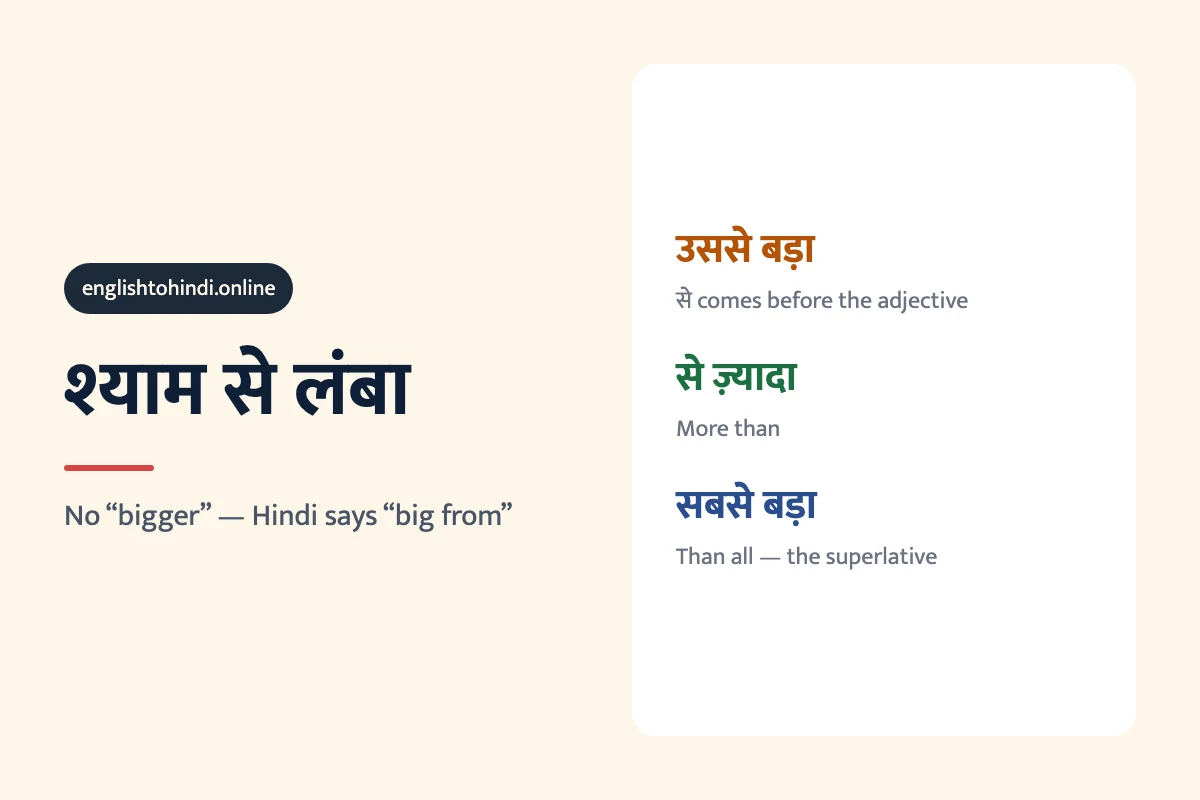
Hindi has no comparative ending like English “-er” and no superlative like “-est”. It compares with the postposition से, which here means “than”. राम श्याम से लंबा है means “Ram is taller than Shyam”, literally “Ram, Shyam from, tall is”. For the superlative, से becomes सबसे, “than all” — राम सबसे लंबा है means “Ram is the tallest”.
The adjective itself never changes for degree. बड़ा is big, bigger and biggest; what changes is the phrase in front of it. This makes comparison one of the easier corners of Hindi grammar, provided you put से in the right place.
The pattern: A, B से, adjective
The thing you are comparing against comes first, followed immediately by से, and the adjective comes last. English puts “than” after the adjective; Hindi puts it before. Reversing that is the single most common error.
| Hindi | Roman | English |
|---|---|---|
| यह उससे बड़ा है | Yah usse bada hai | This is bigger than that |
| दिल्ली मुंबई से ठंडी है | Dilli Mumbai se thandi hai | Delhi is colder than Mumbai |
| चाय कॉफ़ी से सस्ती है | Chai coffee se sasti hai | Tea is cheaper than coffee |
| मेरा भाई मुझसे लंबा है | Mera bhai mujhse lamba hai | My brother is taller than me |
मुझसे, उससे, इनसे and किससे are pronouns fused with से, exactly as described in Hindi postpositions. मैं से is never correct — it is always मुझसे.
The adjective still agrees
Degree does not change the adjective, but gender and number still do. ठंडा becomes ठंडी for a feminine noun, so दिल्ली मुंबई से ठंडी है uses ठंडी because दिल्ली is feminine. Which form you need is decided by Hindi noun gender, not by the comparison.
- यह लड़का उससे बड़ा है — this boy is older than him.
- यह लड़की उससे बड़ी है — this girl is older than her.
- ये कमरे उनसे बड़े हैं — these rooms are bigger than those.
से ज़्यादा and से कम
You can add ज़्यादा (more) or कम (less) after से for emphasis or where the comparison is about quantity rather than a quality. Both are extremely common in speech.
| Hindi | Roman | English |
|---|---|---|
| यह उससे ज़्यादा महँगा है | Yah usse zyaada mehnga hai | This is more expensive than that |
| आज कल से कम गर्मी है | Aaj kal se kam garmi hai | It’s less hot than yesterday |
| मुझे चाय कॉफ़ी से ज़्यादा पसंद है | Mujhe chai coffee se zyaada pasand hai | I like tea more than coffee |
| दस से ज़्यादा लोग आए | Das se zyaada log aaye | More than ten people came |
अधिक is the formal written equivalent of ज़्यादा. In conversation ज़्यादा is what you will hear almost every time; अधिक belongs to news reports and official writing.
सबसे: the superlative
सब means “all”, so सबसे is literally “than everyone”. Put it in front of the adjective and you have the superlative, with no other change to the sentence.
यह इस दुकान की सबसे अच्छी मिठाई है।
Yah is dukaan ki sabse achchhi mithai hai.
- सबसे बड़ा — the biggest.
- सबसे छोटा — the smallest, or the youngest in a family.
- सबसे पहले — first of all, before anything else.
- सबसे ज़्यादा — the most.
सबसे छोटा and सबसे बड़ा are the standard way to say youngest and eldest sibling, which is why they turn up constantly in the vocabulary of Hindi family words.
Comparing amounts: जितना और उतना
For “as … as”, Hindi uses another correlative pair — जितना in the first half and उतना in the second, the same two-marker structure behind जो and वह.
- यह उतना महँगा नहीं है — it isn’t that expensive.
- जितना तुम खा सको, उतना लो — take as much as you can eat.
- वह मुझसे उतना ही लंबा है — he is exactly as tall as me.
Mistakes worth avoiding
- Putting से after the adjective. यह बड़ा से उससे है is wrong; the order is यह उससे बड़ा है.
- Using मैं with से. It is मुझसे, not मैं से.
- Trying to inflect the adjective for degree. There is no बड़ातर — बड़ा already covers big, bigger and biggest.
- Using ज़्यादा without से in a direct comparison. यह ज़्यादा महँगा है means “this is more expensive”, but it does not say than what.
The short version
- Comparison is B से plus the adjective: राम श्याम से लंबा है.
- से comes before the adjective, unlike English “than”.
- Pronouns fuse with से: मुझसे, उससे, इनसे.
- Superlative is सबसे: सबसे बड़ा, सबसे अच्छी.
- ज़्यादा and कम add quantity; अधिक is the formal version of ज़्यादा.
Frequently asked questions
How do you say “than” in Hindi?
Hindi uses the postposition से. It goes after the thing being compared against and before the adjective, which is the reverse of English word order. राम श्याम से लंबा है means “Ram is taller than Shyam”, literally “Ram, Shyam from, tall is”.
How do you make comparatives in Hindi?
You do not change the adjective. Hindi has no equivalent of the English “-er” ending, so बड़ा means big and bigger alike. The comparison comes from adding से in front of the adjective — यह उससे बड़ा है means “this is bigger than that”.
What does सबसे mean?
सबसे means “than all” and forms the superlative. सबसे बड़ा is “the biggest”, सबसे अच्छा is “the best”, and सबसे पहले is “first of all”. It is simply सब, meaning all, joined to the same से used for ordinary comparisons.
What is the difference between ज़्यादा and अधिक?
They both mean “more” and are interchangeable in meaning. ज़्यादा is the everyday spoken word and is what you will hear in conversation. अधिक is formal and belongs to writing, news reports and official language.
Why is it मुझसे and not मैं से?
Pronouns fuse with postpositions in Hindi rather than sitting next to them. मैं plus से becomes मुझसे, वह plus से becomes उससे, and ये plus से becomes इनसे. The same fusion produces मुझे, तुम्हें and उसे with को.
How do you say “as tall as” in Hindi?
Use the pair जितना and उतना, or उतना ही for an exact match. वह मुझसे उतना ही लंबा है means “he is exactly as tall as me”, and जितना तुम खा सको, उतना लो means “take as much as you can eat”. Both halves of the pair are stated, unlike in English.
More guides
- Hindi plurals: लड़का, लड़के, लड़कों and which to use whenHindi has two plurals for every noun: one for the plain sentence and one for when a postposition follows. लड़के and लड़कों are both “boys”, and using the wrong one is the most common learner error.
- वाला in Hindi: what वाला, वाली and वाले actually meanवाला means “the one that” — the one who sells it, the one wearing it, the thing about to happen. One suffix doing three jobs English needs three constructions for.
- How to say “can” in Hindi: सकना, आना and पानामैं हिंदी बोल सकता हूँ. Ability, permission and “managed to” are three different verbs in Hindi, and picking the wrong one is the usual learner mistake.
Looking for a specific phrase? Browse the phrase guides.