कितने का है?: shopping and bargaining in Hindi
The englishtohindi.online editors · · 7 min read
The phrases that actually get used in a market — asking a price, halving it, asking for change, and the one sentence that ends a negotiation.
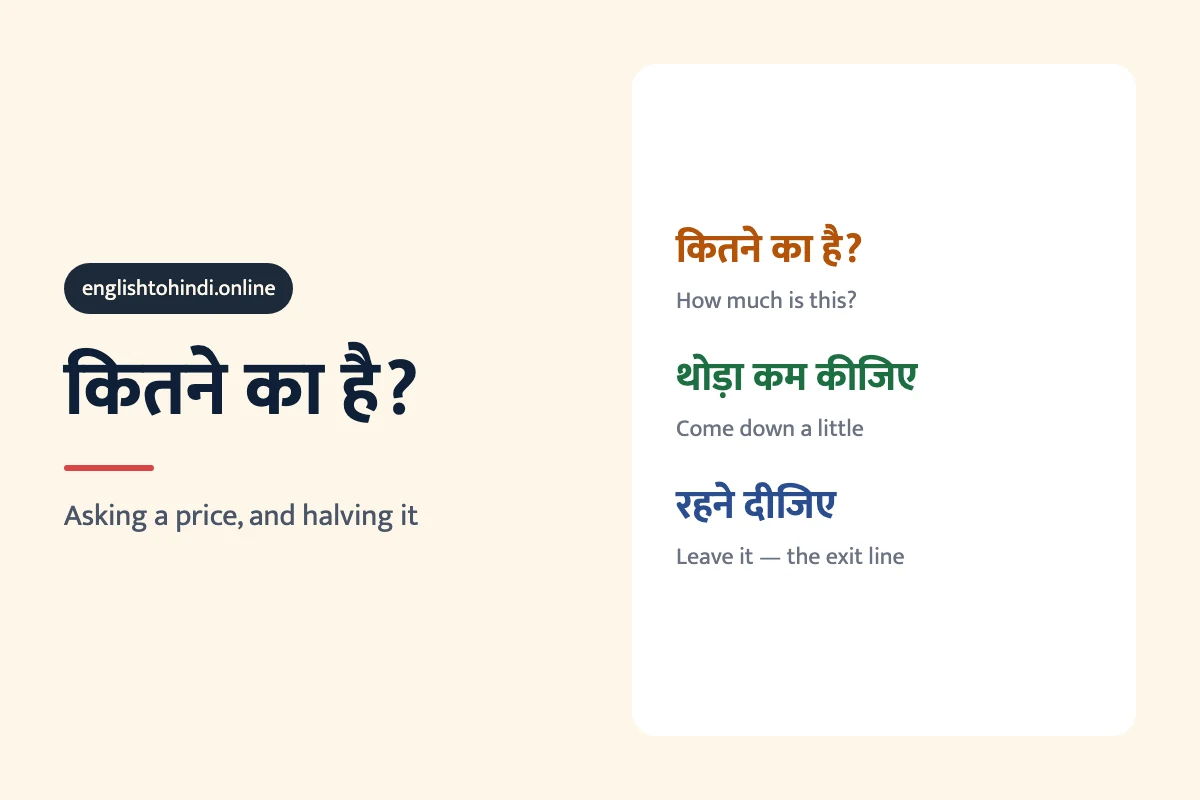
The core shopping phrase in Hindi is यह कितने का है? — “how much is this?”. If the item is feminine it becomes यह कितने की है?, and for plural items यह कितने के हैं?. To bargain, say बहुत महँगा है, थोड़ा कम कीजिए (“that’s very expensive, come down a bit”). To ask for a kilo of something, एक किलो दीजिए.
Almost every sentence you need in a market is one of about fifteen, and most of them are built from the polite imperatives दीजिए and कीजिए. Learn those two and the rest assembles itself — the everyday phrases list covers the ones that turn up outside the market too.
Asking the price
का, की and के change with the gender and number of the item, which is the one grammatical decision you have to make on the spot. Getting it wrong is understood instantly, so it is not worth freezing over.
| Hindi | Roman | Used for |
|---|---|---|
| यह कितने का है? | Yah kitne ka hai? | A masculine item — कुर्ता, आम |
| यह कितने की है? | Yah kitne ki hai? | A feminine item — कमीज़, साड़ी |
| ये कितने के हैं? | Ye kitne ke hain? | Plural masculine — जूते, आम |
| भाव क्या है? | Bhaav kya hai? | What’s the rate? — used for produce |
| कितने रुपये? | Kitne rupaye? | How many rupees? — blunt but universal |
Which form you need is decided by Hindi noun gender. If you genuinely cannot remember, कितने का है? is the form people default to and nobody will misunderstand you.
Pointing at the one you want
This is where वाला does the heavy lifting. Attach it to a colour, a size or a position and you have singled out an item without knowing its name.
- लाल वाला दिखाइए — show me the red one.
- बड़े वाला कितने का है? — how much is the big one?
- वो पीछे वाला — that one at the back.
- नीली वाली दे दीजिए — give me the blue one.
The colour words themselves are in colours in Hindi, including which ones change form and which never do.
Bargaining
Bargaining is expected in markets and street stalls, and not in shops with printed prices. The register is friendly rather than confrontational — these are requests, phrased as polite imperatives.
| Hindi | Roman | English |
|---|---|---|
| बहुत महँगा है | Bahut mehnga hai | That’s very expensive |
| थोड़ा कम कीजिए | Thoda kam kijiye | Come down a little |
| आख़िरी दाम क्या है? | Aakhri daam kya hai? | What’s your final price? |
| इतने में दे दीजिए | Itne mein de dijiye | Give it to me for this much |
| ठीक है, दे दीजिए | Theek hai, de dijiye | Fine, I’ll take it |
रहने दीजिए — “leave it” — is the sentence that ends a negotiation, and it is also the strongest move in one. Saying it while turning away produces a better price surprisingly often. Its polite form matters: रहने दे is blunt to the point of rude.
Every bargaining phrase here is an आप-level imperative, built the way Hindi imperatives describes. Using करो instead of कीजिए with a shopkeeper you have never met changes the tone considerably.
Quantities
| Hindi | Roman | English |
|---|---|---|
| एक किलो | Ek kilo | One kilo |
| आधा किलो | Aadha kilo | Half a kilo |
| पाव | Paav | Quarter kilo |
| ढाई किलो | Dhai kilo | Two and a half kilos |
| एक दर्जन | Ek darjan | A dozen |
| थोड़ा सा | Thoda sa | Just a little |
ढाई means 2.5 and डेढ़ means 1.5 — single words for quantities English needs three for. They belong to the same system as सवा and पौने, covered in Hindi numbers.
एक किलो टमाटर दीजिए। कितने का हुआ?
Ek kilo tamaatar dijiye. Kitne ka hua?
Paying
- छुट्टा है? — do you have change? छुट्टा is small change, and being asked for it constantly is a fact of life in India.
- खुले पैसे नहीं हैं — I don’t have change.
- कार्ड चलेगा? — will a card work?
- UPI चलेगा? — the question that has largely replaced the previous one.
- बिल दीजिए — give me the bill.
चलेगा literally means “will it walk”, and it is the everyday word for “will that be acceptable”. चलेगा? on its own is a complete question, and चलेगा as an answer means “that works”.
The short version
- यह कितने का है? — how much is this? की for feminine, के for plural.
- लाल वाला दिखाइए — show me the red one.
- बहुत महँगा है, थोड़ा कम कीजिए — the standard opening to a bargain.
- आख़िरी दाम क्या है? — what’s your final price?
- रहने दीजिए — leave it. The exit line, and the best leverage you have.
- छुट्टा है? — do you have change?
Frequently asked questions
How do you ask “how much is this?” in Hindi?
यह कितने का है? for a masculine item, यह कितने की है? for a feminine one, and ये कितने के हैं? for plural items. भाव क्या है? is used for produce sold by weight. If you are unsure of the gender, कितने का है? is the default form and will always be understood.
How do you bargain in Hindi?
Open with बहुत महँगा है, थोड़ा कम कीजिए — “that’s very expensive, come down a little”. Then ask आख़िरी दाम क्या है?, “what’s your final price?”. To close, say ठीक है, दे दीजिए. Bargaining is expected at markets and street stalls, but not in shops with printed prices.
What does रहने दीजिए mean?
रहने दीजिए means “leave it” or “never mind”, and it is how you walk away from a negotiation. Said while turning away, it frequently produces a better offer. Use the polite दीजिए form — रहने दे is blunt enough to sound rude to a stranger.
How do you ask for a kilo of something in Hindi?
एक किलो दीजिए, or name the item — एक किलो टमाटर दीजिए for a kilo of tomatoes. आधा किलो is half a kilo, पाव is a quarter kilo, डेढ़ किलो is one and a half, and ढाई किलो is two and a half.
What does छुट्टा mean?
छुट्टा means small change. छुट्टा है? means “do you have change?” and you will be asked it constantly, because shopkeepers frequently cannot break large notes. खुले पैसे means the same thing.
What does चलेगा mean in a shop?
चलेगा literally means “will it walk” and is the everyday way to ask whether something is acceptable. कार्ड चलेगा? means “will a card work?” and UPI चलेगा? asks the same about a UPI payment. As an answer, चलेगा means “that works for me”.
More guides
- Hindi plurals: लड़का, लड़के, लड़कों and which to use whenHindi has two plurals for every noun: one for the plain sentence and one for when a postposition follows. लड़के and लड़कों are both “boys”, and using the wrong one is the most common learner error.
- वाला in Hindi: what वाला, वाली and वाले actually meanवाला means “the one that” — the one who sells it, the one wearing it, the thing about to happen. One suffix doing three jobs English needs three constructions for.
- How to say “can” in Hindi: सकना, आना and पानामैं हिंदी बोल सकता हूँ. Ability, permission and “managed to” are three different verbs in Hindi, and picking the wrong one is the usual learner mistake.
Looking for a specific phrase? Browse the phrase guides.