रास्ता पूछना: asking for directions in Hindi
The englishtohindi.online editors · · 6 min read
स्टेशन कहाँ है? सीधा जाइए, फिर दाएँ मुड़िए. The phrases for asking the way, understanding the answer, and getting an auto to stop.
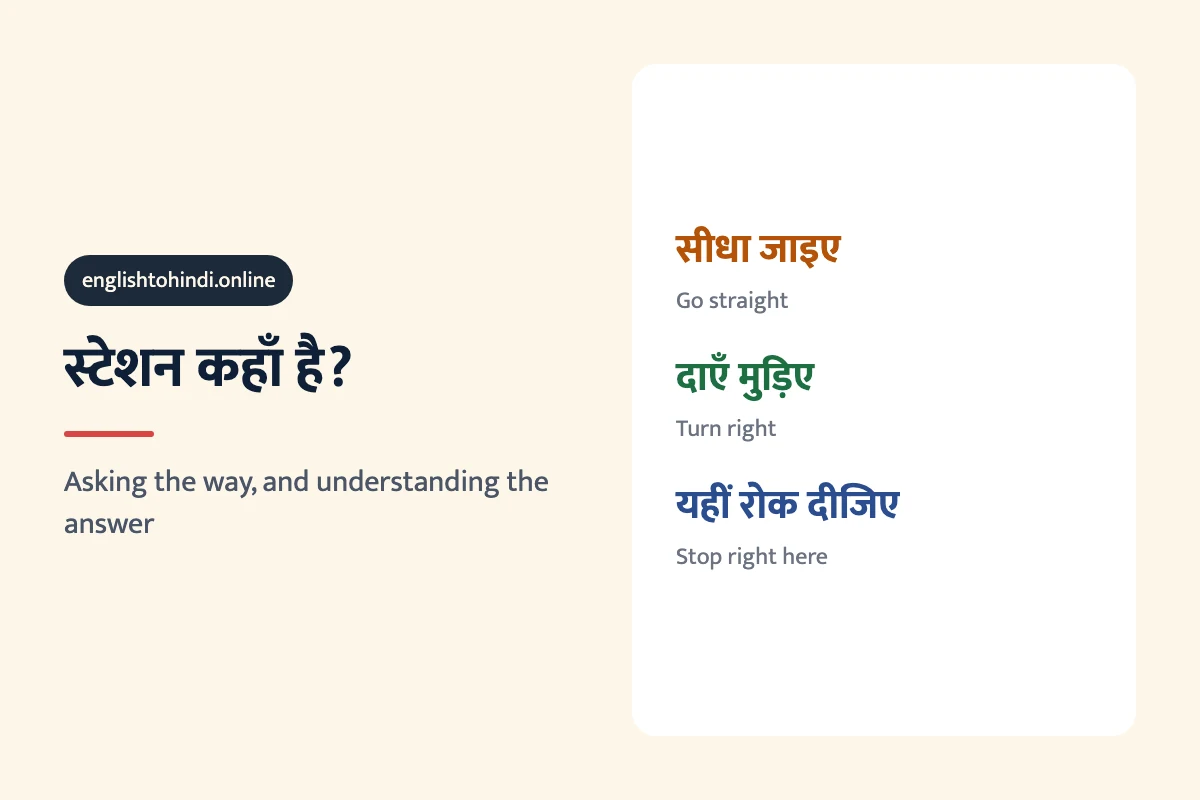
To ask the way in Hindi, say माफ़ कीजिए, स्टेशन कहाँ है? — “excuse me, where is the station?”. The answers you will get back are built from four words: सीधा (straight), दाएँ (right), बाएँ (left) and मुड़िए (turn). सीधा जाइए, फिर दाएँ मुड़िए means “go straight, then turn right”.
The hard part is not asking. It is understanding the reply, which arrives fast and usually contains one of about eight phrases. Those eight are below, and the rest of what a journey demands is in travel phrases.
Asking
| Hindi | Roman | English |
|---|---|---|
| माफ़ कीजिए, स्टेशन कहाँ है? | Maaf kijiye, station kahan hai? | Excuse me, where is the station? |
| यहाँ से कितनी दूर है? | Yahan se kitni door hai? | How far is it from here? |
| कैसे जाऊँ? | Kaise jaun? | How do I get there? |
| क्या यह रास्ता सही है? | Kya yah raasta sahi hai? | Is this the right way? |
| पैदल जा सकते हैं? | Paidal ja sakte hain? | Can I walk there? |
कहाँ stays where it is rather than moving to the front of the sentence, which is the general rule for Hindi question words.
The answers you will hear
| Hindi | Roman | English |
|---|---|---|
| सीधा जाइए | Seedha jaiye | Go straight |
| दाएँ मुड़िए | Daayen mudiye | Turn right |
| बाएँ मुड़िए | Baayen mudiye | Turn left |
| थोड़ा आगे | Thoda aage | A little further ahead |
| वापस जाइए | Vaapas jaiye | Go back |
| बस स्टॉप के सामने | Bus stop ke saamne | Opposite the bus stop |
| पास ही है | Paas hi hai | It’s very close |
| बहुत दूर है | Bahut door hai | It’s far |
Every instruction here is an आप-level imperative — जाइए, मुड़िए, लीजिए. They are built by adding इए to the stem, as set out in Hindi imperatives. If someone says जाओ instead, they are being casual, not rude.
Position words
These follow the noun rather than preceding it, and most of them need के in front — के सामने, के पास, के पीछे. They are compound postpositions, the two-word kind covered in Hindi postpositions.
- के सामने — in front of, opposite. मंदिर के सामने.
- के पीछे — behind. दुकान के पीछे.
- के पास — near. स्टेशन के पास.
- के बगल में — next to. बैंक के बगल में.
- के बीच में — between, in the middle of.
- के कोने पर — at the corner of.
बैंक के बगल में एक मंदिर है, उसके सामने ही है।
Bank ke bagal mein ek mandir hai, uske saamne hi hai.
In an auto or taxi
This is where directions actually get used. The exchange is short and follows a fixed shape.
- स्टेशन चलेंगे? — will you go to the station?
- कितना लोगे? — how much will you take?
- मीटर से चलिए — go by the meter.
- यहीं रोक दीजिए — stop right here.
- थोड़ा आगे — a bit further.
- बस, यहीं — that’s it, right here.
रोक दीजिए rather than रोकिए is the natural form, because the stopping is being done for you — the compound verb pattern with देना. Negotiating the fare uses the same phrases as shopping and bargaining.
Landmarks, not street names
Directions in most Indian cities run on landmarks rather than addresses. You will be told to turn at a temple, a chai stall or a hospital, and asked which landmark you are near rather than which street you are on.
- चौक — a crossroads or square.
- गली — a narrow lane.
- मोड़ — a bend or turning.
- पुल — a bridge.
- मंदिर, मस्जिद, बाज़ार — the three most common reference points.
The short version
- माफ़ कीजिए, … कहाँ है? — excuse me, where is …?
- सीधा जाइए — go straight. दाएँ मुड़िए — turn right. बाएँ मुड़िए — turn left.
- यहाँ से कितनी दूर है? — how far is it from here?
- Position words follow the noun and take के: के सामने, के पास, के बगल में.
- यहीं रोक दीजिए — stop right here.
- Expect landmarks rather than street names.
Frequently asked questions
How do you ask for directions in Hindi?
Say माफ़ कीजिए, स्टेशन कहाँ है? — “excuse me, where is the station?”. Replace स्टेशन with wherever you are going. यहाँ से कितनी दूर है? asks how far it is, and कैसे जाऊँ? asks how to get there.
How do you say left and right in Hindi?
बाएँ is left and दाएँ is right. बाएँ मुड़िए means “turn left” and दाएँ मुड़िए means “turn right”. सीधा means straight ahead, so सीधा जाइए is “go straight on”.
How do you tell an auto driver to stop in Hindi?
यहीं रोक दीजिए means “stop right here”. यहीं is यहाँ with the emphatic ही attached, giving “right here” rather than just “here”. थोड़ा आगे means “a bit further on”, and बस, यहीं means “that’s it, right here”.
How do you say “in front of” and “next to” in Hindi?
के सामने means in front of or opposite, and के बगल में means next to. Both follow the noun rather than preceding it — मंदिर के सामने is “opposite the temple”. Other useful ones are के पास (near), के पीछे (behind) and के बीच में (between).
How do you ask how far something is in Hindi?
यहाँ से कितनी दूर है? means “how far is it from here?”. Common replies are पास ही है (it’s very close), थोड़ा आगे है (it’s a bit further on) and बहुत दूर है (it’s far). पैदल जा सकते हैं? asks whether it is walkable.
Why do Hindi directions use landmarks instead of street names?
Because most Indian cities are navigated by landmark rather than address. Directions are commonly given relative to a temple, market, bridge or chai stall, and you may be asked which landmark you are near rather than which street you are on. Useful words are चौक (crossroads), गली (lane) and मोड़ (turning).
More guides
- Hindi plurals: लड़का, लड़के, लड़कों and which to use whenHindi has two plurals for every noun: one for the plain sentence and one for when a postposition follows. लड़के and लड़कों are both “boys”, and using the wrong one is the most common learner error.
- वाला in Hindi: what वाला, वाली and वाले actually meanवाला means “the one that” — the one who sells it, the one wearing it, the thing about to happen. One suffix doing three jobs English needs three constructions for.
- How to say “can” in Hindi: सकना, आना and पानामैं हिंदी बोल सकता हूँ. Ability, permission and “managed to” are three different verbs in Hindi, and picking the wrong one is the usual learner mistake.
Looking for a specific phrase? Browse the phrase guides.