मेरा नाम … है: how to introduce yourself in Hindi
The englishtohindi.online editors · · 6 min read
Name, where you're from, what you do and how much Hindi you speak — the six sentences that carry a first conversation, and the word order mistake to avoid.
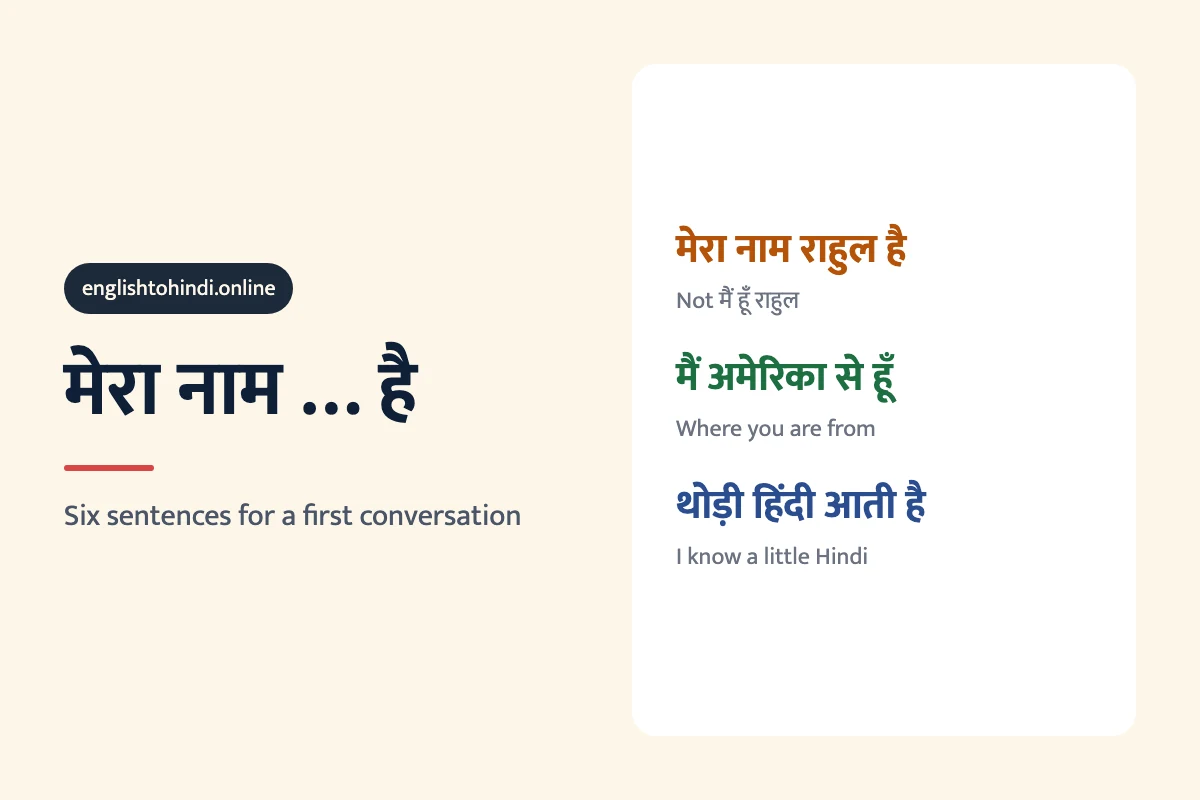
To introduce yourself in Hindi, say मेरा नाम राहुल है (“my name is Rahul”), then मैं अमेरिका से हूँ (“I’m from America”) and मैं यहाँ काम करता हूँ or मैं छात्र हूँ for what you do. Close with आपसे मिलकर ख़ुशी हुई, “pleased to meet you”. The verb हूँ comes at the end of every one of those sentences, not in the middle.
That last point is the mistake worth heading off. मैं हूँ राहुल copies English word order and marks you instantly as a beginner; the Hindi sentence puts the verb last, as Hindi word order explains. The introductions themselves sit with the rest of the conversation phrases.
The six sentences
| Hindi | Roman | English |
|---|---|---|
| मेरा नाम राहुल है। | Mera naam Rahul hai. | My name is Rahul. |
| मैं अमेरिका से हूँ। | Main America se hoon. | I’m from America. |
| मैं दिल्ली में रहता हूँ। | Main Dilli mein rehta hoon. | I live in Delhi. |
| मैं इंजीनियर हूँ। | Main engineer hoon. | I’m an engineer. |
| मैं हिंदी सीख रहा हूँ। | Main Hindi seekh raha hoon. | I’m learning Hindi. |
| आपसे मिलकर ख़ुशी हुई। | Aapse milkar khushi hui. | Pleased to meet you. |
Three of those change if a woman is speaking: रहती हूँ, सीख रही हूँ, and करती हूँ. The ending follows the speaker’s own gender, not the listener’s — the subject of Hindi verb gender.
Asking the same questions back
An introduction is an exchange, and the return questions are short. All of them keep the question word in place rather than moving it to the front, which is covered in Hindi question words.
- आपका नाम क्या है? — what is your name?
- आप कहाँ से हैं? — where are you from?
- आप क्या करते हैं? — what do you do?
- आप कहाँ रहते हैं? — where do you live?
Use आप throughout with someone you have just met. Every one of these questions has a तुम version, and using it with a stranger is the error described in आप, तुम or तू.
Saying what you do
Job titles usually stay in English in modern speech — मैं डॉक्टर हूँ, मैं सॉफ़्टवेयर इंजीनियर हूँ. The Hindi words exist and are used in formal contexts.
| Hindi | Roman | English |
|---|---|---|
| मैं छात्र हूँ / छात्रा हूँ | Main chhaatra / chhaatraa hoon | I’m a student (m / f) |
| मैं शिक्षक हूँ / शिक्षिका हूँ | Main shikshak / shikshika hoon | I’m a teacher (m / f) |
| मैं डॉक्टर हूँ | Main doctor hoon | I’m a doctor |
| मैं व्यापारी हूँ | Main vyapaari hoon | I’m a businessperson |
| मैं नौकरी करता हूँ | Main naukri karta hoon | I have a job / I’m employed |
Talking about your Hindi
This comes up in the first minute of every conversation, and there is a correct way to say it. Use आना rather than सकना for a language, as set out in how to say “can” in Hindi.
- मुझे थोड़ी हिंदी आती है — I know a little Hindi.
- मैं हिंदी सीख रहा हूँ — I’m learning Hindi.
- थोड़ा धीरे बोलिए — please speak a little slowly.
- फिर से कहिए — say that again.
- मुझे समझ नहीं आया — I didn’t understand.
मुझे थोड़ी हिंदी आती है। ज़रा धीरे बोलिए।
Mujhe thodi Hindi aati hai. Zara dheere boliye.
Age and family
Age uses का or की agreeing with the speaker: मैं पच्चीस साल का हूँ from a man, मैं पच्चीस साल की हूँ from a woman. The numbers themselves are in Hindi numbers.
- मैं शादीशुदा हूँ — I’m married.
- मेरे दो बच्चे हैं — I have two children.
- मेरे परिवार में चार लोग हैं — there are four people in my family.
Family questions arrive early and in more detail than English speakers expect. The vocabulary is unusually specific — there are four separate words for “uncle” — and it is all in Hindi family words.
Three mistakes to avoid
- मैं हूँ राहुल. The verb goes last: मेरा नाम राहुल है.
- मैं से अमेरिका हूँ. The postposition follows the noun: मैं अमेरिका से हूँ.
- Forgetting the gender ending. A woman saying मैं रहता हूँ is the single most audible learner error, and it is corrected by one letter: रहती.
The short version
- मेरा नाम … है — my name is …
- मैं … से हूँ — I’m from …
- मैं … हूँ — I’m a (job).
- मुझे थोड़ी हिंदी आती है — I know a little Hindi.
- आपसे मिलकर ख़ुशी हुई — pleased to meet you.
- The verb goes last in all of them, and its ending follows your own gender.
Frequently asked questions
How do you introduce yourself in Hindi?
Start with मेरा नाम राहुल है, “my name is Rahul”. Follow with मैं अमेरिका से हूँ for where you are from, and मैं इंजीनियर हूँ or मैं छात्र हूँ for what you do. Close with आपसे मिलकर ख़ुशी हुई, “pleased to meet you”. The verb हूँ goes at the end of each sentence.
How do you say “my name is” in Hindi?
मेरा नाम … है. मेरा नाम सारा है means “my name is Sara”. मैं हूँ सारा copies English word order and is incorrect — Hindi puts the verb at the end of the sentence. मेरा does not change here, because it agrees with नाम, which is masculine.
How do you ask someone’s name in Hindi?
आपका नाम क्या है? with someone you have just met, or तुम्हारा नाम क्या है? with a friend or a child. The question word क्या stays in its normal position before the verb rather than moving to the front as in English.
How do you say “I’m learning Hindi”?
मैं हिंदी सीख रहा हूँ if you are a man, and मैं हिंदी सीख रही हूँ if you are a woman. To say you already know some, use मुझे थोड़ी हिंदी आती है, which is the natural way to describe a language skill in Hindi.
How do you say your age in Hindi?
मैं पच्चीस साल का हूँ from a man and मैं पच्चीस साल की हूँ from a woman — the का or की agrees with the speaker. To ask, say आपकी उम्र क्या है? or आप कितने साल के हैं?
What should I say if I don’t understand?
मुझे समझ नहीं आया means “I didn’t understand”. फिर से कहिए asks the person to repeat, and ज़रा धीरे बोलिए asks them to speak more slowly. All three use the polite आप form, which is what you want with someone you have just met.
More guides
- Hindi plurals: लड़का, लड़के, लड़कों and which to use whenHindi has two plurals for every noun: one for the plain sentence and one for when a postposition follows. लड़के and लड़कों are both “boys”, and using the wrong one is the most common learner error.
- वाला in Hindi: what वाला, वाली and वाले actually meanवाला means “the one that” — the one who sells it, the one wearing it, the thing about to happen. One suffix doing three jobs English needs three constructions for.
- How to say “can” in Hindi: सकना, आना and पानामैं हिंदी बोल सकता हूँ. Ability, permission and “managed to” are three different verbs in Hindi, and picking the wrong one is the usual learner mistake.
Looking for a specific phrase? Browse the phrase guides.